Nursing to Sleep: Is It OK? Safe Lying-Down Feeds and How to Gently Stop
See Your Baby's Sleep Pattern Emerge
Get Started FreeIf your baby only falls asleep at the breast, you may wonder whether you're building a habit you'll regret. Nursing to sleep is common and natural, and it isn't a bad habit you have to break. Two things do need attention: feeding lying down makes it easy to doze off together, so safe sleep rules matter, and once teeth come in, cavities become a concern. If frequent night wakings for the breast are wearing you out, you can change the pattern gradually by moving the feed to the start of the bedtime routine and putting your baby down drowsy.
💡 If nursing to sleep works for you both, it's fine to keep doing it. If you doze off while feeding in bed, move your baby back to their own sleep space as soon as you wake, and once teeth appear, brush after the last feed. To change the habit, feed first in the routine and allow 3 days to 3 weeks.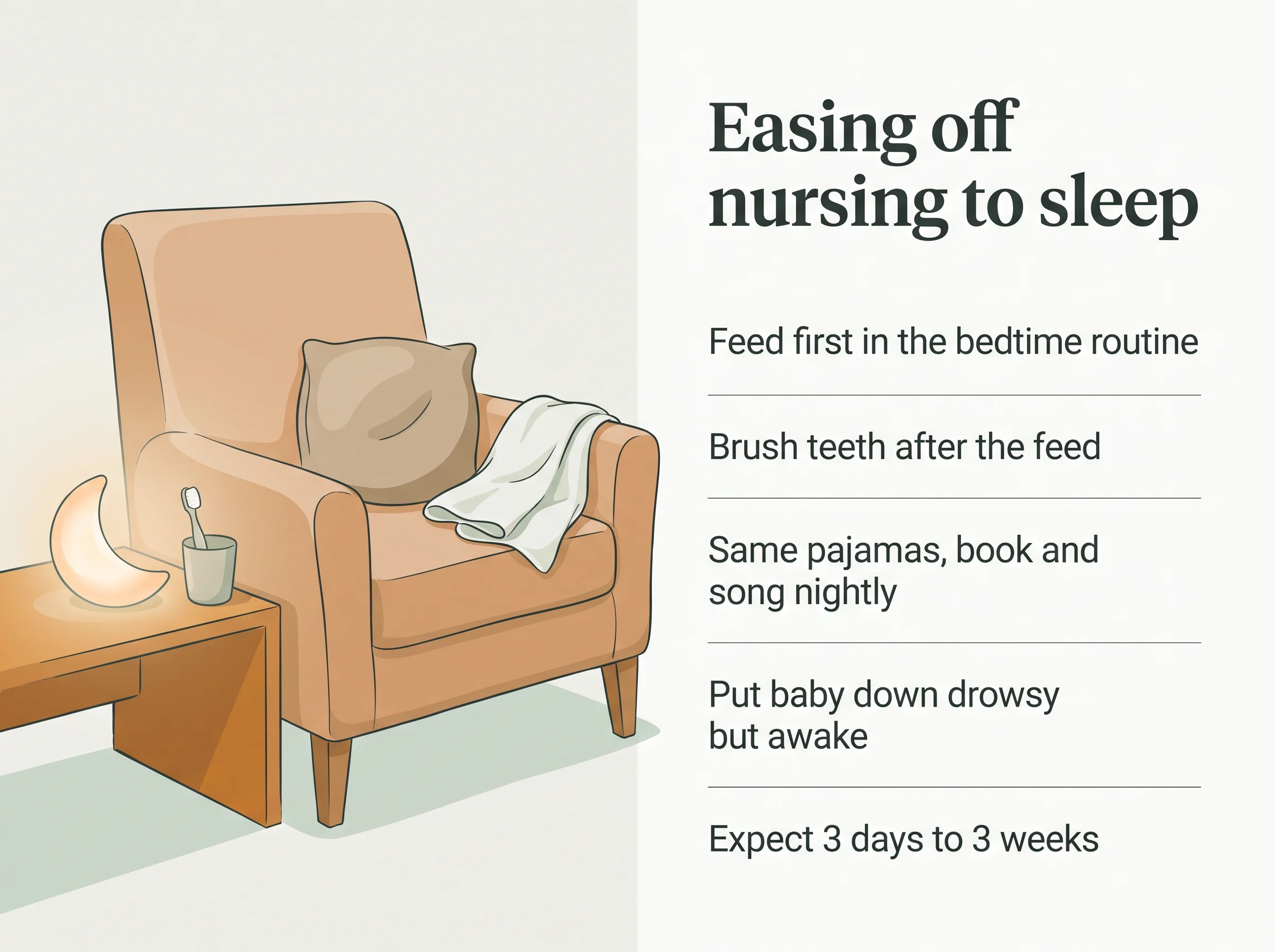
Do You Need to Stop Nursing to Sleep?
The Australian Breastfeeding Association says most babies naturally feed to sleep, even as they get older, and that this is normal and supported by research. Feeding to sleep isn't a "bad habit," and babies can still learn to settle in other ways with other people. Raising Children Network, an Australian parenting website, likewise says sleep habits such as dummies, rocking or feeding aren't something you have to phase out; you can choose what works best for your family.
The catch is that a baby who routinely falls asleep at the breast may also need to feed to get back to sleep when they wake in the night (Raising Children Network). The American Academy of Pediatrics (AAP) notes that babies who are held or rocked to sleep may struggle to go back to sleep if they wake up, and suggests putting babies to bed drowsy rather than waiting until they're asleep. That helps them learn to fall asleep on their own, in their own bed.
| Fine to keep going | Worth changing |
|---|---|
| You and your baby are both comfortable with it | Your baby wakes often, needs the breast every time, and you're exhausted |
| Your baby feeds and drifts back to sleep quickly | Someone else needs to do bedtime, such as when you go back to work |
| No teeth yet, or you brush after the last feed | Teeth have come in and your baby sleeps latched for long stretches |

Newborns naturally drift off while feeding. The AAP says it's normal for newborns to wake every one or two hours and eat often. There's no rush to change anything; Raising Children Network suggests that from around 6 to 9 months, you can start gently reducing the settling help you give.
Lying-Down Feeds: Safe Sleep Rules
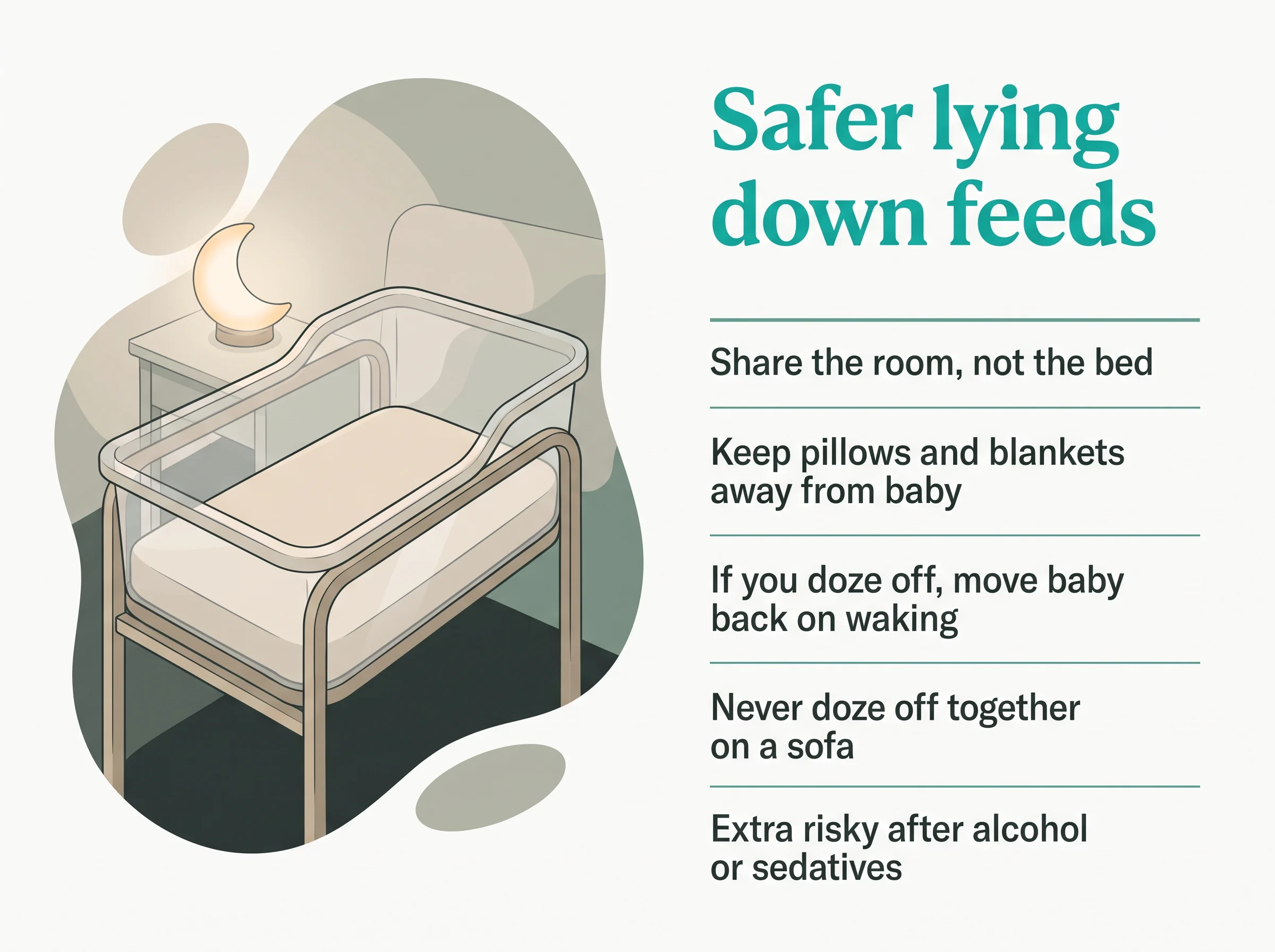
Feeding lying down is restful, but it also makes it easy to fall asleep together. The AAP recommends sharing a room with your baby for at least the first 6 months, but not a bed. Room sharing can lower the risk of SIDS by as much as 50%.
- Back to their own space before you sleep: If you bring your baby into your bed to feed or comfort them, put them back in their own sleep space before you go to sleep.
- Clear the bed: If there's any chance you'll fall asleep while your baby is in your bed, remove pillows, blankets, sheets and anything else that could cover your baby's face, head or neck or make them overheat.
- Move them as soon as you wake: If you do fall asleep, place your baby on their back in their own crib or bassinet as soon as you wake up.
- Never on a sofa or armchair: The risk of sleep-related infant death is up to 67 times higher when babies sleep with someone on a couch, soft armchair or cushion. Don't feed on the sofa when you're drowsy.
- Higher-risk situations: The risk is more than 10 times higher when babies share a bed with someone who is very tired, has taken medicine that makes it harder to wake, or has used alcohol or drugs. Smoking or vaping raises it too. Bed sharing is 5 to 10 times riskier when a baby is under 4 months, and 2 to 5 times riskier when a baby was born preterm or with low birth weight.
Before a feed, the AAP suggests thinking about how tired you are. If you might nod off, ask someone to stay with you while you breastfeed, set an alarm to go off every few minutes, or put on a podcast or show that keeps your attention.
For the full safe sleep setup, see SIDS Prevention and Baby Sleep Environment.
Once Teeth Arrive: Nursing to Sleep and Cavities
The American Academy of Pediatric Dentistry (AAPD) recommends avoiding on-demand or nighttime bottle-feeding and breastfeeding beyond 12 months of age to help prevent early childhood cavities, along with parents brushing their child's teeth with an age-appropriate toothbrush and the right amount of fluoride toothpaste.
That doesn't mean you have to wean. The AAP supports continuing breastfeeding after solids are introduced for as long as you and your baby want, for 2 years or beyond. The practical goal is less time spent asleep at the breast and brushing after the last feed of the night. Moving the feed to the start of the routine makes feed, brush, bed fall into place naturally.
For brushing tips by age, see Baby's First Dental Visit.
How to Gently Stop Nursing to Sleep, Step by Step
Raising Children Network recommends moving gradually from your current way of settling to less hands-on methods, and only moving to the next step once your baby falls asleep easily the current way.
1. Feed first in the bedtime routine
- Feeding your baby earlier at night, so feeding isn't part of falling asleep, can help reduce how often they feed overnight (Raising Children Network).
- For example: feed, brush teeth, pajamas, a book or song, then bed. Keep the routine to a few quiet, enjoyable activities about 20 minutes before bed, at around the same time each night (Raising Children Network).
2. Unlatch before they're fully asleep
- If you feed to sleep, feed until your baby is drowsy but not asleep. Then move to rocking in your arms, then to rocking only until drowsy and hands-on settling such as patting, and finally slow or stop the patting (Raising Children Network).
3. Put your baby down drowsy
- Placing your baby down while they're still a little awake helps them learn to self-soothe, and gradually they get used to falling asleep on their own, including when they wake at night (AAP).
4. Soothe with your voice and touch
- When your baby cries, start by looking at them, then speak softly, and move slowly to a pacifier, light touch or massage, allowing time between each step (AAP). A gentle "I'm here. Time to sleep," or a soft "sh, sh" can help too (Raising Children Network).
5. Let someone else do bedtime
- Babies can learn to settle in other ways with other people (Australian Breastfeeding Association), so a partner or another family member can take some bedtimes.
When your baby wakes at night
- Night feeds aren't playtime. Keep the lights dim and the room boring so your baby learns that sleep comes after the feed (AAP).
- It's normal for a 6-month-old to wake during the night and settle again after a few minutes, so you don't need to rush in at every sound. Of course, feed, change or comfort them when they need it (AAP).
- If your baby is growing well, you can think about phasing out night feeds from 6 months for bottle-fed babies and from 12 months for breastfed babies, but there's no hurry if night feeds work for you (Raising Children Network). For how to taper them, see the Night Weaning Guide.
How long does it take?
- It can take 3 days to 3 weeks for a baby to get used to a new way of falling asleep, and most cry for the first few nights. If your baby gets very upset, stop and cuddle them, then try again at the next bedtime (Raising Children Network).
- If you start to feel angry or overwhelmed, put your baby down in a safe place, take a moment to calm yourself, and ask your partner to take over if you can (Raising Children Network).
For daytime rhythm, see Eat-Play-Sleep Routine; for building a wind-down, see Baby Bedtime Routine.
When to Get Help
- Weight gain worries: Phasing out night feeds is for babies who are growing well (Raising Children Network). If you're worried about weight gain or how much your baby is eating, check with your pediatrician before cutting feeds.
- Nothing seems to work: Talk to your pediatrician or a child health nurse if you feel things aren't working (Raising Children Network).
- You're running on empty: If exhaustion and overwhelm don't let up, ask family or friends to step in, and talk to your doctor if you think you may have postpartum depression (AAP). See the Postpartum Depression Self-Check.
Track the Change with BebeSnap
While you're changing how your baby falls asleep, it's easy to lose track of how many times they woke or when the last feed was. Logging feeds and sleep together in BebeSnap shows what's shifting over a few days.
- Feeding log: what time and how long your baby fed at night, with left and right sides timed separately
- Sleep log: when your baby fell asleep and woke, and the gap after the last feed
- Average wake-ups: how many times your baby wakes at night
- Family sharing: everyone sees the same log on nights a partner does bedtime
👉 See how to use BebeSnap's sleep log
Frequently Asked Questions (FAQ)
Q: Until what age is nursing to sleep OK?
A: There's no set age. If nursing to sleep works for you and your baby, you can keep doing it (Raising Children Network), and the AAP supports breastfeeding for 2 years or beyond if you both want. Once teeth come in, brush after the last feed; the American Academy of Pediatric Dentistry advises avoiding on-demand and nighttime feeds after 12 months.
Q: Is it safe to fall asleep while nursing lying down?
A: The AAP advises sharing a room with your baby but not a bed. If you might doze off while feeding in bed, clear pillows and blankets away from your baby, and if you do fall asleep, move your baby back to their own sleep space as soon as you wake. Falling asleep together on a sofa or armchair is up to 67 times riskier.
Q: How do I start to stop nursing to sleep?
A: Move the feed to the start of the bedtime routine: feed, brush teeth, book, then bed. Unlatch when your baby is drowsy but not yet asleep, then gradually reduce your help from rocking to patting (Raising Children Network). Put your baby down drowsy. Expect some crying at first; it can take 3 days to 3 weeks.
Q: Can nursing to sleep cause cavities?
A: Once teeth arrive, it can add to the risk. The American Academy of Pediatric Dentistry recommends avoiding on-demand or nighttime breastfeeding and bottle-feeding after 12 months, along with parents brushing with an age-appropriate toothbrush and fluoride toothpaste. A simple habit that helps is brushing your baby's teeth after the last feed, then putting them to bed.
References
- AAP HealthyChildren - A Parent's Guide to Safe Sleep
- AAP HealthyChildren - Safe Sleep Tips for Sleep-Deprived New Parents
- AAP HealthyChildren - Getting Your Baby to Sleep
- AAPD - Policy on Early Childhood Caries: Consequences and Preventive Strategies
- Raising Children Network - How to Phase Out Baby Sleep Habits
- Raising Children Network - Responsive Settling: 6-18 Months
- Australian Breastfeeding Association - Helping Your Baby to Sleep
See Your Baby's Sleep Pattern Emerge
Track sleep and watch wake windows and night stretches appear as clear graphs.
See what the app does firstMedical Disclaimer: This article is for informational purposes only and does not replace professional medical advice. If you have concerns about your baby's health, please consult a pediatrician.
You Might Also Like
Kaup Index (Baby BMI): How to Calculate It and What's Normal by Age
Wonder Weeks Calculator: Your Baby's 10 Mental Leaps From the Due Date
Baby Weight Gain Calculator: Grams Per Day From Two Weigh-Ins
Baby Impetigo: Golden Crusts, Antibiotic Treatment, and When Nursery Is Safe Again
You Might Also Like

How Much Sleep Does a 1- to 2-Year-Old Need? Toddler Sleep Hours, Naps and Bedtime
Children aged 1 to 2 need 11 to 14 hours of sleep per 24 hours, naps included (AASM, endorsed by the AAP). Most sleep 10 to 12 hours at night and 1 to 2 hours by day, and move from two naps to one between 12 and 18 months.
Baby Breathing Red Flags at Night: When Cough or Congestion Needs Urgent Help
A baby coughing or sounding congested at night needs urgent help if breathing looks hard, lips or face change color, feeding drops sharply, the baby is hard to wake, or a baby under 12 weeks has a fever.

Keeping Baby Warm at Night in Winter: Layers, Sleep Sacks, Heating Pads and Cold Hands
Keep your baby warm at night with layers or a sleep sack instead of blankets: no more than one layer more than you'd wear (AAP). Skip hats indoors, heating pads and hot water bottles, and check the chest or back of the neck, not cold hands.