Wonder Weeks Calculator: Your Baby's 10 Mental Leaps From the Due Date

🌊 Wonder Weeks Leap Calculator
Count from the due date, not the birth date. Prematurity shifts the timing.
Wonder Weeks is an observational theory and the timing varies by 1 to 2 weeks either way. Some babies get very fussy, others barely change. Dates that do not line up are not a problem.
For reference only, not a medical diagnosis. See a paediatrician if your baby seems unwell.
Keep Every Growth Milestone
Get Started FreeWhen your baby suddenly wakes at night and refuses feeds, the first thought is often "is this a leap?" Enter your due date in the calculator above and it lays out all ten leaps with dates, and tells you whether one is happening right now. There is one thing people get wrong: Wonder Weeks counts from the due date, not the birth date. Below is why that matters, and how far you should trust these dates.
Why the due date, not the birth date
The leaps Wonder Weeks describes follow a brain development clock, and that clock starts at conception rather than at birth. So the due date is the reference point.
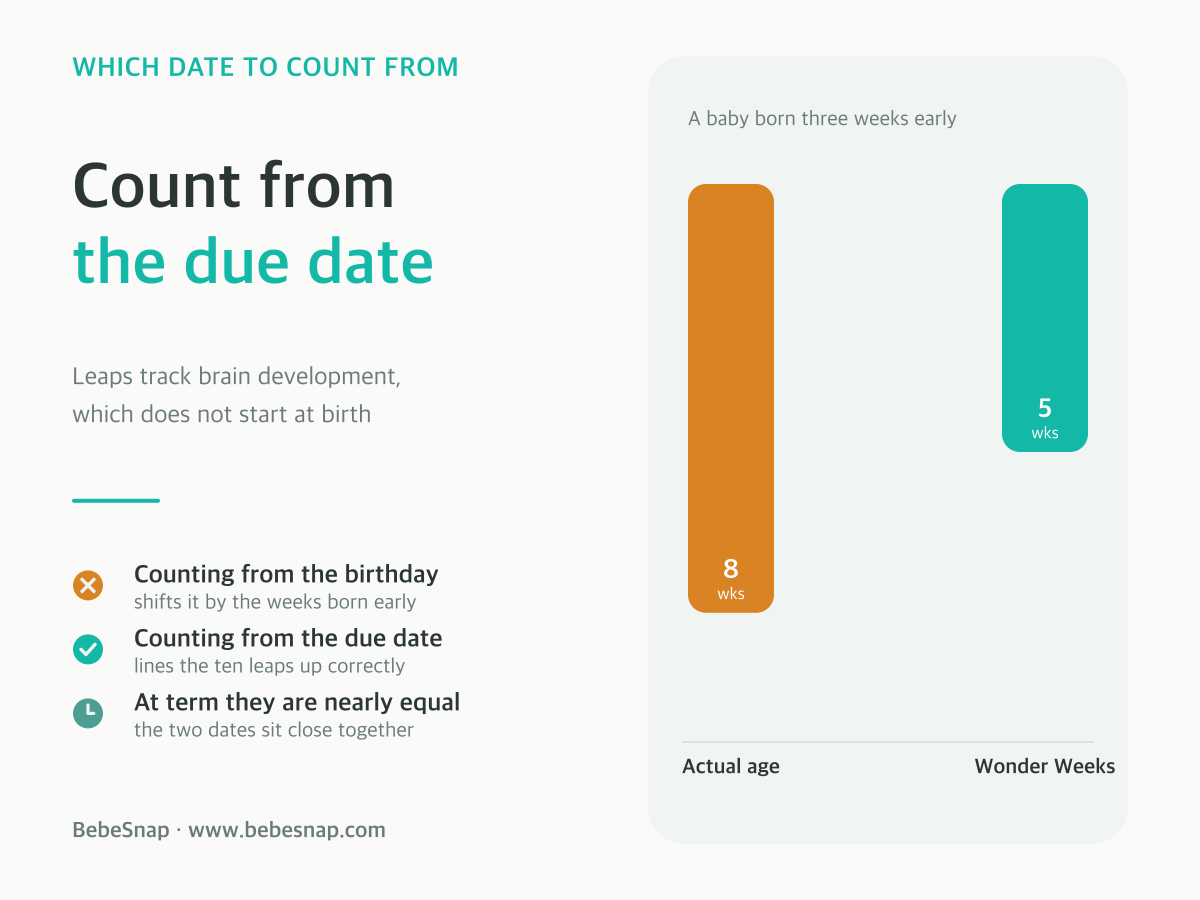
A baby born three weeks early is at 8 weeks of age but only week 5 on the Wonder Weeks scale. Counting from the birth date puts everything three weeks out of step, and that mismatch is where "the book does not match my baby" usually comes from.
All 10 leaps
| Leap | Week | What opens up |
|---|---|---|
| Leap 1 | Week 5 | World of Sensations |
| Leap 2 | Week 8 | World of Patterns |
| Leap 3 | Week 12 | Smooth Transitions |
| Leap 4 | Week 19 | World of Events |
| Leap 5 | Week 26 | World of Relationships |
| Leap 6 | Week 37 | World of Categories |
| Leap 7 | Week 46 | World of Sequences |
| Leap 8 | Week 55 | World of Programs |
| Leap 9 | Week 64 | World of Principles |
| Leap 10 | Week 75 | World of Systems |
The early leaps sit 3 to 4 weeks apart and the later ones stretch to 9 to 11 weeks. So the sense that the newborn months are relentless is not your imagination.
What a leap looks like
During a leap your baby changes from their usual self.
- Waking often and crying after weeks of sleeping well
- Refusing the breast or bottle, or feeding less than usual
- Fussing and crying for no clear reason
- Not wanting to be away from you
- Only falling asleep while held
A single leap usually runs 1 to 2 weeks, and sometimes as long as three.

Three ways these dates get misused
1. Worrying when the dates do not match The timing varies by 1 to 2 weeks in either direction. If the calculator says "Leap 5" and your baby is perfectly content, the calculation is not wrong, babies differ. Some have a hard week that is not on the list at all.
2. Blaming every hard day on a leap This is the risky one. A fever, floppiness, or a cry that sounds different from usual are signs of illness, not a leap. A baby in a leap plays happily and then suddenly fusses; they are not listless all day. See your pediatrician for a fever. In a baby under 3 months, a temperature of 100.4°F (38°C) or higher needs a doctor right away, even at night. If your baby is floppy or hard to wake, or has a weak or high-pitched cry, go to the ER or call 911.
3. Looking for leaps past 20 months Wonder Weeks covers ten leaps, ending at week 75. Fussiness after that has other explanations worth looking into.
Track leaps with BebeSnap
- See exactly when sleep and feeding shifted from the usual pattern
- Compare night wakings week over week
- Confirm from your records that the rhythm returned after a leap
- Ask the AI chatbot about the changes you are seeing
Frequently Asked Questions (FAQ)
Q: Should I calculate Wonder Weeks from the birth date or the due date?
A: Use the due date. The leaps track a brain development clock that does not start on the day of birth, so the due date is the correct reference. A baby born three weeks early is 8 weeks old but only at week 5 on the Wonder Weeks scale. If your baby arrived at term and the two dates are close together, either one gives you nearly the same answer.
Q: My baby is fine on a date the calculator flags. Is something wrong?
A: No. Wonder Weeks timing varies by 1 to 2 weeks either way, and babies do not all react the same. Some get very fussy while others barely change, and having a hard week that is not on the list is common too. Dates that fail to line up say nothing about your baby's development.
Q: How long does a leap last?
A: Usually 1 to 2 weeks, and occasionally up to three. Later leaps can feel longer because what the baby is learning gets more complex. Most babies return to their previous sleep and feeding rhythm afterwards, so it is generally better to hold your existing routine than to start new sleep training mid-leap.
Q: How do I tell a leap from illness?
A: A baby in a leap plays normally and then fusses suddenly, and usually settles when held. A fever, being listless all day, or eating far less are different: do not put those down to a leap, and see your pediatrician. Under 3 months, 100.4°F (38°C) or higher needs a doctor right away, even at night. If your baby is floppy or hard to wake, or has a weak or high-pitched cry, go to the ER or call 911.
References
Keep Every Growth Milestone
Log height, weight, and milestones. The growth curves are drawn for you.
See what the app does firstYou Might Also Like
Tomato for Babies: When to Start, Skin and Seeds, and Why Cherry Tomatoes Are Never Served Whole
Apple for Babies: Stage-by-Stage Portions and When Raw Apple Is Safe
Spinach for Babies: When to Start, Why Boiling Matters, and When to Skip It
Potato for Babies: When to Start, Safe Shapes, and Why Never to Blend It
You Might Also Like

Baby Weight Gain Calculator: Grams Per Day From Two Weigh-Ins
Enter two weigh-ins and get the gain per day. The guide is 25-30g a day at 0-3 months, 15-20g at 3-6 months, and 10-15g at 6-12 months.

How Much Milk With Solids at 7-9 Months | Stage 2 Weaning Milk Amount
How much milk with solids at 7-9 months? Even with 2 solid meals, keep about 600-800ml of milk in 3-4 feeds a day and let it taper naturally instead of cutting it. Includes a sample daily schedule.
Baby Not Gaining Weight? Normal Growth Rates by Age & When to Worry
Worried your baby isn't gaining weight? Newborns gain 25~30g a day, but this slows to 10~15g a day after 6 months. The key warning sign is a drop of 2 or more percentile bands.