Apple for Babies: Stage-by-Stage Portions and When Raw Apple Is Safe
Stop Trying to Remember Feed Times
Get Started FreeApple has a reputation as the easy first fruit. Babies like it, allergy worries are low, and it is in the shops all year. The question parents actually get stuck on is different: when can you stop cooking it and just hand over a piece? The short answer is that by the official texture standards, raw apple does not meet the bar at any point during weaning. The reason is in the teeth.
When apple can start
Weaning starts with rice porridge, and once your baby is used to that, you widen out into vegetables and fruit. Japan's Ministry of Health guidance names this order explicitly and puts potato, carrot and fruit together in the same widening step. Apple belongs here, from the first stage at around five to six months.
Start any new food with one small spoonful, then build up while you watch. Trying it on a weekday morning, when your clinic is open, is worth doing for the same reason.
💡 Delaying a food because you are worried about allergy does not help. Current guidance is that there is no scientific evidence that delaying the start of weaning, or of any particular food, prevents food allergy.Texture and portions by stage
| Stage | Texture standard | Apple | Vegetables and fruit, combined |
|---|---|---|---|
| 5-6 months | Smooth, fully pureed | Grated and cooked, loosened with water | No official figure. One spoon at a time |
| 7-8 months | Squashes against the tongue | Cooked, finely chopped | 20-30g |
| 9-11 months | Squashes between the gums | Cooked, small pieces or soft sticks | 30-40g |
| 12-18 months | Chewable with the gums | Thin slices or grated | 40-50g |

"Vegetables and fruit" is one box, not two
This is the part most people miss. In the official weaning progression table, group Ⅱ is a single row reading "vegetables and fruit (g)". The 30-40g at nine to eleven months is not 30-40g of vegetables plus 30-40g of fruit. It is the two of them added together.
Apple is sweet and babies eat it readily. That makes it easy to fill the whole box with apple alone, which leaves no room for vegetables in that meal. If you have noticed that fruit keeps growing while vegetables keep getting pushed back, this is usually where it starts.
A simple split helps. Keep fruit to under a third of the box and give the rest to vegetables. At nine to eleven months that is roughly 10g of apple alongside 25g of vegetables. The one-third figure is not itself official; it is a working ruler, so adjust it to what your baby eats.
Front teeth arrive first, molars arrive last
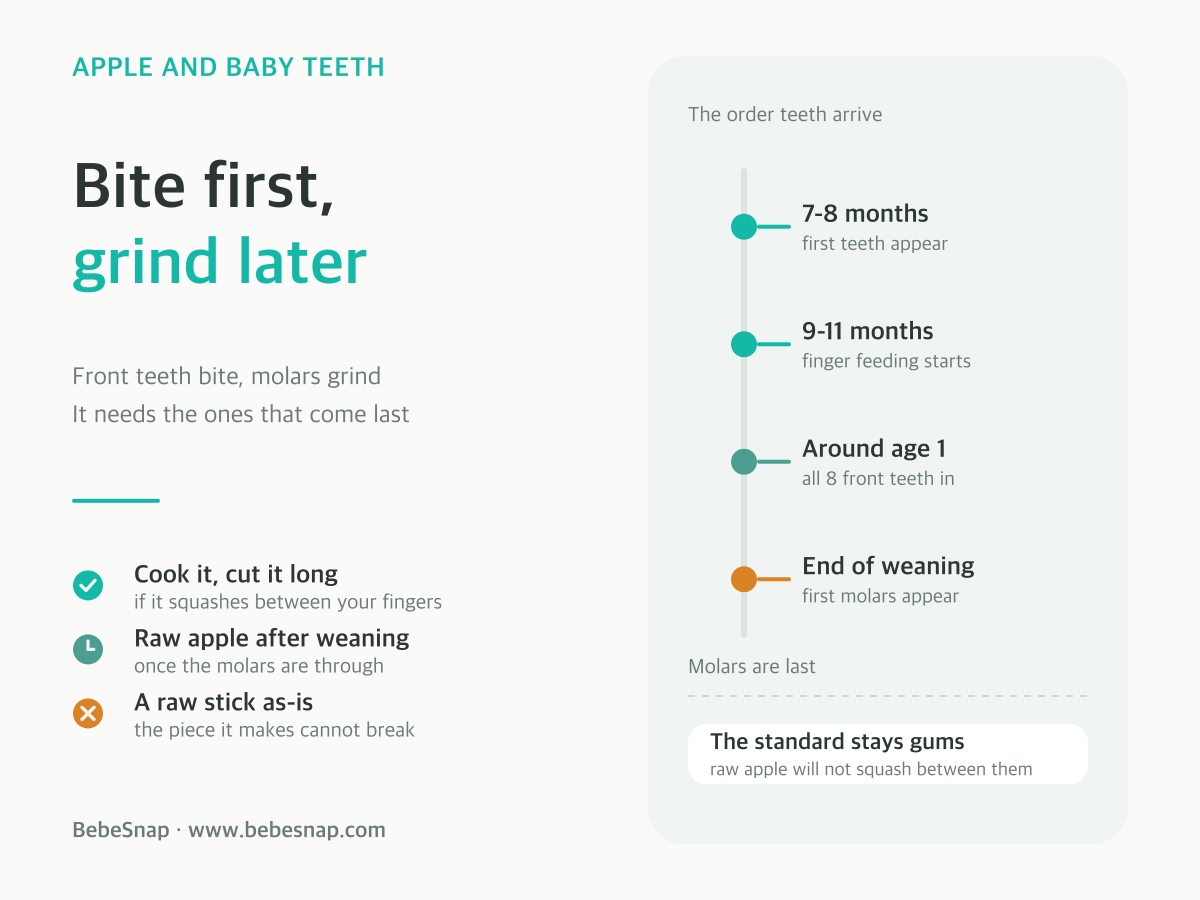
The same table carries a row for when teeth come through, and for apple this is the key to everything.
- 7-8 months: the first teeth start to appear
- Around age one: all eight front teeth are in
- Late in the final weaning stage: the first molars start coming through
Front teeth and molars do different jobs. Front teeth bite off. Molars grind down. Eating raw apple safely needs the bitten-off piece broken into fragments, and the teeth that do that job are the last to arrive.
So when a baby with only front teeth bites into raw apple, the piece that comes away travels more or less intact toward the throat. A baby biting confidently is not a signal that it is safe; it can mean they are now producing pieces they have no way to break down.
The feeding-skills row of the same table says the same thing from another angle. At nine to eleven months the skill is "can squash things between the gums", and even in the final stage it is "chewing with the gums". Right to the end of weaning, the standard is gums, not teeth. Raw apple does not squash between gums.
The riskiest window is when finger feeding begins
Babies usually start picking food up at around nine months. Once yours is reaching for things, an apple stick is the obvious thing to hand over. But that window lines up exactly with having front teeth and no molars.
Do this instead of a raw stick.
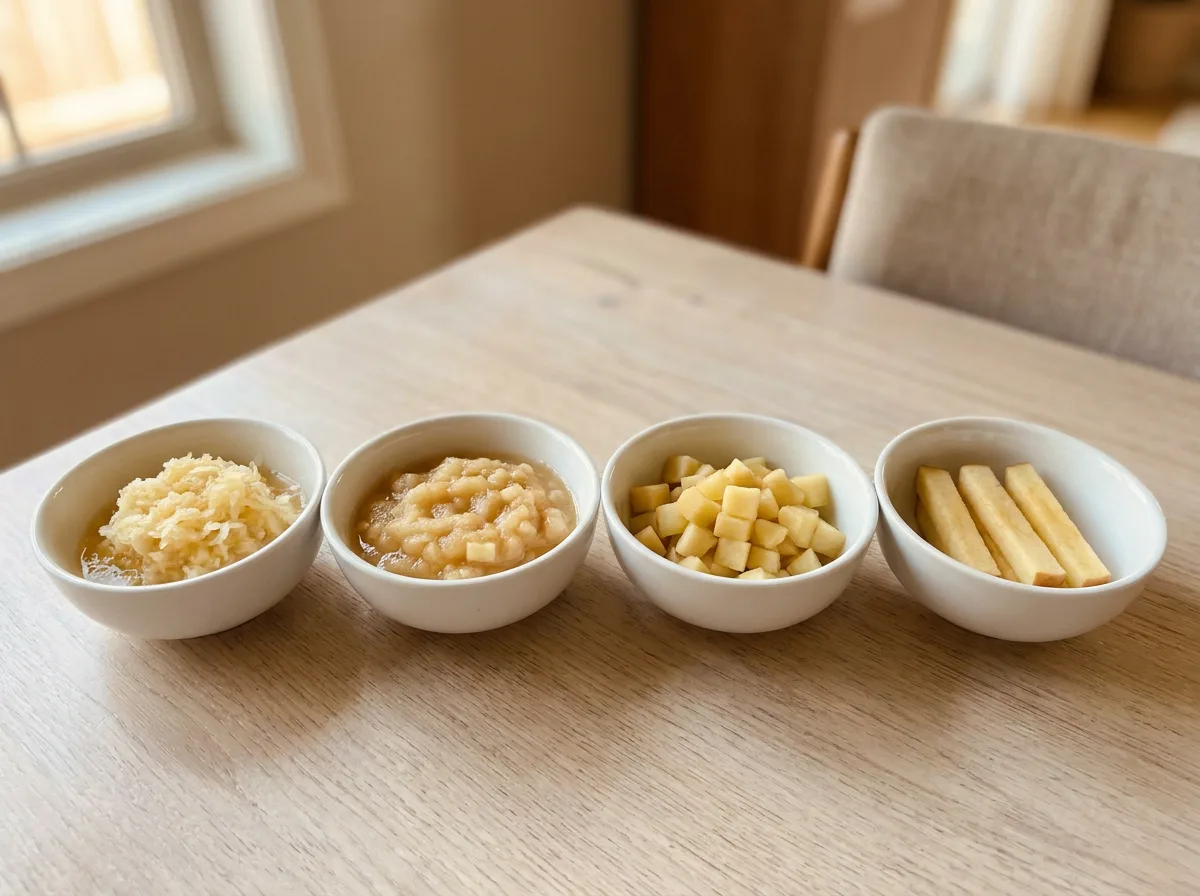
1. Cook it
- Steam or simmer until it squashes under gum pressure
- Cut it finger length so your baby can hold it
2. Peel it
- Skin stays tough even after cooking, and gums cannot break it
3. Test it with your hand
- If it squashes between your thumb and forefinger, it passes
- If you have to press hard, it is still too firm for your baby
Apple is named in the national choking figures
Japan's Consumer Affairs Agency published a review covering 2010 to 2014. Of 623 choking deaths in children aged fourteen and under, about 17% were caused by food, 103 cases, and 87 of those were children aged six or under. By age, children under one accounted for 49 cases, or 47%, followed by 18 at age one and nine at age two. The youngest group is the largest.
In the list of foods involved, sweets come first at 11 cases, and fruit(apples, grapes and similar)accounts for 5. Apple is named there.
The report includes cases. A two-year-old was sitting at the table with their mother, eating a whole peeled seedless grape(3cm across)on their own. There were no signs of illness; the child suddenly coughed, then foamed at the mouth and lost consciousness. The mother tried to hook it out with her fingers and could not. When she carried the child outside, a passer-by performed abdominal thrusts and the grape came out in one piece.
The same report records an infant under one who choked on weaning food itself and was admitted to intensive care. It is not only unusual foods that are dangerous. Childcare guidance puts it directly: regardless of a child's age in months, foods they eat every day can lead to choking.
Here is how the agency frames safe serving.
Before the meal
- Cut food small, to a size that is easy to eat
- Keep each mouthful to an amount your child can manage comfortably
- No hard beans or nuts until around age three
During the meal
- Never feed a child who is playing, walking, or lying down
- Encourage slow chewing rather than hurried swallowing
- Offer water or tea to moisten the throat
- Check that they are not getting sleepy and that they are sitting properly
- Do not startle a child who is eating
Childcare guidance adds one more line: foods that have caused choking in the past are best explained to parents and not used at all. Whole cherry tomatoes are the worked example. Apple belongs in the same category, with the difference that changing its shape solves the problem.
What about apple juice
The official guidance contains one sentence worth quoting. For a baby who has not yet started weaning, the best source of nutrition is breast milk or formula, and giving fruit juice or electrolyte drinks before weaning begins has no recognised nutritional value.
In other words, there is no need to "practise flavours" with apple juice before solids start. After weaning begins the same logic holds: for the same amount, grated apple brings the fibre with it.
On a label, apple goes by other names
Apple differs from potato and spinach in one respect. It is on Japan's allergen labelling list, which covers 29 items.
- Mandatory, 9 items: shrimp, cashew, crab, walnut, wheat, buckwheat, egg, milk, peanut
- Recommended, 20 items: almond, abalone, squid, salmon roe, orange, kiwi, beef, sesame, salmon, mackerel, soybean, chicken, banana, pistachio, pork, macadamia, peach, yam, apple, gelatin
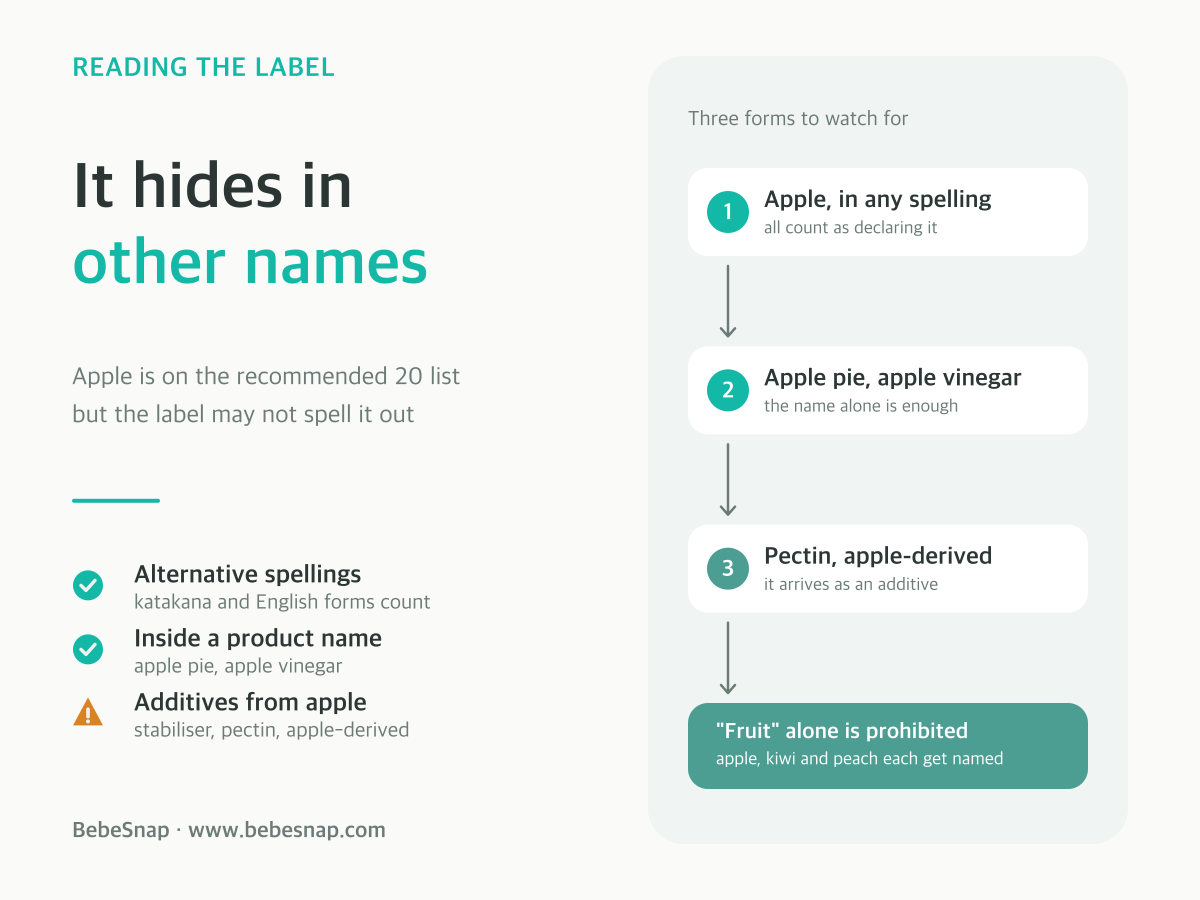
The label will not always spell out the plain word. The rules recognise three forms.
1. Alternative wordings
- Katakana and English-derived spellings both count as declaring apple
2. Product names that contain it
- Apple pie, apple vinegar, baked apple and toffee apple all count on their own
3. Additives derived from apple
- Stabiliser(pectin, apple-derived)and thickening polysaccharide(apple-derived)are both apple
- With fruit vinegar, you need to check separately whether apple was used
There is a rule pointing the other way too. Lumping items together as "fruit" or "fruit juice" is prohibited. If apple, kiwi and peach are in a product, each has to be named. So a label that only says "fruit juice" is not a compliant one.
One more. Additive declarations can be omitted when something counts as a processing aid or carry-over, but allergen declarations cannot be omitted. Even when the additive name is not shown, an apple-derived ingredient has to appear somewhere.
Preparing and storing
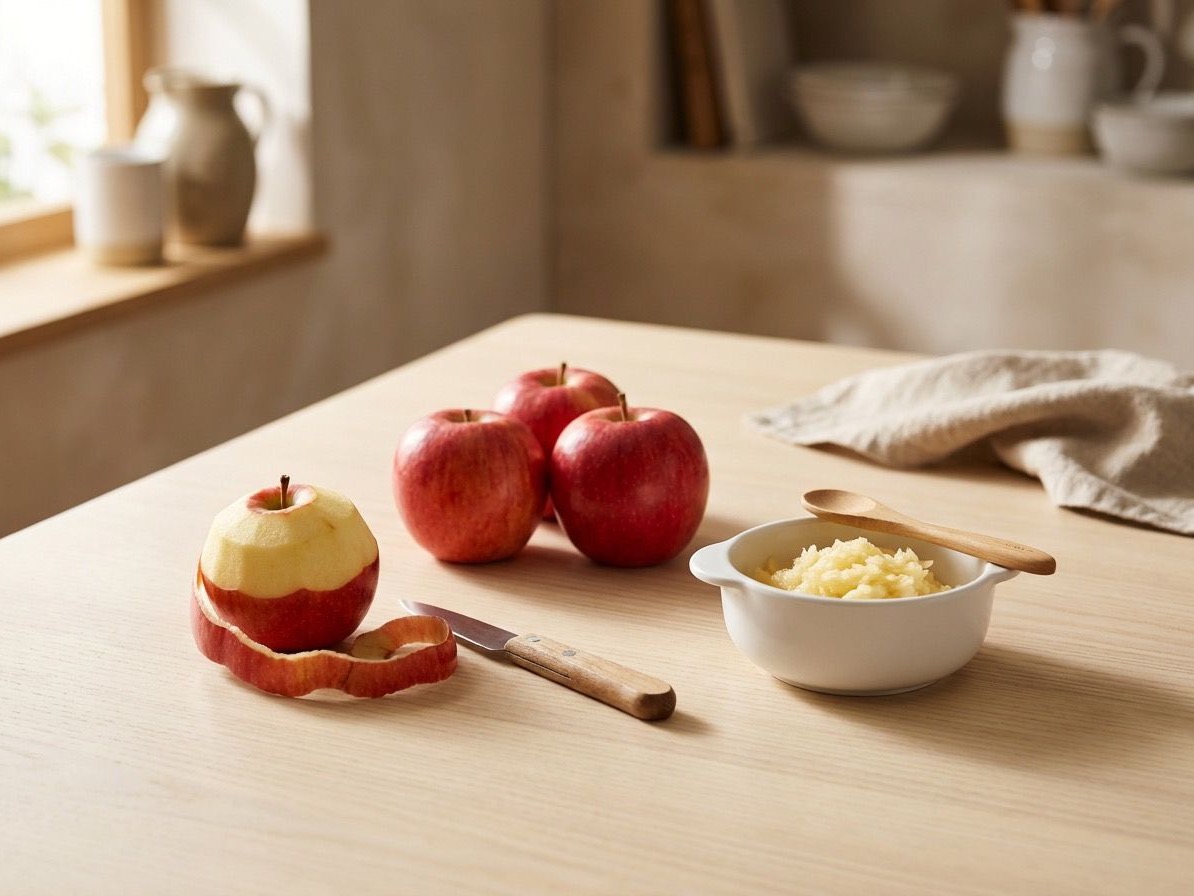
Peel it, and take out the core and seeds generously. The flesh around the core stays firm and seeds are a swallowing risk.
Grated apple browns quickly. It has not spoiled, and cooking stops the browning. Since the early stages need cooking anyway, grating and heating straight away is the easier order.
Freeze it cooked, in single portions. Freezing and thawing drives off moisture and leaves it dry, so loosen it back to its original consistency with water or stock when you reheat. Do not refreeze what you have thawed, and do not save leftovers from a bowl your baby has eaten from.
Track how your baby takes apple with BebeSnap
- Log the date and amount of each new food, so you can trace back what caused a reaction
- Photograph nappies and let the AI read colour and consistency changes for you
- Build up a record of stage and volume, so it becomes visible when your baby is ready to move on
Frequently Asked Questions (FAQ)
Q: When can my baby start eating apple?
A: From the first weaning stage, around five to six months, once your baby is used to rice porridge. Grate it, cook it, and loosen it with water until smooth. Introduce it with one small spoonful on a weekday when your clinic is open. Delaying it out of allergy concern has no proven preventive effect.
Q: When is raw apple safe to give?
A: Even in the final weaning stage at twelve to eighteen months, the official texture standard is still "chewable with the gums". Raw apple is firmer than that, and the molars that grind food only start coming through late in that stage. Cook or grate it until then. Biting confidently with front teeth is not the same as being able to break a piece down.
Q: How much apple should I give at one meal?
A: The official table treats "vegetables and fruit" as a single box: 20-30g at seven to eight months, 30-40g at nine to eleven, 40-50g at twelve to eighteen, counting both together. Apple is sweet enough to fill that box on its own, so keeping fruit under a third of it leaves room for vegetables.
Q: Is apple covered by allergen labelling?
A: In Japan, yes. Apple is one of the 20 recommended-labelling items, separate from the 9 mandatory ones. It can be declared as an alternative spelling, or inside a product name such as apple pie or apple vinegar, or as an additive like apple-derived pectin. Korea's own labelling list does not include apple.
References
Stop Trying to Remember Feed Times
Log time, amount, and intervals. BebeSnap turns them into your baby's daily pattern.
See what the app does firstMedical Disclaimer: This article is for informational purposes only and does not replace professional medical advice. If you have concerns about your baby's health, please consult a pediatrician.
You Might Also Like
Wonder Weeks Calculator: Your Baby's 10 Mental Leaps From the Due Date
Baby Weight Gain Calculator: Grams Per Day From Two Weigh-Ins
Baby Impetigo: Golden Crusts, Antibiotic Treatment, and When Nursery Is Safe Again
Baby Mouth Sores (Stomatitis): Causes, How to Tell Them Apart, and Dehydration Signs
You Might Also Like
Spinach for Babies: When to Start, Why Boiling Matters, and the One Time to Skip It
Spinach can start with first purees. Everyone says to boil it, but nobody says why: oxalic acid for the taste, and nitrate, which leafy greens carry a lot of. Boiling cuts nitrate by 30 to 40 percent, and there is one situation where you should skip spinach entirely.
Baby Food Freezing: How to Freeze in Cubes for 1 Month Storage
Too busy to make baby food daily? Freeze in cube trays for 1 month storage. Learn safe thawing and reheating methods.

Potato for Babies: When to Start, Safe Shapes, and Why Never to Blend It
Potato can start once your baby is used to first purees. But green patches carry over 13 times the glycoalkaloid of normal flesh, the skin layer around 96 times the centre, and cooking does not destroy it. Potato is also the one baby food you should never blend.