Baby Weight Gain Calculator: Grams Per Day From Two Weigh-Ins
⚖️ Baby Weight Gain Calculator
Previous Measurement
Latest Measurement
The trend matters more than any single number. Following the same percentile band is usually fine even if the weight stalls for a few weeks; the signal worth checking is a drop of two or more percentile bands on the growth chart.
This calculation is for reference only and is not a medical diagnosis. Consult your pediatrician if you are concerned.
📋 Typical Weight Gain by Age
Keep Every Growth Milestone
Get Started FreeYou weighed your baby twice and now you are trying to work out how much that is per day. Enter the date of birth and both weigh-ins above and the calculator gives you the daily gain, plus how it compares to the guide for your baby's age. The arithmetic itself is simple: divide the weight gained by the days that passed. The number is easy to misread, though, so this guide also covers how to read it properly.
The Formula
| Item | Detail |
|---|---|
| Formula | (latest weight − previous weight) ÷ days between the two dates |
| Example | Sept 1: 5,200g → Sept 15: 5,600g |
| Result | 400g ÷ 14 days = about 29g per day |
The part people get wrong is counting the days. September 1 to September 15 is 14 days, not 15. Enter the dates above and the calculator handles it for you.
Newborn Weight Loss Percentage
In the first days, a newborn's weight is read not as a gain but as the share of birth weight lost. The calculator above measures the pace of gain, so for this window use the formula below.
| Item | Detail |
|---|---|
| Formula | (birth weight − current weight) ÷ birth weight × 100 |
| Example | Birth weight 3,000g → 2,820g on day 3 |
| Result | 180g ÷ 3,000g × 100 = 6% |
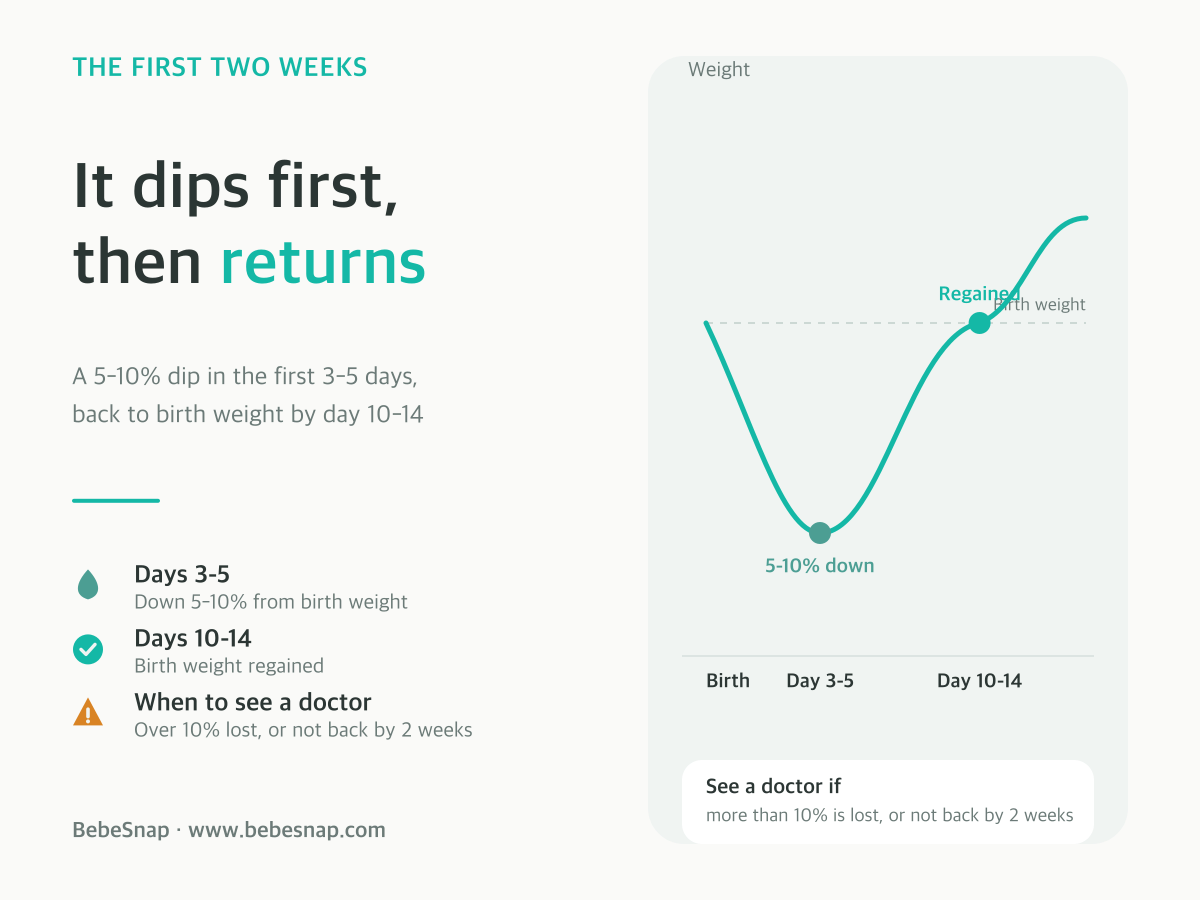
Losing up to 5-10% of birth weight is within physiological weight loss, and most babies are back to birth weight by days 10-14. A loss of more than 10% needs a doctor.
Typical Gain by Age
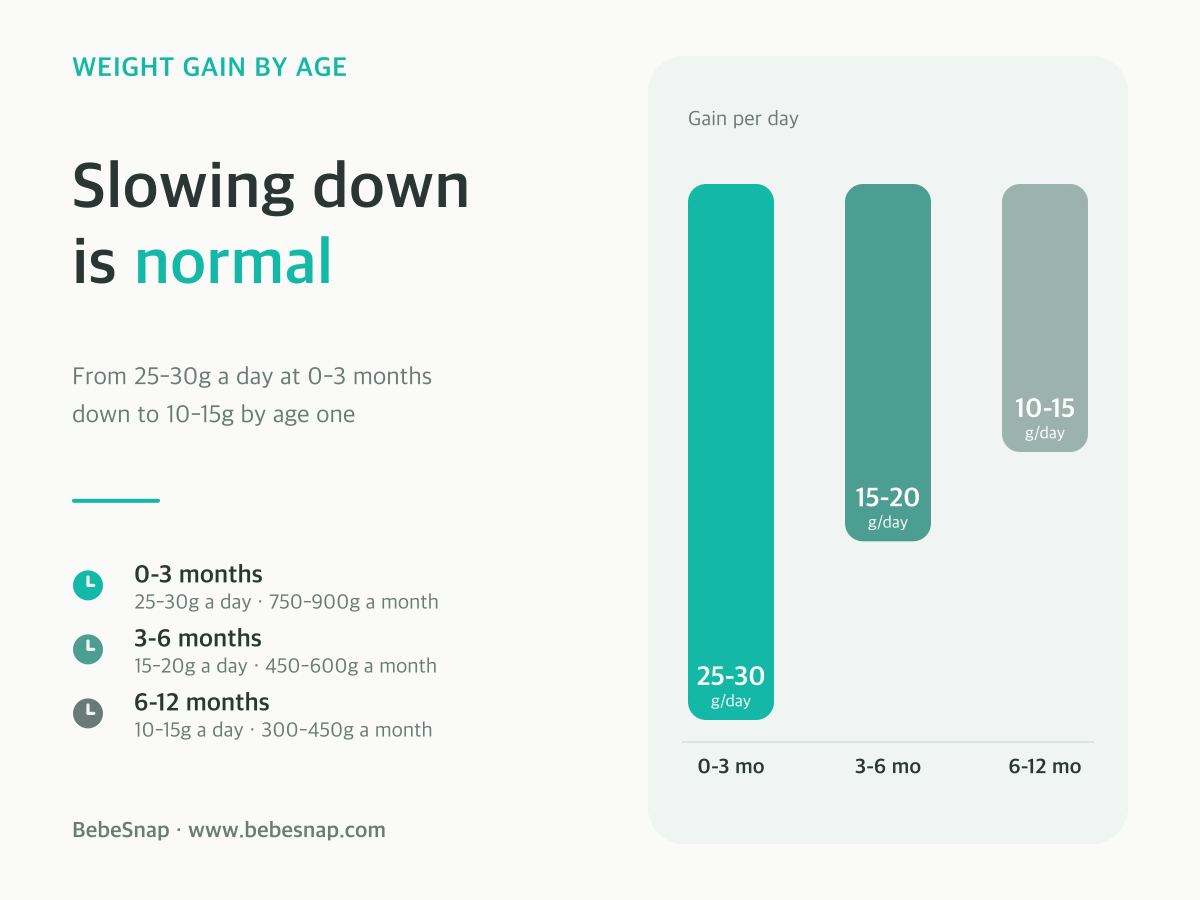
Growth naturally slows down over the first year. A six-month-old not gaining like a newborn is not a problem; that is the expected path.
| Age | Per Day | Per Month | Milestone |
|---|---|---|---|
| 0-3 months | 25-30g | About 750-900g | Birth weight regained by about 2 weeks |
| 3-6 months | 15-20g | About 450-600g | Birth weight doubles around 4-6 months |
| 6-12 months | 10-15g | About 300-450g | Birth weight roughly triples by age one |
Three Ways This Number Gets Misread
1. Weighing again after only a couple of days A wet diaper or a recent feed alone can move the reading by more than 100g. Weigh two days apart, find 200g, and the math says 100g a day: but that is measurement conditions, not growth. Weigh at least a week apart for the daily figure to mean anything.
2. Taking a newborn's number at face value Babies lose weight in the first days after birth. Around days 3-5 they shed 5-10% of their birth weight (physiological weight loss), and most are back to birth weight by days 10-14. A zero or negative result in that window is not a broken calculation; it is simply that stage. If more than 10% is lost, the weight keeps falling after about day 5, or it is not back by two weeks, that does need a doctor.
3. Judging on a single number This is the most common mistake. Weight should be read as a trend on the growth chart, not as one reading. Following the same percentile band is usually fine even if one weigh-in shows a smaller gain, and the signal worth checking is a drop of two or more percentile bands. Our guide on a baby not gaining weight covers that in detail.
💡 This calculator is a reference for gauging whether growth is on track. It is not a diagnosis, and if you are worried, reviewing the growth chart with your pediatrician is the most accurate route.When to See a Doctor
- The weight is still lower on a repeat weighing
- A gain of 15g a day or less continues for several days before three months
- The percentile drops two or more bands on the growth chart
- Height and head circumference have stalled as well
- Feeding drops noticeably, or wet diapers fall below six a day
If the feeding volume itself is the question, start with the formula calculator to check the amount for your baby's weight.
Tracking Growth With BebeSnap
- Log each weigh-in and the daily gain is calculated for you
- The percentile is plotted on the growth chart so the trend is visible at a glance
- Feeding and diaper logs build up alongside it, making causes easier to spot
Frequently Asked Questions (FAQ)
Q: How do I calculate my baby's daily weight gain?
A: Subtract the previous weight from the latest weight and divide by the number of days between the two dates. If a baby was 5,200g on September 1 and 5,600g on September 15, that is 400g over 14 days, or about 29g a day. Note that September 1 to September 15 is 14 days, not 15.
Q: How many grams a day should a baby gain?
A: It depends on age. From 0-3 months the pace is fastest at 25-30g a day, then 15-20g at 3-6 months and 10-15g at 6-12 months. Per month that is about 750-900g, 450-600g and 300-450g. The slowdown after six months is simply the normal growth path, and months with less than 10g a day are common near the first birthday.
Q: How often should I weigh my baby?
A: At least a week apart if you want a meaningful daily figure. Diaper state and whether a feed just happened can shift the reading by over 100g, and weighing a few days apart amplifies that error straight into the daily number. Weekly weighing under the same conditions beats daily weighing.
Q: My baby lost weight. Should I see a doctor?
A: In the first few days this may be physiological weight loss: babies shed fluid after birth, start gaining again from about day 5 and usually regain birth weight by two weeks. See your pediatrician if more than 10% is lost, a repeat weighing after day 5 is still lower, the weight is not back by two weeks, or wet diapers fall below six a day.
References
Keep Every Growth Milestone
Log height, weight, and milestones. The growth curves are drawn for you.
See what the app does firstYou Might Also Like
Tomato for Babies: When to Start, Skin and Seeds, and Why Cherry Tomatoes Are Never Served Whole
Apple for Babies: Stage-by-Stage Portions and When Raw Apple Is Safe
Spinach for Babies: When to Start, Why Boiling Matters, and When to Skip It
Potato for Babies: When to Start, Safe Shapes, and Why Never to Blend It
You Might Also Like

Wonder Weeks Calculator: Your Baby's 10 Mental Leaps From the Due Date
Enter your due date and get all 10 leap dates. They land at weeks 5, 8, 12, 19, 26, 37, 46, 55, 64 and 75, each lasting 1 to 2 weeks.

White Noise for Baby Sleep: Safe Volume Levels & How to Use
Does white noise really help babies sleep? Learn a safe volume (under 50dB), distance, and usage time.
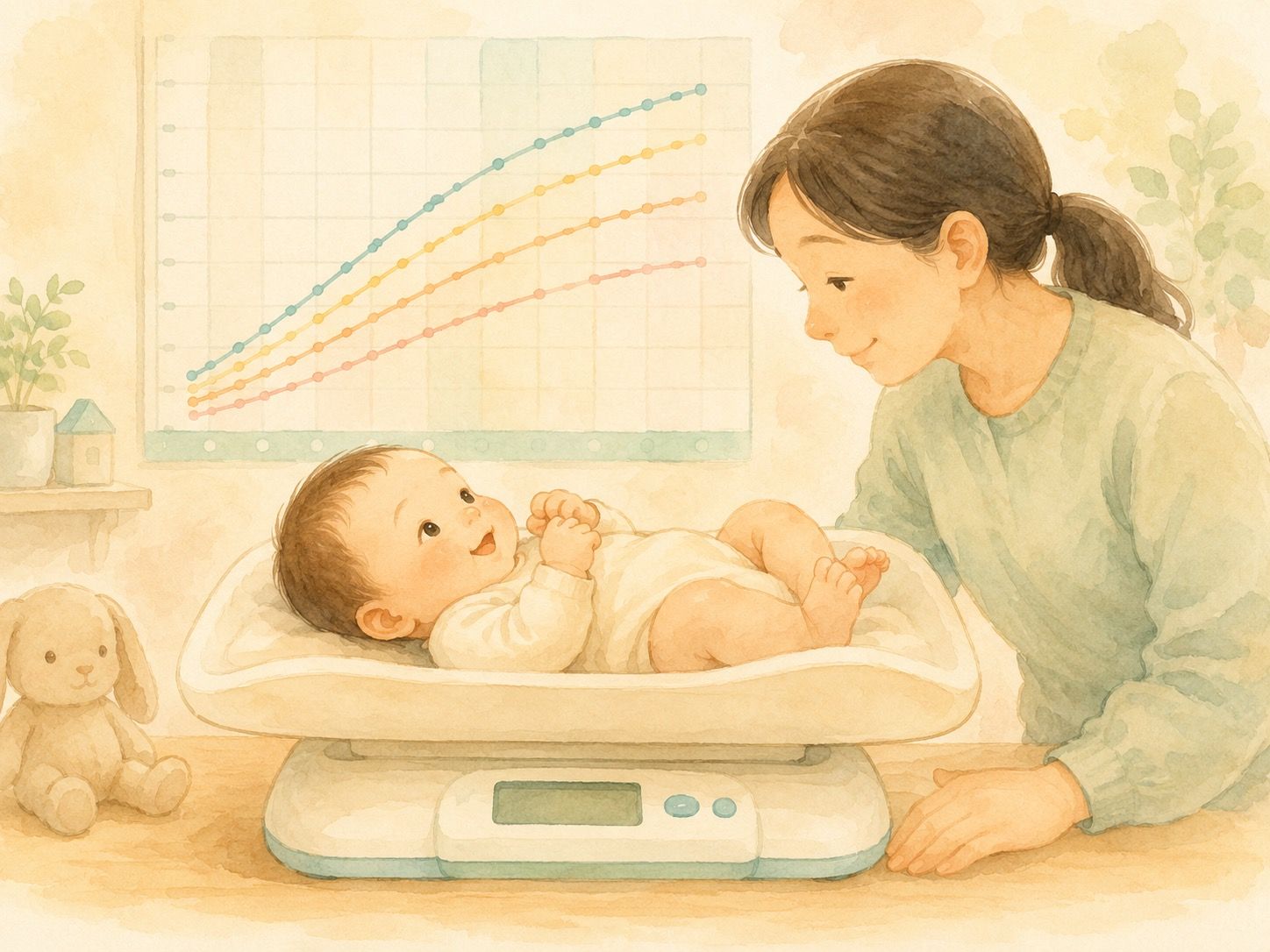
Baby Not Gaining Weight? Normal Growth Rates by Age & When to Worry
Worried your baby isn't gaining weight? Newborns gain 25~30g a day, but this slows to 10~15g a day after 6 months. The key warning sign is a drop of 2 or more percentile bands.