Baby Not Gaining Weight? Normal Growth Rates by Age & When to Worry
Keep Every Growth Milestone
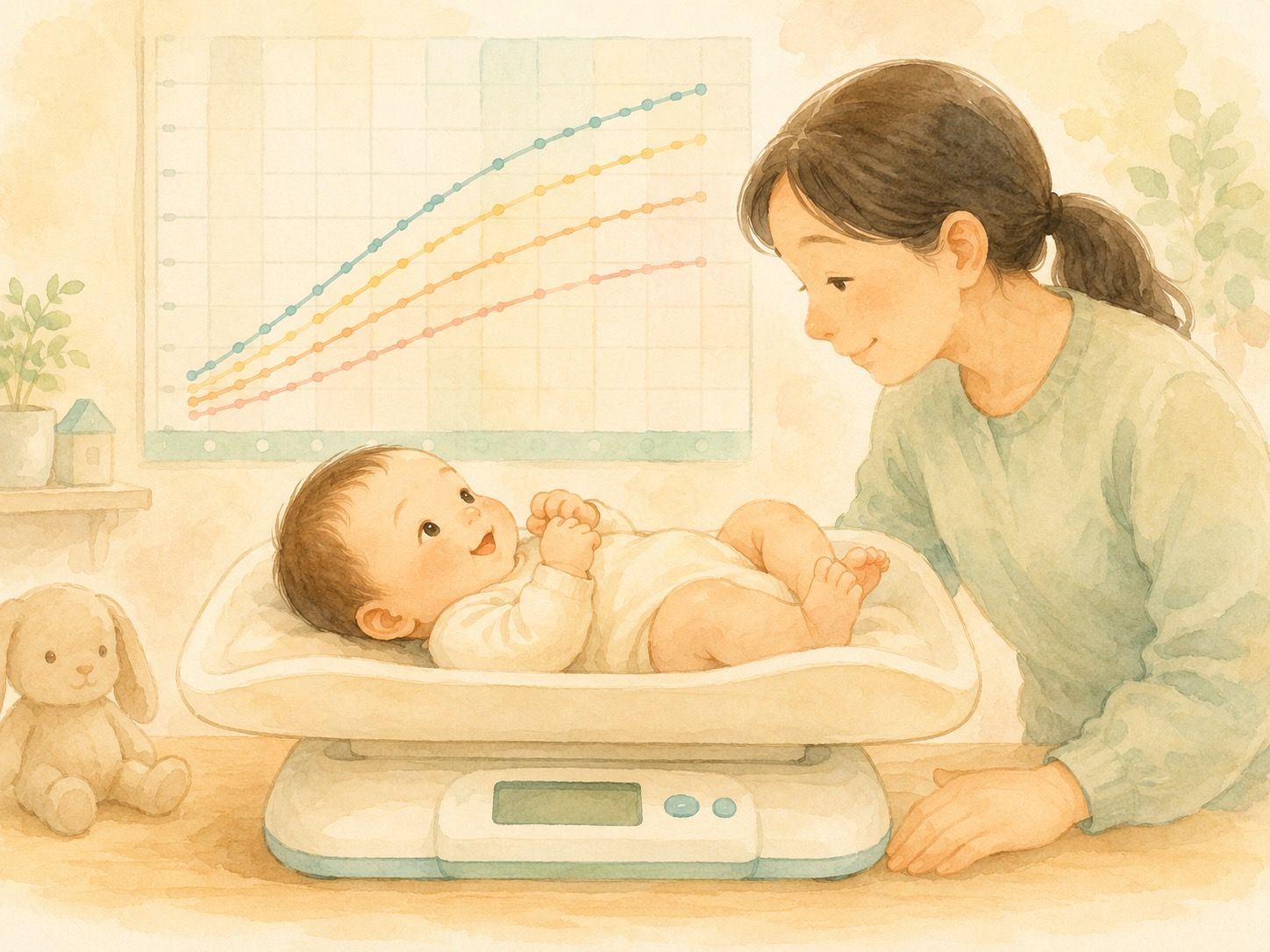
Get Started FreeWhen the scale reads almost the same as last month, your heart sinks a little. So let's start with the answer that matters most: your baby's weight should be read as a trend on the growth curve, not a single number, and if they are tracking along the same percentile band, one smaller gain is usually completely normal. The most important signal that calls for a closer look is a drop of 2 or more percentile bands on the growth chart. Here is the one thing to hold onto: a small absolute number and a slide off a curve your baby was tracking well are two completely different problems.
This Slower Pace Is Actually Normal
Here is where most parents get tripped up. You expect the rapid gains of the newborn weeks to continue, but weight gain naturally slows as your baby grows. The first few months are the fastest growth of your baby's entire life, and it is normal for the brakes to come on after that.
| Age | Daily Gain | Monthly Gain | Milestone |
|---|---|---|---|
| 0~3 months | 25~30g (about 1 oz) | about 750~900g | Birth weight regained by 2 weeks |
| 3~6 months | 15~20g | about 450~600g | Doubles birth weight by 4~6 months |
| 6~12 months | 10~15g | about 300~450g | Triples birth weight by 12 months |
Notice how the daily gain after 6 months drops to less than half of the early rate. This is simply the normal growth path, not an effect of solids: the pace already starts slowing from about 2 months, well before solids, and months with less than 10g a day are common near the first birthday. That is why so many parents feel their baby "isn't gaining well lately": when in most cases it is simply the normal rhythm of growth.
💡 In the first few months, gaining less than 15g a day for several days in a row is worth checking your feeding. But the gentle slowdown after 6 months is not a warning sign; it is a natural shift.If you have two weigh-ins, the baby weight gain calculator works out the grams per day and compares them with the guide for your baby's age.
Plateaus You Don't Need to Worry About
A weight that holds steady for a few days, or even a week or two, is something almost every parent runs into. The situations below usually resolve on their own, so there is no need to rush. The exception is a baby under 3 months: this is when babies normally gain 25~30g a day, so if the weight hasn't moved for a week or two, check in with your pediatrician rather than waiting.
Transitioning to Solid Foods
- When solids start around 6 months, milk intake drops and the pace of weight gain naturally eases
- Your baby simply isn't eating solids skillfully yet, so calorie intake dips briefly
A Sudden Jump in Activity
- Once rolling, scooting, crawling, and pulling to stand begin, calorie burn spikes
- Babies may hold steady for a few days while pouring energy into mastering new movements
Right After a Minor Illness
- After a cold, stomach bug, or mouth sores, appetite temporarily dips and weight can stall
- Once they recover, they usually return to their previous pace within a few days
What these situations share is that height and head circumference keep growing, and the baby stays active. If weight alone has paused, the body has simply shifted its priorities for a little while.
Reassuring Plateau vs One That Needs a Closer Look
So how do you tell the difference? Walking through the items below helps you decide which side your baby is on right now.
| What to Check | Reassuring Plateau | Needs a Closer Look |
|---|---|---|
| Growth curve | Stays on the same percentile band | Drops 2 or more percentile bands |
| Height & head size | Keep growing steadily | Height growth stalls too |
| Activity & mood | Active and playful | Floppy or less responsive (call 911) |
| Duration | Recovers within a few days to 2 weeks | Stalls for 3+ weeks (1~2 weeks under 3 months), or any drop |
| Background | After solids, more activity, or illness | Persists with no clear reason |

The most important criterion is the top row, where your baby sits on the growth curve. If your baby was at the 25th percentile and keeps tracking near the 25th, that is normal even though the absolute number is small. On the other hand, if they slide from the 50th to the 25th and then to the 10th: more than two bands down; it is worth finding out why. For a detailed guide to reading percentiles, see How to Read Baby Growth Charts.
Why Isn't My Baby Gaining?: Common Causes
If you have decided the plateau needs a closer look, the cause usually falls into one of the four groups below. Most are related to feeding or meals, which means they can often be corrected at home.
1. Not Taking In Enough
- A shallow latch can mean your baby is actually drinking little, or feeds may be too short
- Adding too much water to formula not only cuts calories but can cause dangerous water intoxication (hyponatremia), so always follow the labeled ratio exactly
2. Solids Too Low in Calories
- Very watery, thin purees fill the belly but deliver few calories
- A diet built only around vegetables and fruit can lack the fat and protein needed for growth
3. Burning a Lot of Energy
- A baby who has started crawling and walking may gain slowly even while eating the same amount
4. An Underlying Physical Cause
- Frequent infections, reflux with regular spit-up, or cow's milk protein allergy can interfere with absorption
- Rarely, thyroid, heart, or metabolic conditions are the cause, so persistent cases need evaluation
Practical Ways to Help Healthy Weight Gain
If the cause is feeding or meals, you can gradually raise calorie intake with the strategies below. Rather than forcing more volume, the key is to increase the calorie density of each bite.
Start by Reviewing Feeds
- For breastfeeding, offer every 2~3 hours and fully empty one breast before switching sides
- For formula, follow the age-based amount and concentration exactly so it isn't made too thin
- Since the stomach is small, small frequent feeds work better than large infrequent ones
Boost the Calorie Density of Solids
- Make purees thicker with less water, and add a small amount of avocado, unsalted butter, or olive oil for healthy fats
- Include a little protein daily, egg yolk, tofu, cheese, or meat
Use High-Calorie Snacks
- Avocado, banana, sweet potato, unsweetened yogurt, and cheese pack a lot of calories into a small volume
Don't Fill Up on Milk or Juice
- After age 1, limit cow's milk to 480~600ml a day. Filling up on milk means less appetite for meals, creating a vicious cycle
When to See a Doctor
Most cases improve with attention at home, but see your pediatrician if you notice the signs below.
- The percentile has dropped 2 or more bands on the growth chart
- Weight has stalled for 3 or more weeks (1~2 weeks in a baby under 3 months), or has actually fallen
- Not just weight, but height and head circumference growth have also stopped
- Your baby shows dehydration signs (fewer than six wet diapers a day, fewer tears when crying); call 911 if your baby is floppy, less alert or responsive than usual, hard to wake, or has had no wet diaper in 12 hours
- Repeated spit-up after every feed, or crying in pain when swallowing
Tracking the Trend with BebeSnap
The more you worry about slow weight gain, the more you need to look at the trend rather than a single number. BebeSnap makes that trend visible.
- Growth Tracker: Enter weight, height, and head circumference to auto-generate a growth curve and see percentile changes at a glance
- Trend Graphs: Judge by the pattern, whether the percentile is holding steady or slipping over several weeks
- Feeding & Solids Log: View intake alongside weight to pinpoint the cause, and show it directly at your pediatric visit
Frequently Asked Questions (FAQ)
Q: How many grams should a baby gain per day?
A: It depends on age. From 0~3 months, babies gain the fastest at 25~30g a day; from 3~6 months 15~20g; and from 6~12 months 10~15g, slowing gradually. A drop to less than half the early rate after 6 months is simply the normal growth path, and months with less than 10g a day are common near the first birthday.
Q: My baby's weight hasn't changed in 2 weeks, should I see a doctor?
A: Under 3 months, two weeks with no gain is reason enough to see your pediatrician. In older babies who keep growing in length and head size and stay active, a plateau of up to 2 weeks is usually normal, often after starting solids, more activity, or an illness. See your pediatrician if it lasts 3+ weeks, weight drops, or the percentile falls 2 or more bands.
Q: My baby isn't gaining well after starting solids. Why?
A: Once solids begin, milk intake decreases and your baby can't yet eat solids skillfully, so calorie intake dips briefly. Watery, thin purees only give a sense of fullness: make them thicker and add healthy fats like avocado or unsalted butter to raise the calorie density.
Q: What foods help a baby gain weight quickly?
A: Foods that pack calories into a small volume are ideal, avocado, banana, sweet potato, unsweetened yogurt, cheese, and tofu are great choices. Adding a little olive oil or unsalted butter to purees helps too. After age 1, limit cow's milk to 480~600ml a day so milk doesn't crowd out meals.
References
- Nemours KidsHealth - Failure to Thrive
- AboutKidsHealth - Poor Weight Gain in Infants and Young Children
- Boston Children's Hospital - Slow Weight Gain in Infants and Children
- AAP HealthyChildren - Understanding Growth Charts
- AAP - New Guidance on Faltering Weight in Children
- NICE NG75 - Faltering Growth
- WHO - Child Growth Standards
Keep Every Growth Milestone
Log height, weight, and milestones. The growth curves are drawn for you.
See what the app does firstYou Might Also Like
Tomato for Babies: When to Start, Skin and Seeds, and Why Cherry Tomatoes Are Never Served Whole
Apple for Babies: Stage-by-Stage Portions and When Raw Apple Is Safe
Spinach for Babies: When to Start, Why Boiling Matters, and When to Skip It
Potato for Babies: When to Start, Safe Shapes, and Why Never to Blend It
You Might Also Like
Wonder Weeks Calculator: Your Baby's 10 Mental Leaps From the Due Date
Enter your due date and get all 10 leap dates. They land at weeks 5, 8, 12, 19, 26, 37, 46, 55, 64 and 75, each lasting 1 to 2 weeks.

Baby Snoring & Infant Sleep Apnea: Causes, Symptoms, and When to Seek Help
About 3.2% of babies snore regularly at 3 months. Learn when snoring is normal and when a 20-second breathing pause means calling 911 right away.

8-Month-Old Daily Schedule: 2 Naps, 3 Solid Meals & a Sample Timetable
Wondering what an 8-month-old's day looks like? Here's a sample daily timetable built on 2 naps, 2.5-3.5 hour wake windows, 11-12 hours of night sleep, and 3 solid meals.