8-Month-Old Daily Schedule: 2 Naps, 3 Solid Meals & a Sample Timetable

Keep Every Growth Milestone
Get Started FreeThe short answer: an 8-month-old's day runs on 2 naps (morning and afternoon), 3 solid meals, and 3-4 milk feeds. The nonstop eat-sleep-repeat cycle of the newborn days is behind you, and a more grown-up rhythm (up in the morning, one long stretch at night) is finally taking shape. Now that your baby is busy crawling and pulling to stand, here's a sample timetable to help you structure the day.
What Does an 8-Month-Old's Day Look Like?
By 8 months, the day becomes fairly predictable. Most babies take two naps (morning and afternoon) and sleep 11-12 hours at night in one long stretch. Naps plus night sleep add up to about 13-15 hours of total sleep per day.
The key to this stage is the wake window. An 8-month-old can usually stay happily awake for 2.5-3.5 hours before getting sleepy again. The final stretch, from the afternoon nap to bedtime, tends to run a little longer at 3.5-4 hours. Once you understand this rhythm, you don't have to memorize exact nap times; you can naturally catch your baby at the right sleepy window.
💡 8 months at a glance: 2 naps (2-3 hours total) · wake windows of 2.5-3.5 hours · 11-12 hours of night sleep · 3 solid meals · 500-600ml of breast milk or formula per day.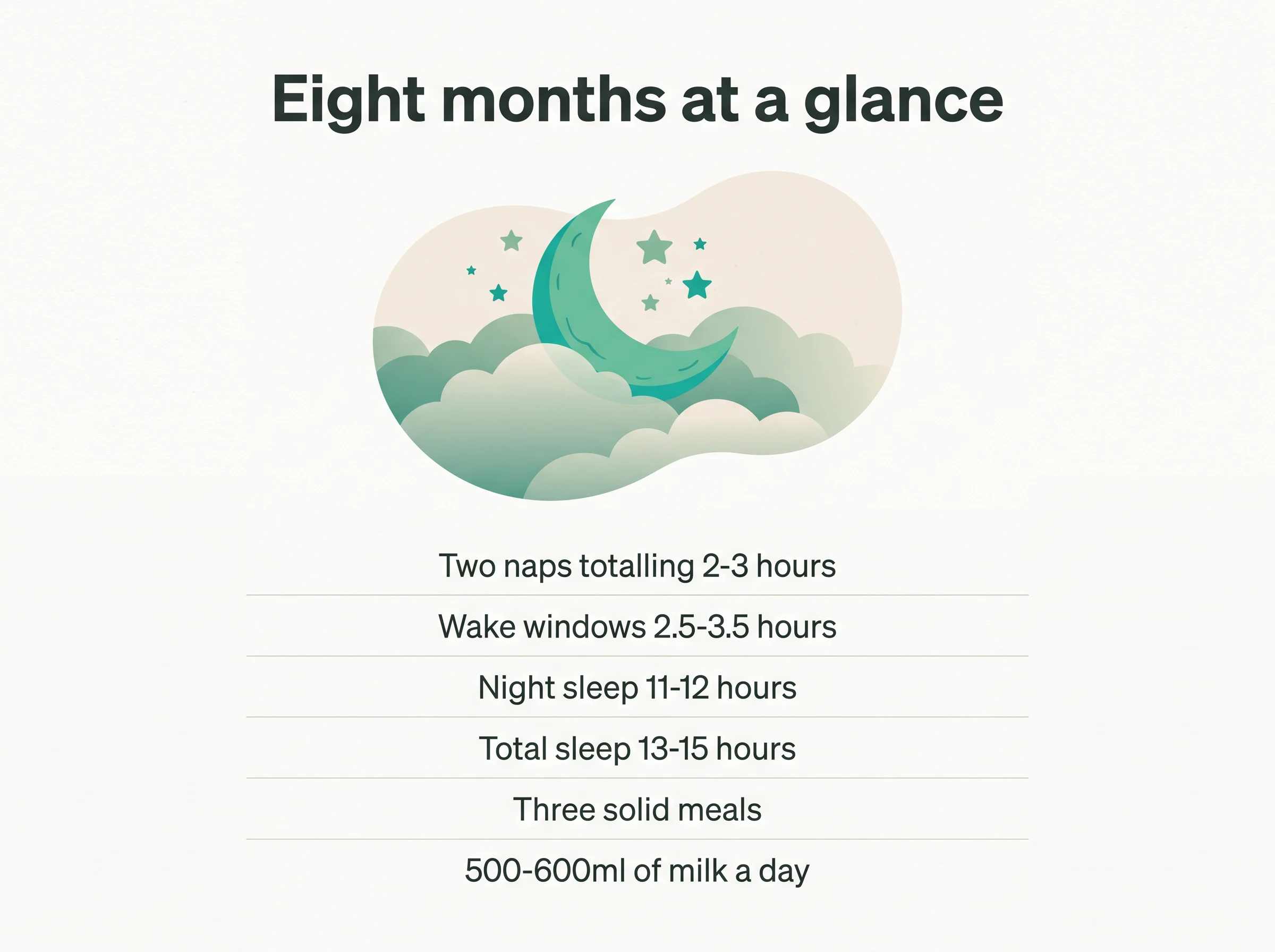
A Sample 8-Month Daily Timetable
The schedule below assumes a baby who wakes at 7 a.m. The clock times aren't rigid rules, the spacing (the eat-play-sleep order and the wake windows) is what matters. Just shift the whole timetable earlier or later to match your own baby's wake-up time.
| Time | Activity |
|---|---|
| 6:30-7:00 | Wake up · first milk feed (180-240ml breast milk or formula) |
| 7:30 | Breakfast solids (meal 1) |
| 7:30-9:30 | Play · crawling (wake window ~2.5 hours) |
| 9:30-10:45 | Morning nap (1-1.5 hours) |
| 10:45 | Milk feed |
| 11:00-12:30 | Outing · play |
| 12:30 | Lunch solids (meal 2) |
| 13:30-15:00 | Afternoon nap (1.5 hours) |
| 15:00 | Milk feed |
| 15:30-17:00 | Play · walk |
| 17:30 | Dinner solids (meal 3) |
| 18:15 | Bath · bedtime routine |
| 18:45 | Bedtime milk feed |
| 19:00 | Night sleep (11-12 hours) |

In this example, the morning nap falls 2.5 hours after waking, the afternoon nap about 2.75 hours after the morning nap ends, and bedtime roughly 4 hours after the afternoon nap. This works because wake windows lengthen across the day. If a nap ends short, trim the next wake window a little; if it runs long, stretch it: stay flexible rather than locked to the clock.
Why Do Naps Settle Into Two a Day?
Around 7-8 months, most babies drop from three naps to two. The reason is simple: your baby can now tolerate longer wake windows, so three short naps are no longer needed. Instead, the morning and afternoon naps each become longer and deeper.
- Morning nap: usually starts between 9 and 10 a.m., lasting 1-1.5 hours
- Afternoon nap: starts around 1-2 p.m. after lunch solids, lasting 1.5-2 hours
- Total nap time: 2-3 hours a day is about right
Aim for 11-12 hours of night sleep. Pushing bedtime too late can actually cause more night wakings from overtiredness, so keep bedtime within 3.5-4 hours of when your baby woke from the last nap.
How Do You Balance 3 Solid Meals With Milk Feeds?
Eight months is a transition period when solids move from two meals a day to three. This matters because major guidelines, including AAP, describe most babies eating around three meals a day by 8-9 months. At 8 months you're building up to that, so add the third meal gradually as your baby shows readiness.
More solids doesn't mean cutting milk sharply. At this stage breast milk or formula is still the main source of nutrition, while solids are for practicing chewing and swallowing and adding variety.
- Solids: 3 meals a day (breakfast, lunch, dinner), about half to a full baby bowl per meal
- Milk: breast milk on demand, or 500-600ml of formula split across 3-4 feeds
- Timing: spacing solids and milk apart a bit helps your baby eat solids better
Can You Start Finger Foods Now?
Yes, 8 months is a great time to start finger foods. Around now your baby develops the pincer grasp (picking up small items with thumb and forefinger) and wants to self-feed. Letting your baby pick up food builds fine motor skills and hand-to-mouth coordination, and it builds a love of eating and healthy self-feeding habits.
Start with soft-cooked vegetables cut into finger-sized strips (carrot, sweet potato, zucchini), ripe banana, or small pieces of tofu. Most of it will be dropped and squished at first, but that mess is the practice.
⚠️ Always avoid choking hazards. Whole grapes and cherry tomatoes (always quarter them), nuts, hard raw vegetables, sticky foods, and hot dogs are dangerous for an 8-month-old. Keep your baby seated and supervised for every meal.When Do Babies Move From 3 Naps to 2?
If your baby is still taking three naps, these signs mean it's time to move to two. This usually happens between 7 and 9 months.
- Refusing the third (late-afternoon) nap or not settling when laid down
- The late nap pushing bedtime later than you'd like
- Morning and afternoon naps running longer than before
To transition, gradually push the morning nap later, and move bedtime about 30 minutes earlier while the count drops to two so your baby doesn't get overtired. During the transition (about 2-3 weeks) days can be inconsistent, so don't stress about a perfect timetable.
When the Schedule Keeps Falling Apart
If you finally set a rhythm and then, right around 8 months, your baby suddenly wakes often at night and refuses naps, it's usually not that the schedule is wrong; it's more likely a temporary developmental shift. This matters because crawling, pulling to stand, and the onset of separation anxiety often collide now, producing the common 8-month sleep regression.
When this happens, keep the daily framework (2 naps, 3 solid meals, a consistent bedtime routine) steady, give plenty of daytime practice for crawling, and hold your bedtime routine consistent; that's what helps most.
💡 If night wakings and nap refusal drag on for weeks, it may be the 8-month sleep regression. The causes and solutions are covered in a separate article, so check it out when schedule tweaks alone don't fix things.Managing the 8-Month Rhythm With BebeSnap
Wake windows and nap timing shift a little every day, which is hard to track in your head. Logging feeds, solids, and naps in BebeSnap makes your baby's unique daily pattern visible.
- Feeding, solids & sleep logs: manage all 3 solid meals and nap times on one screen with one tap
- Pattern graphs: review nap and night-sleep rhythms week by week to fine-tune the schedule
- AI parenting chat: 24/7 answers on nap transitions, solid portions, and more
Frequently Asked Questions (FAQ)
Q: How many naps does an 8-month-old take per day?
A: Most 8-month-olds take two naps a day, one in the morning and one in the afternoon, totaling about 2-3 hours. Night sleep runs 11-12 hours in one long stretch. Wake windows are 2.5-3.5 hours, with the final window from the last nap to bedtime a bit longer at 3.5-4 hours.
Q: How many solid meals and milk feeds does an 8-month-old need?
A: Eight months is a transition from two solid meals a day to three. Offer about half to a full baby bowl at breakfast, lunch, and dinner, alongside 500-600ml of breast milk or formula split across 3-4 feeds. Even as solids increase, breast milk or formula remains the main source of nutrition at this age.
Q: What time should an 8-month-old go to bed on this schedule?
A: Aim to start night sleep within 3.5-4 hours of when your baby woke from the last afternoon nap. For a baby waking at 7 a.m., a bedtime around 7 p.m. works well. Pushing bedtime too late can backfire, causing more night wakings from overtiredness, so watch the timing.
Q: My 8-month-old won't follow the schedule and wakes often at night. Is that normal?
A: It's very common. At 8 months, motor milestones like crawling and pulling to stand often collide with separation anxiety, triggering a sleep regression. Keep the daily framework: 2 naps, 3 solid meals, a consistent bedtime routine: and give plenty of daytime practice; it usually passes within 2-6 weeks.
References
Keep Every Growth Milestone
Log height, weight, and milestones. The growth curves are drawn for you.
See what the app does firstYou Might Also Like
Tomato for Babies: When to Start, Skin and Seeds, and Why Cherry Tomatoes Are Never Served Whole
Apple for Babies: Stage-by-Stage Portions and When Raw Apple Is Safe
Spinach for Babies: When to Start, Why Boiling Matters, and the One Time to Skip It
Potato for Babies: When to Start, Safe Shapes, and Why Never to Blend It
You Might Also Like
Wonder Weeks Calculator: Your Baby's 10 Mental Leaps From the Due Date
Enter your due date and get all 10 leap dates. They land at weeks 5, 8, 12, 19, 26, 37, 46, 55, 64 and 75, each lasting 1 to 2 weeks.

8-Month Sleep Regression: Separation Anxiety, Crawling & Sleep Solutions
Is your 8-month-old suddenly waking at night and refusing naps? Learn how separation anxiety and crawling affect sleep - it passes in 2-6 weeks.
Baby Not Gaining Weight? Normal Growth Rates by Age & When to Worry
Worried your baby isn't gaining weight? Newborns gain 25~30g a day, but this slows to 10~15g a day after 6 months. The key warning sign is a drop of 2 or more percentile bands.