Baby Sign Language Guide: Communicating Before Words
Keep Every Growth Milestone
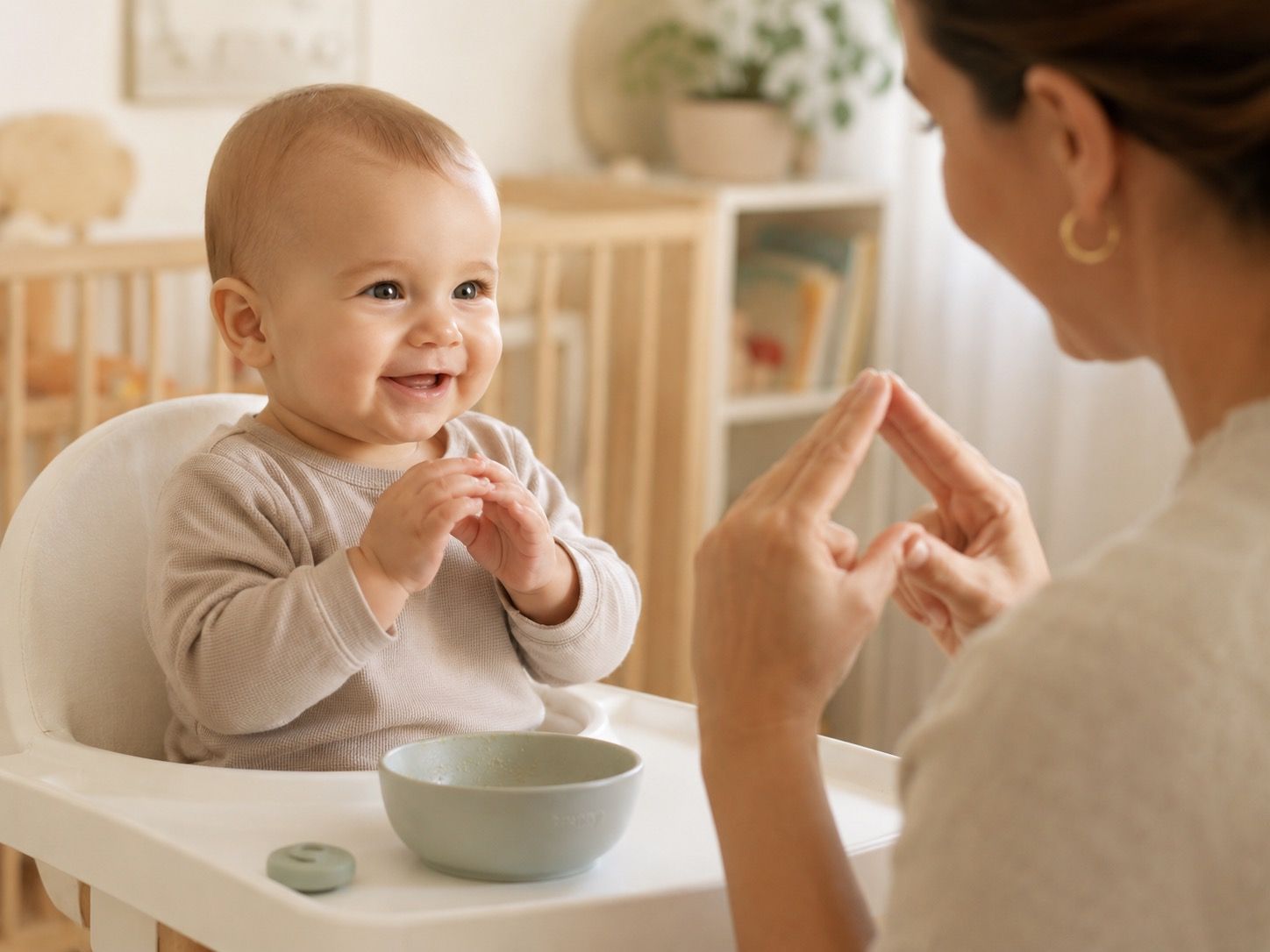
Get Started FreeHave you ever bounced and shushed a wailing baby, completely stumped about what they actually wanted? Hungry? Tired? Something hurting? Your little one clearly has something to say, but the words just aren't there yet. That's exactly the gap baby sign language helps close. It's a way to trade simple hand signals with your baby before they can talk. Start showing the signs around 6~8 months, and most babies start signing back, "more," "all done," with their own little hands around 8~12 months. In this guide, I'll walk you through what baby sign language actually is, when and how to start, the best signs to teach first, and the myths that trip a lot of us up, all without the hype.
So What Exactly Is Baby Sign Language?
Baby sign language is just a handful of simple gestures that let your baby show you what's on their mind before they can speak. You teach them to use their hands for everyday needs like "more," "all done," or "sleepy." It's not some formal curriculum, think of it more as a little set of hand signals you and your baby agree on. That framing alone takes a lot of pressure off.
One thing worth clearing up: baby sign language is not the same as the formal sign languages used by Deaf communities, like ASL or BSL. Those are full languages with their own grammar and vocabulary. Baby sign language, on the other hand, is a temporary tool to bridge communication before speech kicks in. It borrows a few gestures from formal sign languages, but it isn't a complete language with grammar. So you really don't need to stress about doing it "correctly."
💡 Baby signs are there to support speech, not replace it. That's why you should always pair the sign with the spoken word, never just the hands alone.When Should You Start?
The sweet spot for showing baby signs is around 6~8 months. Around this age, your baby's hand-eye coordination is coming along and they start loving the back-and-forth of games like peekaboo, which means they're getting ready for this kind of exchange.
Here's the catch, though: your baby won't copy you right away. Usually, after weeks of you patiently modeling the signs, babies start making them on their own around 8~12 months. The reason is simple, that's when the tiny muscles in their fingers are finally developed enough. So if there's no response for the first few weeks or even months, please don't take it as a flop. All that quiet repetition is quietly adding up.
| Age | What's happening | What parents do |
|---|---|---|
| 6~8 months | Hand-eye coordination develops, ideal time to start | Model 2~3 basic signs repeatedly |
| 8~10 months | Recognizes and starts responding to signs | Tie the same signs to daily routines |
| 10~12 months | Baby produces signs to express needs | Praise warmly and respond immediately |
Does It Actually Work? Let's Be Honest
The clearest payoff of baby sign language is that there are fewer of those frustrating, nobody-understands-me moments, for both of you. When your baby can sign "more" or "water," the meltdowns that come from an unmet need nobody could decode start to fade. You can read what they want and respond faster, so you both feel less stuck. And honestly, those "I don't know what you need" moments are the hardest part of this whole pre-talking stage, so any relief there is huge.
The second payoff is a closer bond. The simple act of trading signs is a focused, eye-to-eye moment where you're both fully tuned in to each other, and that kind of connection runs deep. It's a bigger gift than it sounds.
But let me be straight with you. The big claims, "signing raises your baby's IQ," "makes them a genius," "speeds up talking dramatically," just aren't backed by solid science. A few early gestures don't translate into lifelong brain gains. The American Speech-Language-Hearing Association (ASHA) and various studies agree that baby signing doesn't guarantee any long-term language or cognitive edge. So go into it not to build a smarter kid, but simply to connect more joyfully with the baby you already have. That mindset is the healthiest place to start.
⚠️ Don't get swept up in "make your baby a genius" marketing. The real value of signing is less frustration and a stronger connection with your little one.The Best Signs to Teach First
Don't try to do it all at once. Start with just 2~3 signs that come up most in your baby's day. Below are the ones parents usually teach first. If your version of the motion looks a little different from someone else's, that's totally fine. What matters way more than getting the shape "right" is that everyone in the house uses the same motion every time.
| Sign | How to make it | When to use it |
|---|---|---|
| More | Tap the fingertips of both hands together in front of you | When wanting more food or play |
| Eat | Bring pinched fingertips toward the mouth | When hungry or wanting to eat |
| All done | Open both hands and wave them side to side | When finished with a meal or activity |
| Water | Tap three fingers gently at the corner of the mouth | When thirsty |
| Hurt | Point both index fingers toward each other near the sore spot | When something is uncomfortable or painful |
| Sleep | Rest a palm against the cheek and tilt the head slightly | When tired and ready to sleep |
| Mom·Dad | Tap the thumb to the chin for mom, to the forehead for dad | When calling or looking for a parent |

How to Actually Teach It
Good news: there are no formal lessons here. Everyday repetition is the best teacher there is. Just keep a few simple things in mind and weave the signs naturally into your day.
First, never sign in silence, always say the word too. Say "Want more?" while you make the "more" sign at the same time. Pairing the word with the gesture is what helps your baby go "oh, that hand thing means this." Next, attach each sign to the same moment every time: the "eat" sign at every meal, the "sleep" sign at every bedtime. Repeating it in the same context etches the pattern right into your baby's memory.
Be generous with the repetition, many times a day, over weeks. As I mentioned, it's completely normal for the payoff not to show up until 8~12 months, so don't rush it. And get the whole crew on board: when mom, dad, and grandparents all use the same motion, your baby picks it up much faster. A gesture your family made up together works perfectly well, even if it's not "official" sign language. Finally, the instant your baby signs, respond right away and light up with a smile. A warm "You asked for water, good job!" gives them that little hit of "it worked!" that makes them want to do it again.
💡 Start with signs you'll use over and over, like "more" and "all done." The more times your baby sees a sign each day, the quicker it clicks.The Big Worry: Will Signing Delay Talking?
This is the number-one reason parents hold back: "If she leans on gestures, won't she talk later?" Let me put your mind at ease, that worry just isn't well supported.
Multiple studies and professional groups have found no clear evidence that signing delays speech. If anything, always using signs alongside words gives your baby practice linking words to meaning, which can actually give language a little boost. When your baby is ready to talk, she naturally trades the gestures in for spoken words. Signs aren't a roadblock to talking, they're more like stepping stones toward it.
On the flip side, there's no promise that signing will dramatically speed up talking either. Don't over-hope or over-worry, just settle into the calm middle ground: it won't slow things down, and it won't magically rush them.
When Nothing Seems to Be Working
You've modeled the signs faithfully for weeks, even months, and your baby just... doesn't. It's deflating, I know. But take heart, in the vast majority of cases there's nothing wrong at all. Run through this little checklist and you'll probably breathe easier.
It might simply be too early, if those finger muscles aren't quite there yet, signs can show up sometime after 8~12 months. Or you might be juggling too many signs at once; narrowing it down to 2~3 is far easier for a baby to grasp. Often it's just a matter of more reps, so try working them in more frequently throughout the day. And remember every baby moves at her own pace, some show you what they want through pointing or babbling long before they ever sign.
⚠️ Skipping baby signs entirely is not a problem in itself. But if by 12 months your baby isn't using any gestures at all, no pointing, no waving, that's worth bringing up with your pediatrician.Capture the Memories with BebeSnap
Jotting down which sign your baby did first, and when, turns the whole experience into a keepsake you'll smile at later. The BebeSnap app makes it effortless.
- Milestone records: Log the date of that first sign and save a photo to go with it
- AI development helper: Get guidance on the communication stages right for your baby's age
- Family sharing: Share the signs your baby has learned so everyone uses the same ones
- AI chatbot consultation: Ask anything about signs or language development, anytime
Frequently Asked Questions (FAQ)
Q: At what age should I start baby sign language?
A: Usually start teaching around 6~8 months, when your baby's hand-eye coordination is developing and they enjoy back-and-forth games like peekaboo. Your baby signing back typically appears at 8~12 months, once the small finger muscles are developed enough, so don't rush it if there's no response for the first weeks or months.
Q: Will baby sign language delay my baby's speech?
A: There's little evidence that baby sign language delays speech. When used alongside the spoken word every time, it actually gives your baby practice linking words to meaning, which can support language development. As your baby becomes ready to talk, they naturally trade gestures for spoken words, so signs act as stepping stones toward speech.
Q: Do I have to copy formal sign language exactly?
A: No, you don't have to copy formal sign language exactly. What matters more is that your whole family (mom, dad, and grandparents) uses the same motion consistently every time, since a gesture your family made up works perfectly well. Borrowing from formal sign language can simply make signs easier to learn.
Q: How many signs should I start with?
A: Begin with just 2~3 high-frequency signs like "more," "eat," and "all done": the ones that come up most in your baby's day, since frequent signs click faster. Pair each with the spoken word and tie it to the same routine, then add more one at a time as your baby gets comfortable.
References
Keep Every Growth Milestone
Log height, weight, and milestones. The growth curves are drawn for you.
See what the app does firstYou Might Also Like
Apple for Babies: Stage-by-Stage Portions and When Raw Apple Is Safe
Spinach for Babies: When to Start, Why Boiling Matters, and the One Time to Skip It
Potato for Babies: When to Start, Safe Shapes, and Why Never to Blend It
Introducing Fish to Your Baby: When to Start, What Order, What to Avoid
You Might Also Like
Wonder Weeks Calculator: Your Baby's 10 Mental Leaps From the Due Date
Enter your due date and get all 10 leap dates. They land at weeks 5, 8, 12, 19, 26, 37, 46, 55, 64 and 75, each lasting 1 to 2 weeks.
BebeSnap AI Skin Analysis: Baby Acne vs Eczema, Identify with One Photo
Can't tell if it's baby acne or eczema? Care differs for each condition. Analyze with one photo using AI.

Thumb-Sucking & Pacifier Weaning: When and How to Stop
Worried about thumb-sucking? Pacifier weaning is best by age 2-4. To avoid bite problems, most kids should stop before age 4.