Why Is My Baby Always Sick? Normal Daycare Illness vs. Warning Signs

Check Your Baby's Health from One Photo
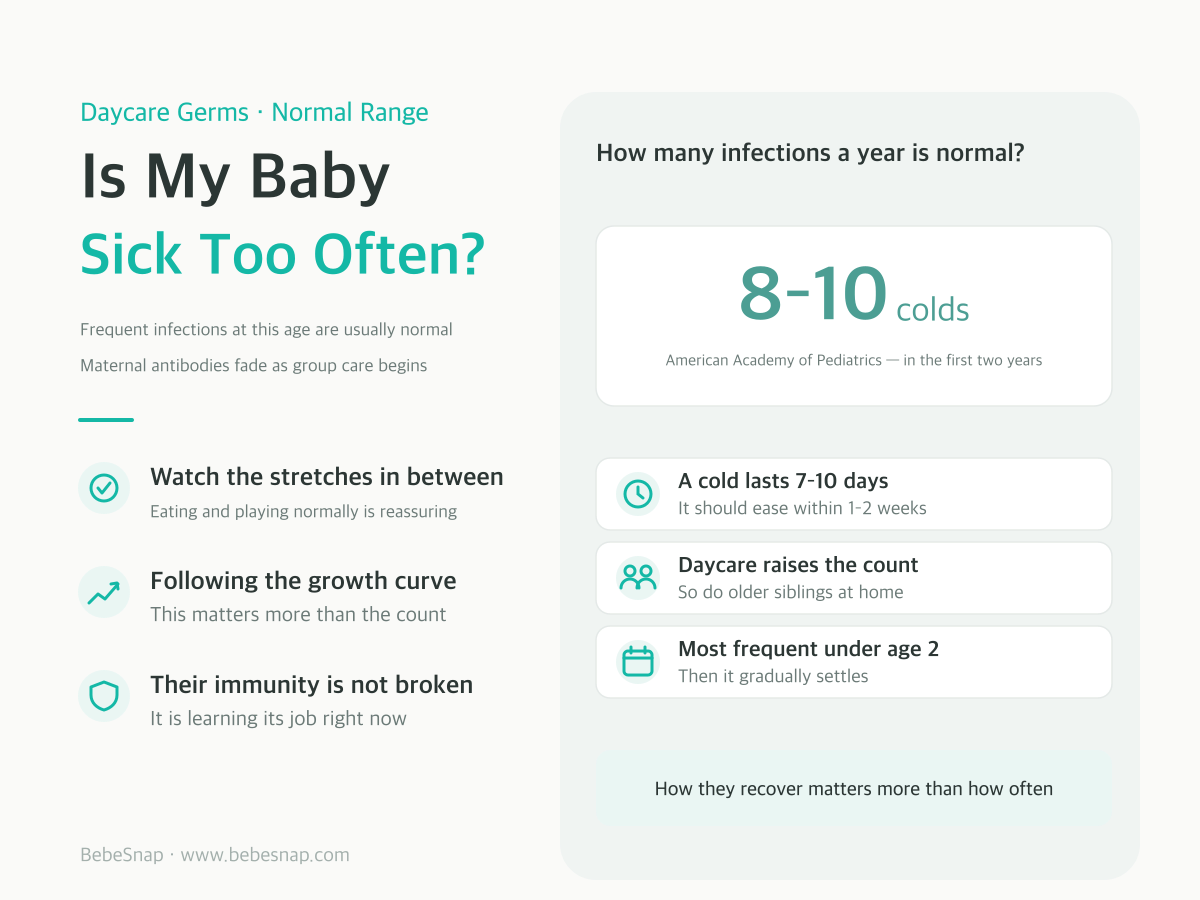
Get Started FreeHave you actually counted how many times your child has been sick this year? Since daycare started, the runny nose never quite clears, and three days after one illness ends another fever begins. So let's start with the numbers. The American Academy of Pediatrics notes that most children have around 8 to 10 colds in their first two years alone, and six to ten a year is considered a normal range for young children generally. Even when it feels like one illness a month, this usually doesn't mean your child's immune system is broken. It means it is in the middle of learning its job.
There is no single English word for this stretch, but every daycare parent knows it: the first year of group care, when your child seems to catch everything. That's what this article is about. The question isn't really "when does it stop" on a calendar, it's how to read what's happening. Below, we'll cover what counts as a normal range, which signals genuinely warrant testing, and which of the popular immune-boosting remedies actually hold up.
💡 Six to ten colds a year is a normal range for young children, and many have 8 to 10 in their first two years alone. Each one typically runs 7 to 10 days. If your child eats, plays, and sleeps normally between illnesses, the count alone is rarely the problem.Why does this all hit at once right now?
It isn't a coincidence. Two separate things happen to overlap at this exact age.
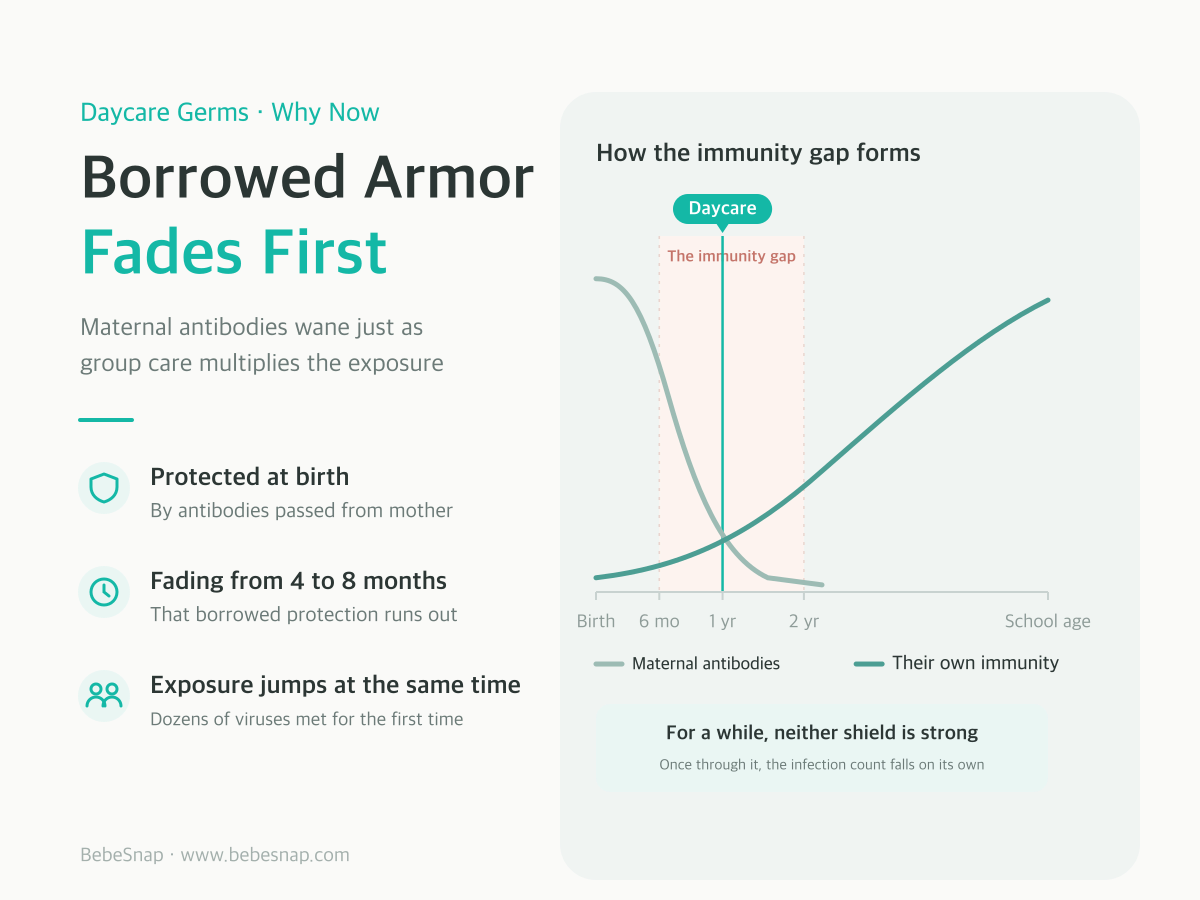
The first is an immunity gap. Babies are born carrying antibodies passed from their mother, and those antibodies fade gradually between 4 and 8 months of age. Meanwhile, your baby's own immune system has no experience yet. This matters because immunity is built by memory: the body has to meet a germ once in order to remember it. So there's a window where the borrowed shield is thinning and the homemade one is still under construction.
The second is that exposure jumps sharply at exactly this point. Around the first birthday, children start daycare, join playgroups, and share space with other kids. More than 200 different viruses can cause the common cold. From your child's point of view, a lifetime's worth of first encounters gets compressed into a handful of months, and each one has to be worked through.
One clarification worth making: many parents assume every fever at this age is roseola, or blame teething. Roseola is one specific viral illness, with 3 to 4 days of high fever followed by a pink rash as the fever breaks, and teething does not cause high fever. What you're seeing is not one condition but a run of separate infections. If you want the details on that one illness, we covered it in Roseola in babies: high fever then rash.
Is my child sicker than other children?
This is probably the question keeping you up. Different organizations count slightly differently, so there's no single magic number, but if you're inside the ranges below, the course is ordinary.
| Group | Typical number of colds | Notes |
|---|---|---|
| Young children generally | 6 to 10 per year | Commonly cited normal range |
| First two years of life | 8 to 10 over two years | AAP figure |
| Cared for at home | Lower end of those ranges | Fewer daily contacts |
| In daycare or group care | Upper end or above | The first year of care is the heaviest |
| Length of one illness | 7 to 10 days | A cough can linger a few days longer |
What actually wears parents down isn't the total, it's the clustering. Colds don't spread evenly across the twelve months. They pile into fall and winter, so during those months it can feel like every single week. And because one illness lasts 7 to 10 days, catching the next one right after recovery makes two separate colds look like one endless illness. The reason it seems like your child never gets better is usually that this is a new infection, not the old one failing to resolve.
That's why the count isn't the only thing to watch. The better question is whether your child returns to baseline in between. Once the fever breaks, do they eat, play, and sleep like themselves again? Are height and weight still tracking along the growth curve? When those two things hold, a high count is usually still a normal count.
Why did daycare make it so much worse?
Children this age are, biologically speaking, ideal at spreading infection. Everything they touch goes into the mouth, toys get shared mouth to mouth, they can't wash their own hands yet, and they don't cover a sneeze. Put ten of them in a room and one child's virus reaches several others within days. On top of that, colds are contagious starting the day before symptoms appear, which is why keeping sick kids home, while still worth doing, can't block everything.
The encouraging part is that this doesn't stay at this level. One long-term follow-up study observed that infections were most frequent in the early period after starting group care and then declined over time. The reason is straightforward: the number of viruses your child has to meet for the first time is finite, and once an illness has been worked through, immune memory remains. Add in the developmental changes ahead, learning to wash hands and putting them in the mouth less often, and the trend bends downward. The first year of care is typically the hardest, and the second is noticeably easier.
Whatever rate you're living through right now, it is not the permanent rate. That alone makes this stretch easier to sit with.
Does getting sick now really mean less illness later?
Half true. The study usually cited for this is real, but what it actually found is far more cautious than the version that gets repeated.
Researchers in Tucson followed more than a thousand children from birth into their teens, and the results were published in the New England Journal of Medicine. Children with older siblings, or who attended daycare in the first six months of life, were less likely to have asthma and frequent wheezing later in childhood. Each additional older sibling was associated with roughly a 20% lower risk (a relative risk near 0.8). The hygiene hypothesis is the attempt to explain findings like these, proposing that early exposure to a variety of microbes plays a role in how the immune system calibrates itself. It's worth being clear that this remains a hypothesis.
Here's the part that usually gets left out. Those same children wheezed more often, not less, before age 2. So this isn't a free benefit, it's closer to a trade: paid early, possibly repaid later, and not repaid identically for every child. The claim that more illness now is simply good for your child is not what this research supports.
⚠️ Please don't use this study as a reason to seek out exposure. The same children wheezed more before age 2, and more importantly, illnesses that a vaccine can prevent should be prevented rather than lived through.The five you'll meet most often at this age
Most of the diagnoses you'll hear at this stage fall into the five below. We've covered each one separately, so follow the links when you need the detail.
- Common colds: by far the most frequent. Runny nose, cough, and low-grade fever that resolve in 7 to 10 days. Symptom-by-symptom care is in Baby cold symptoms and treatment.
- Ear infections: these often follow a cold. About 80% of children have at least one by age 3, and a baby who can't talk shows it by tugging at the ear and being unusually fussy. See Baby ear infections: signs and prevention.
- Roseola: 3 to 4 days of high fever, then a pink rash as the fever falls. The fever is alarming, but it usually resolves on its own. Details in the roseola guide.
- Hand, foot, and mouth disease: blisters on the palms, soles, and inside the mouth, painful enough that eating drops off. It's the classic daycare outbreak. See Hand, foot, and mouth disease.
- Stomach bugs: vomiting and diarrhea from rotavirus or norovirus, where the whole job is preventing dehydration. Read Rotavirus and norovirus in babies.
When it might not be just a normal run
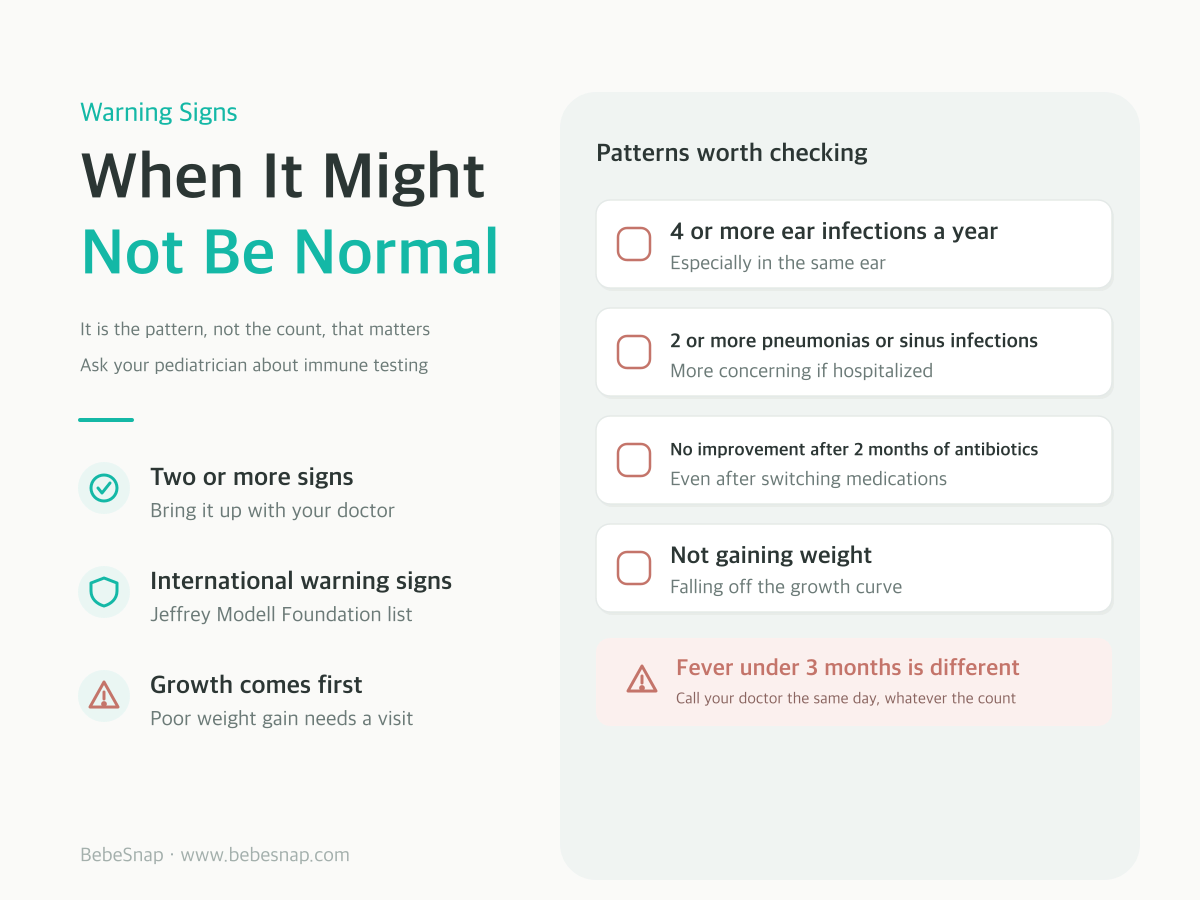
The great majority of frequently sick children are fine. In the rare cases where something else is going on, the signal shows up less in how often a child gets sick and more in how they get sick. Here are the internationally used screening criteria, set beside what an ordinary course looks like.
| What to look at | Usually normal | Worth checking |
|---|---|---|
| Number of infections | 6 to 10 colds a year, more in the first year of daycare | Four or more new ear infections in one year |
| Type of infection | Common viral illnesses like colds and stomach bugs | Two or more pneumonias or serious sinus infections in a year |
| Response to treatment | Better in 7 to 10 days, responds to medication | Two months or more on antibiotics with little effect |
| Growth | Height and weight tracking along the curve | Failure to gain weight or falling off the curve |
| In between illnesses | Back to eating and playing normally | Recurrent deep-seated infections or skin abscesses |

Don't let the right-hand column alarm you. These criteria weren't built to catch common situations, they were built as a net for very rare primary immunodeficiency. And a single item doesn't make a case. Plenty of children have four ear infections in a year with a completely normal immune system. What changes the picture is two or more of those right-hand items appearing together.
⚠️ If two or more items in the right-hand column apply to your child, bring it up with your pediatrician. The combination that matters most is frequent infections plus failure to gain weight normally.Signs that mean going in today
Everything above is a months-long pattern. What follows is a tonight decision. If you see any of these, the count is irrelevant, get medical care now.
- A fever of 100.4°F (38°C) or higher in a baby under 3 months: at this age fever itself is the emergency. Don't give a fever reducer first, go in.
- Trouble breathing: skin pulling in between the ribs or below the neck with each breath, nostrils flaring, or pale or bluish lips and nails. Call 911 right away.
- Limp and unresponsive when woken: if the fever has come down and your child still won't focus or engage, don't wait it out. If your child doesn't respond when woken, call 911.
- Signs of dehydration: no wet diaper for more than 8 hours, crying without tears, or a dry mouth.
- A seizure: a first-ever seizure, or one lasting more than 5 minutes, means calling 911 immediately.
- Fever lasting 5 days or more: even if your child seems comfortable, the cause needs to be identified.
Temperature-by-temperature guidance is in What to do when your baby has a fever, and the call on emergency care is covered in When to take your baby to the ER.
⚠️ A fever of 100.4°F (38°C) in a baby under 3 months, labored breathing, unresponsiveness when woken, and a seizure over 5 minutes leave no room for waiting. Call 911 or go straight to the emergency department.What actually helps at home, and what just costs money
"How do I boost my child's immune system" is the most searched question of this whole stage. The gap between what's supported and what isn't turns out to be pretty clear-cut.
| Well supported | Weak evidence or no help |
|---|---|
| Washing hands with soap for a full 20 seconds | Supplements marketed as immune boosters for kids |
| Staying on schedule with vaccines, flu shot included | Elderberry syrup, echinacea, and similar cold remedies |
| Enough sleep and a predictable daily rhythm | Asking for antibiotics for a cold |
| Keeping a sick child home rather than pushing through | High-dose vitamins with no deficiency present |
| Avoiding secondhand smoke | Overheated, very dry indoor air |
The right-hand column deserves a note. Dietary supplements aren't reviewed for safety or effectiveness before they reach the shelf the way medications are, so a confident label is not the same as evidence, and products for young children are a particularly crowded corner of that market. Antibiotics are a separate issue: they work on bacteria, so they do nothing for a viral cold, and using them unnecessarily makes them less likely to work when your child genuinely needs them. Vitamins follow the same logic as everything else here. They correct a deficiency, they don't buy extra protection, and fat-soluble vitamins accumulate in the body, so pushing the dose upward can do real harm.
The approaches that do have evidence behind them, breastfeeding, vitamin D, and on-time vaccination, are covered in depth in How to boost baby immunity.
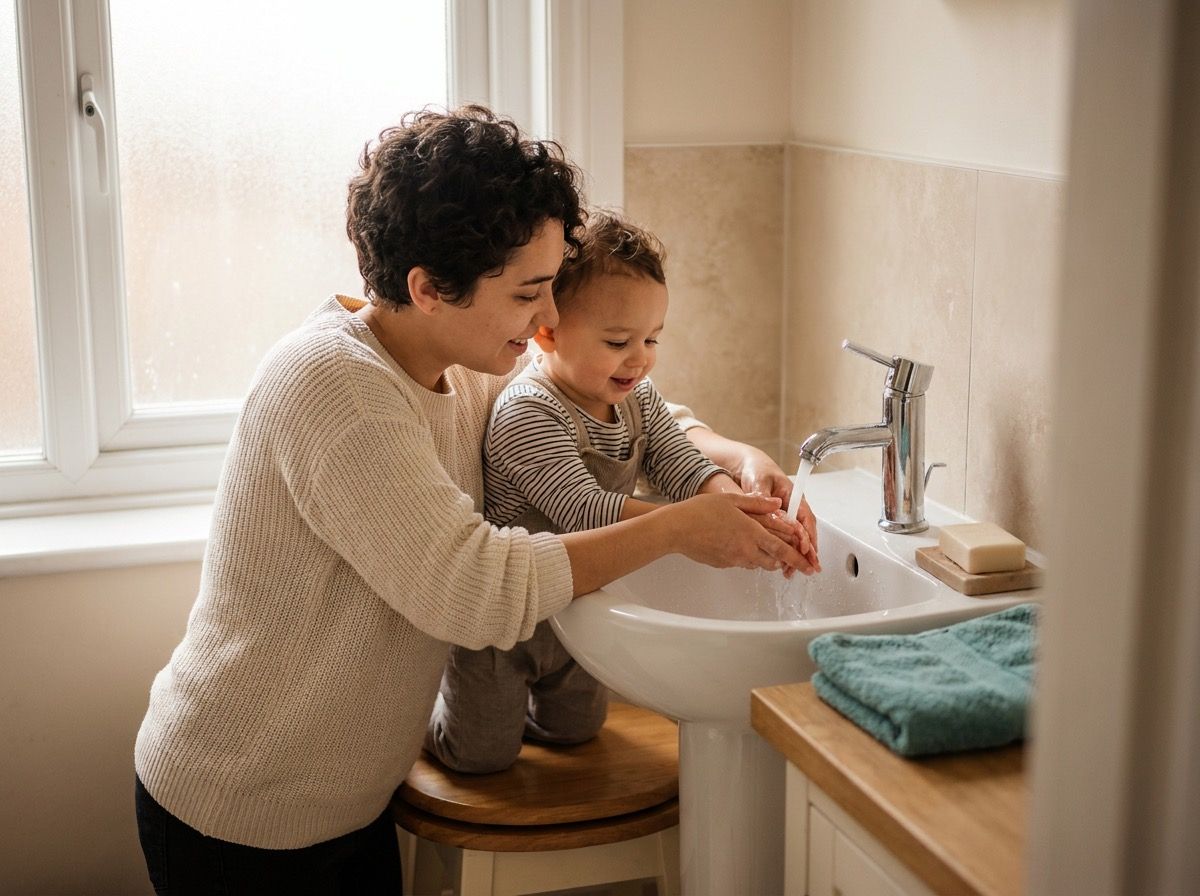
💡 The cheapest and most reliable tool of this whole stage is handwashing. Soap and water for a full 20 seconds, roughly two rounds of "Happy Birthday," and wash both your child's hands and your own after coming home, before meals, and after every diaper change.Counting infections is not something memory does well
To check any of those warning signs, you need to know how many times it happened in the past year. But once you're through it, nobody can remember whether this was the third ear infection or the fourth. That's why the conversation in the exam room so often stops at "she's just sick all the time." Logged as you go in BebeSnap, that sentence turns into a number.
- Which infection of the year this is: recording temperature and symptoms means the count keeps itself.
- How many were ear infections: noting the diagnosis alongside lets you actually test the four-per-year threshold.
- What day of this illness you're on: counted from the first day of fever, so you can see whether it's running past 7 to 10 days.
Keep height and weight in the same place and you'll also catch the combination that matters most: frequent infections alongside a stall in growth.
Frequently Asked Questions (FAQ)
Q: How long does this constant-illness phase last?
A: There's no fixed end date, but the first year of daycare is the heaviest and the rate declines from there. One long-term follow-up study found infections were most frequent early after starting group care, then decreased over time. As your child learns to wash their hands and builds immune memory to viruses already met, the second year is noticeably easier.
Q: How many illnesses a year is actually normal?
A: Six to ten colds a year is a normal range for young children, and the AAP notes that most children have around 8 to 10 colds in their first two years alone. Each illness typically lasts 7 to 10 days. More important than the count is whether your child returns to eating and playing normally in between and keeps gaining weight along the growth curve.
Q: Will keeping my child home from daycare mean fewer illnesses?
A: Staying home while sick helps your child recover and protects other children, so it's worth doing. But colds are contagious starting the day before symptoms appear, so absence alone can't block transmission. Twenty seconds of handwashing with soap and on-time vaccinations are more reliable than keeping your child out.
Q: Do immune-boosting supplements reduce how often my child gets sick?
A: The evidence doesn't support it. Supplements aren't reviewed for effectiveness before sale the way medications are, so confident marketing claims aren't proof. Giving high-dose vitamins to a child without a deficiency doesn't help either, and fat-soluble vitamins accumulate in the body, so extra doses can actually be harmful.
References
Check Your Baby's Health from One Photo
AI stool analysis reads color and texture, and keeps every health record in one place.
See what the app does firstMedical Disclaimer: This article is for informational purposes only and does not replace professional medical advice. If you have concerns about your baby's health, please consult a pediatrician.
You Might Also Like
Tomato for Babies: When to Start, Skin and Seeds, and Why Cherry Tomatoes Are Never Served Whole
Apple for Babies: Stage-by-Stage Portions and When Raw Apple Is Safe
Spinach for Babies: When to Start, Why Boiling Matters, and the One Time to Skip It
Potato for Babies: When to Start, Safe Shapes, and Why Never to Blend It
You Might Also Like
Baby Impetigo: Golden Crusts, Antibiotic Treatment, and When Nursery Is Safe Again
Golden-brown crusts spreading across your baby's skin? Impetigo is a common, highly contagious bacterial skin infection in young children. It stops being contagious 48 hours after treatment starts. Here is how to recognise it and when nursery is safe again.
Baby Anaphylaxis: Allergy Emergency Response Guide
Baby anaphylaxis progresses within minutes, a true emergency! Trouble breathing, full-body hives, and lethargy are signs. Learn 911, epinephrine, and prevention.
Alternating Tylenol and Motrin for Baby Fever: What the AAP and NICE Actually Say
The AAP doesn't recommend routine alternating, and NICE says never give both at once. Each drug keeps its own clock (4 to 6 hours for acetaminophen, 6 to 8 for ibuprofen) no matter what else you gave. Here's what a 2024 review of 5,009 children really showed.