When Do Kids Stop Napping? Signs Your Toddler Is Ready to Drop the Nap
See Your Baby's Sleep Pattern Emerge
Get Started FreeWhen your 2-year-old starts fighting every nap, it's natural to wonder whether it's time to drop it. Most children stop napping between ages 3 and 5. A 2020 meta-analysis of 44 studies on napping in children aged 0 to 12 found that fewer than 2.5% had stopped before age 2, 33% had stopped by around age 3, and 94% had stopped after age 5. Rather than going by age alone, watch how your child does on days without a nap: daytime sleepiness or late-afternoon crankiness are signs they still need more sleep.
💡 Most children stop napping between 3 and 5. Fewer than 2.5% stop before age 2, and 94% have stopped after age 5. If your child is sleepy or cranky on days without a nap, they may still need more sleep.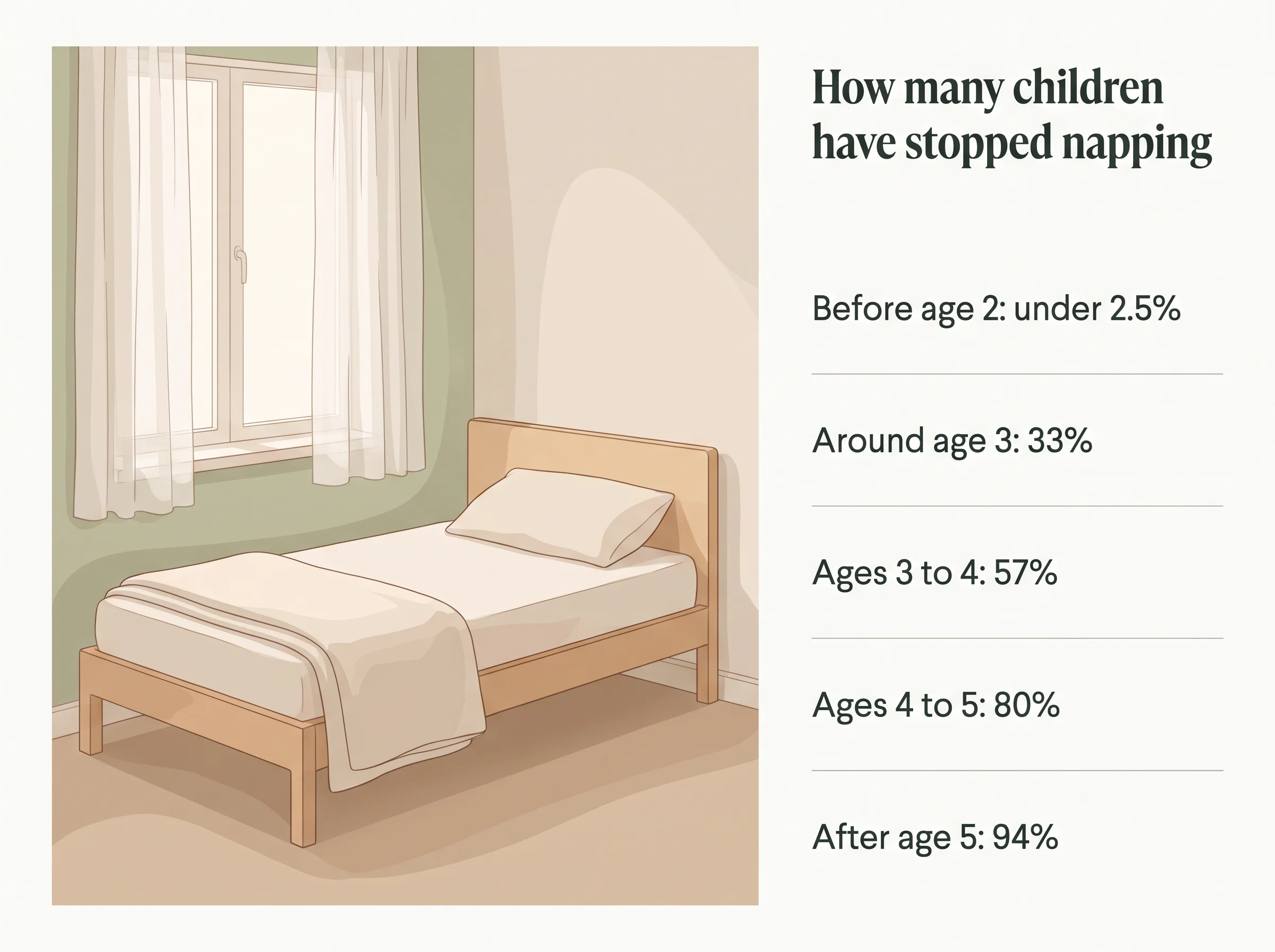
When Do Kids Stop Napping? Usually Between 3 and 5
A 2020 meta-analysis led by researchers at the University of Queensland in Australia pooled 44 studies of napping in children aged 0 to 12. Here's the share of children who had stopped napping at each age.
| Age | Stopped napping |
|---|---|
| Before age 2 | Under 2.5% |
| Around age 3 | 33% |
| 3 to 4 years (36 to 48 months) | 57% |
| 4 to 5 years (48 to 60 months) | 80% |
| After age 5 (over 60 months) | 94% |

Stopping before 2 is rare, and most of the change happens between 3 and 5. Studies also varied widely in these years: at age 3, the share who had stopped ranged from 4.8% in one study to 65% in another. The authors note that these figures describe what children actually do, which may differ from what they should do, and that parents' sleep habits, child care attendance and parents' work patterns can all shape napping.
Nemours KidsHealth, from the US children's health system Nemours, says many preschoolers get enough sleep at night and give up their afternoon nap between ages 3 and 5. KidsHealth New Zealand notes that by age 3 a child may have one nap or none at all.
Total sleep is what counts. The American Academy of Sleep Medicine (AASM) recommends 10 to 13 hours per 24 hours, naps included, for children aged 3 to 5, and the American Academy of Pediatrics (AAP) supports this. Once the nap goes, night sleep needs to cover the total. For ages 1 to 2, see how much sleep toddlers need.
My 2-Year-Old Won't Nap: Is It Time to Stop?
Dropping the nap before age 2 is rare: fewer than 2.5% of children do (2020 meta-analysis). Nemours notes that many toddlers and preschoolers still love their nap, while others don't want to miss a thing and fight going to sleep. So if your 2-year-old refuses naps for a few days, look at nap timing and routine before dropping the nap.
- Not too long, not too late: a long nap, or one late in the day, can keep your child awake until late at night (KidsHealth New Zealand). Nemours suggests regular naptimes that aren't too close to bedtime.
- A short nap routine: soft music, dim lights and a quiet story can help kids settle into their naps (Nemours).
- Don't force it: you can't make a child sleep, so don't let naptime become a battle (Nemours).
For nap timing by age, see our baby nap schedule. If wake windows seem off, see nap refusal.
Signs Your Child Still Needs a Nap
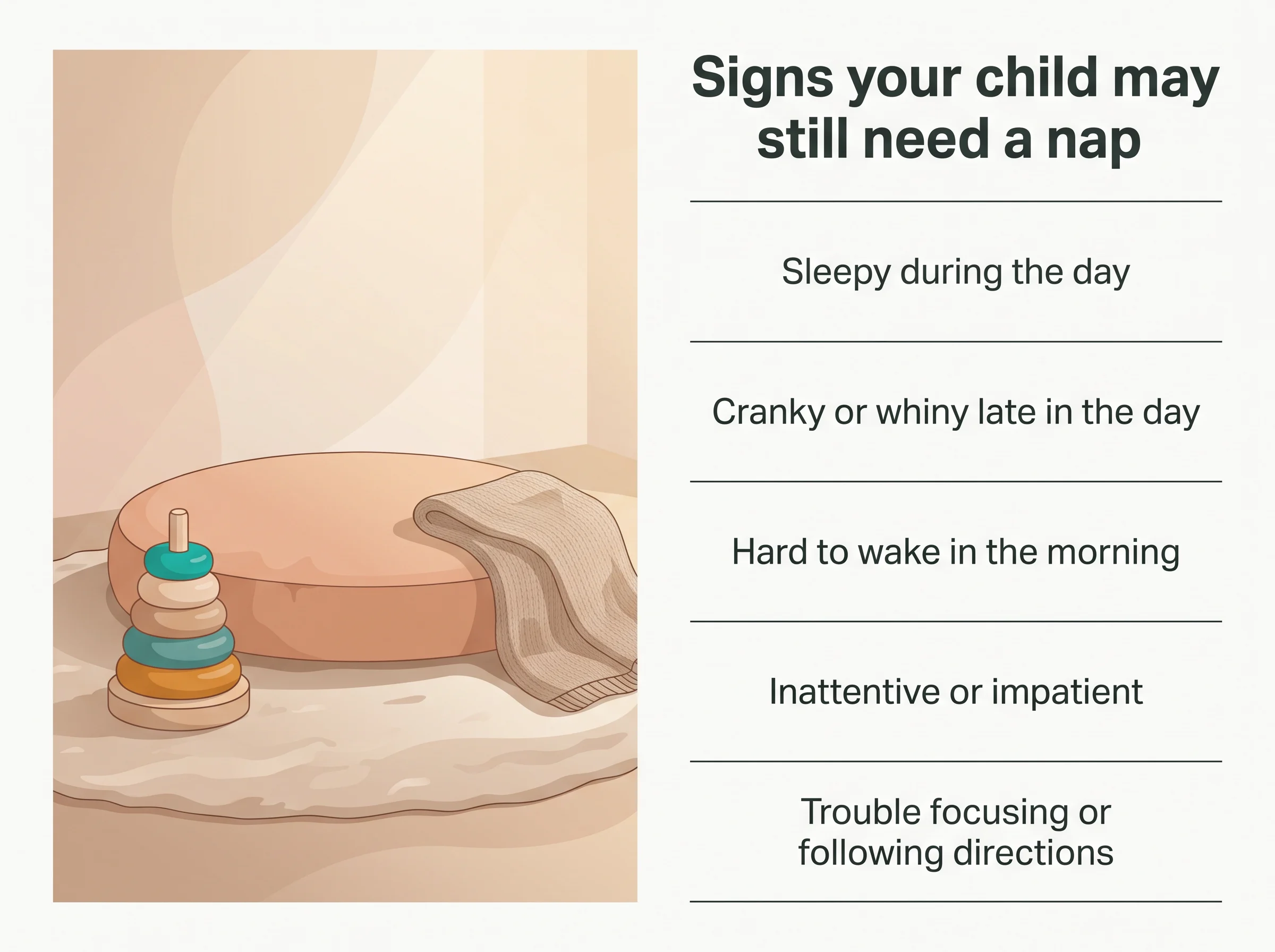
Kids may need a nap if they don't get enough sleep at night, says Nemours, which suggests checking whether your child:
- Seems sleepy during the day.
- Gets cranky, whiny or moody, especially later in the day.
- Is hard to get out of bed in the morning.
- Seems inattentive, impatient, hyperactive or aggressive.
- Has trouble focusing or following directions.
If any of these sound familiar, Nemours suggests adjusting bedtime or the nap schedule. If your child gets through nap-free days without these signs and sleeps well at night, it's fine to start phasing out the nap. For a 3- to 5-year-old, 10 to 11 hours at night already falls within the recommended 10 to 13 hours a day.
Dropping the Nap: Quiet Time and an Earlier Bedtime
- Swap the nap for quiet time: if your child won't nap, set aside quiet time to read or play quietly in their room. Quiet time often turns into sleep sooner than parents expect, and even without sleep, kids still get some rest (Nemours).
- Earlier bedtime on nap-free days: if your child gives up daytime naps, consider an earlier bedtime (Nemours). Keep the wake-up time the same and move bedtime earlier to reach 10 to 13 hours.
- Keep naps away from bedtime: if your child still naps, set a regular naptime that isn't too close to bedtime (Nemours).
- The same rhythm on weekends: the same wake-up, meal, nap and play times on weekdays and weekends help children feel secure and make bedtime smoother (AAP).
For building a bedtime routine, see our baby bedtime routine.
Naps at Daycare or Preschool
Child care attendance is one of the factors linked with how children nap (2020 meta-analysis), so a child may nap at daycare but not at home, or the other way around.
- Talk with the teacher: the AAP suggests talking to your child's teacher or child care provider about how alert your child is during the day, and asking to hear about any times your child falls asleep or has learning or behavior problems.
- Long nap at daycare, late bedtime at home: a long or late nap can push bedtime later (KidsHealth New Zealand). Ask when and how long your child naps there, and adjust bedtime at home.
- Can't sleep at daycare: since a child can't be made to sleep (Nemours), ask whether your child can rest quietly instead.
When to Talk to Your Pediatrician
- Ongoing sleep problems: trouble falling asleep, night waking, snoring, stalling and resisting bedtime, sleep apnea, and loud or heavy breathing during sleep are the most common sleep problems in children. Most are easily treated, so talk with your pediatrician (AAP).
- Too little or too much sleep: if your child regularly sleeps less or more than recommended, ask about a possible sleep disorder (AASM).
- Call 911: if your child's breathing stops for more than 20 seconds, their skin turns pale, bluish or grayish, or there's a change in muscle tone, a fever or other signs of illness, call 911 or your local emergency number (AAP).
For snoring and breathing pauses, see baby snoring and sleep apnea.
Track the Nap Transition with BebeSnap
While you're phasing out the nap, compare nap days with nap-free days: what time your child falls asleep and how much they sleep in total. Log when your child falls asleep and wakes up in the BebeSnap app to see the day's sleep at a glance, and show the log to your pediatrician if they ask for a sleep diary.
- Today's total sleep: naps and night sleep added together
- Nap count: how many naps your child took today
- Average bedtime: when your child usually falls asleep
- Family sharing: everyone who cares for your child sees the same log
👉 See how BebeSnap sleep tracking works
Frequently Asked Questions (FAQ)
Q: When do kids stop napping?
A: Most stop between ages 3 and 5. A 2020 meta-analysis of 44 studies found that fewer than 2.5% had stopped before age 2, 33% by around age 3, 80% at ages 4 to 5, and 94% after age 5. The range is wide, so watch how your child does on nap-free days rather than going by age alone.
Q: My 2-year-old refuses naps. Should I drop the nap?
A: Not necessarily. Fewer than 2.5% of children stop napping before age 2, and many toddlers fight naps because they don't want to miss anything. Keep naps regular and not too close to bedtime, offer quiet time instead of forcing sleep, and watch for daytime sleepiness or late-afternoon crankiness.
Q: What time should a preschooler go to bed on days without a nap?
A: Earlier than usual. Nemours suggests an earlier bedtime once a child gives up naps. Children aged 3 to 5 need 10 to 13 hours of sleep per 24 hours, naps included (AASM), so night sleep has to cover the total. Keep the wake-up time steady and move bedtime earlier.
Q: My child naps at daycare but not at home. Is that OK?
A: Napping can differ between settings; child care attendance is one of the factors linked with napping patterns (2020 meta-analysis). If a long daycare nap pushes bedtime late, ask the teacher about nap length and timing. The AAP also suggests checking with teachers about how alert your child is during the day.
References
- Staton et al., Sleep Medicine Reviews (2020) - Many naps, one nap, none: napping patterns in children 0 to 12 years
- Nemours KidsHealth - Naps
- American Academy of Sleep Medicine - Recommended Amount of Sleep for Pediatric Populations (2016)
- AAP HealthyChildren - Healthy Sleep Habits: How Many Hours Does Your Child Need?
- AAP HealthyChildren - Sleep Apnea in Children: Detection & Treatment
- KidsHealth New Zealand - Normal Sleep: Toddlers 1 to 3 Years
See Your Baby's Sleep Pattern Emerge
Track sleep and watch wake windows and night stretches appear as clear graphs.
See what the app does firstMedical Disclaimer: This article is for informational purposes only and does not replace professional medical advice. If you have concerns about your baby's health, please consult a pediatrician.
You Might Also Like
Kaup Index (Baby BMI): How to Calculate It and What's Normal by Age
Wonder Weeks Calculator: Your Baby's 10 Mental Leaps From the Due Date
Baby Weight Gain Calculator: Grams Per Day From Two Weigh-Ins
Baby Impetigo: Golden Crusts, Antibiotic Treatment, and When Nursery Is Safe Again
You Might Also Like
Nursing to Sleep: Is It OK? Safe Lying-Down Feeds and How to Gently Stop
Nursing to sleep is common and not a bad habit. If you doze off feeding in bed, move your baby back to their own sleep space as soon as you wake, and once teeth arrive, brush after the last feed. To change it, feed first in the routine and put your baby down drowsy; it can take 3 days to 3 weeks.
Whooping Cough in Babies: Why Newborns Are Most at Risk and When to Get Tdap
Has the cough gone past two weeks? About one in three infants who catch whooping cough ends up hospitalized, and young babies may show apnea instead of coughing. Here's how to cover the gap before the first shot at 2 months.
How Much Sleep Does a 1- to 2-Year-Old Need? Toddler Sleep Hours, Naps and Bedtime
Children aged 1 to 2 need 11 to 14 hours of sleep per 24 hours, naps included (AASM, endorsed by the AAP). Most sleep 10 to 12 hours at night and 1 to 2 hours by day, and move from two naps to one between 12 and 18 months.