Whooping Cough in Babies: Why Newborns Are Most at Risk and When to Get Tdap

Check Your Baby's Health from One Photo
Get Started FreeThe cough has passed the two-week mark, it comes in bursts that leave your baby red-faced and gasping, and then: between fits; your baby looks completely fine. If that's what you're watching, here's the single most important thing to know about whooping cough: it is most dangerous before the first vaccine dose at 2 months, during the weeks when a baby has no protection of their own at all. And in that window, a baby may not make the famous whooping sound at all. Instead of coughing, some young infants stop breathing for a few seconds: apnea. This guide walks through how to tell whooping cough from a cold, croup, or bronchiolitis, why it's called the 100-day cough, when the vaccines are given, and how a shot during pregnancy plus boosters for the adults nearby can cover those first vulnerable weeks.

Why the youngest babies are at the greatest risk
The same infection plays out very differently depending on age. The American Academy of Pediatrics identifies infants under 1 year as the highest-risk group and reports that about one-third of infants who catch whooping cough are hospitalized. Pneumonia and seizures are the complications that show up at this age. The UK's NHS similarly notes that babies under 6 months can develop dehydration, breathing difficulties, pneumonia, and seizures. In the United States, at least five infants died of whooping cough in 2025.
Two things compound each other here. The first is airway size: swelling and mucus that an adult would simply cough through can substantially block an infant's much narrower airway. The second is that there is a genuine gap in protection. The first pertussis-containing vaccine dose is given at 2 months, which means that from birth until then a baby has neither immunity they built themselves nor immunity a vaccine provided. This matters because it reframes the whole problem: protecting a newborn from whooping cough is less about the baby and more about everyone who comes near the baby.
If you remember only one paragraph from this article, make it this one. Newborns and young infants often do not make the classic whoop. That sound comes from air being pulled hard through a narrowed airway at the end of a coughing fit, and it requires enough strength to take that gasping breath. A small baby may not have it. What appears instead is apnea: pauses in breathing: or cyanosis, a blue tinge to the lips and face. This is why the reassuring thought "she's barely coughing, so it must be mild" is exactly backwards in whooping cough.
⚠️ If a baby under 3 months stops breathing, turns blue around the lips, face, or fingertips, or goes limp, this is not something to watch at home. Call 911 and go to the emergency room immediately. That holds true even with no coughing and no fever.Is it whooping cough, a cold, croup, or bronchiolitis?
Sorting out a coughing baby is genuinely hard. But whooping cough differs from the other common cough illnesses in a few specific places, and the table below shows where those differences sit.
| Feature | Whooping cough | Common cold | Croup | Bronchiolitis |
|---|---|---|---|---|
| Fever | Low-grade or none | Mild to moderate | Low-grade, common | Can reach 38~39°C |
| Sound of the cough | Rapid-fire fits with no room to breathe, then a gasping intake | Light, occasional cough | Barking, seal-like cough | Cough with audible wheezing |
| Between coughing fits | Looks normal, plays as usual | Generally acts like themselves | Noisy breathing on inhale persists | Fast, labored breathing even when not coughing |
| How long the cough lasts | Weeks to months | Usually 1~2 weeks | Mostly 3~5 days | 1~2 weeks (cough may linger) |
| Typical age | Any age; most severe under 1 year | Any age | 6 months to 3 years | Under 2 years, especially under 6 months |
Three rows in that table do most of the work. One is that fever is minimal or absent. Parents naturally relax when there's no fever, but whooping cough is recognized by the shape of the cough, not by temperature. Another is that babies look fine between fits. A child who seemed to be suffocating five minutes ago will be laughing and playing by the time you reach the clinic, which is why so many parents describe the cough to a doctor who never hears it. And the whoop may be absent in young babies, so its absence cannot rule the diagnosis out.
Now add time to the picture. Colds, croup, and bronchiolitis usually declare themselves within 1~2 weeks, whereas whooping cough tends to get worse after the two-week mark rather than better. If the cough has passed two weeks and is markedly worse at night, that's the moment to go back to your pediatrician and specifically ask whether whooping cough should be considered. If your baby is under 6 months and has coughing fits that sound like whooping cough, don't wait for the two-week mark; get seen the same day. For distinguishing coughs by sound, see what your baby's cough sounds like, and for each illness individually, see baby cold symptoms, croup, and RSV and bronchiolitis.
Why they call it the 100-day cough
Whooping cough moves through three defined stages. Knowing which stage you're in tells you both how much longer this is likely to last and what action makes sense right now.
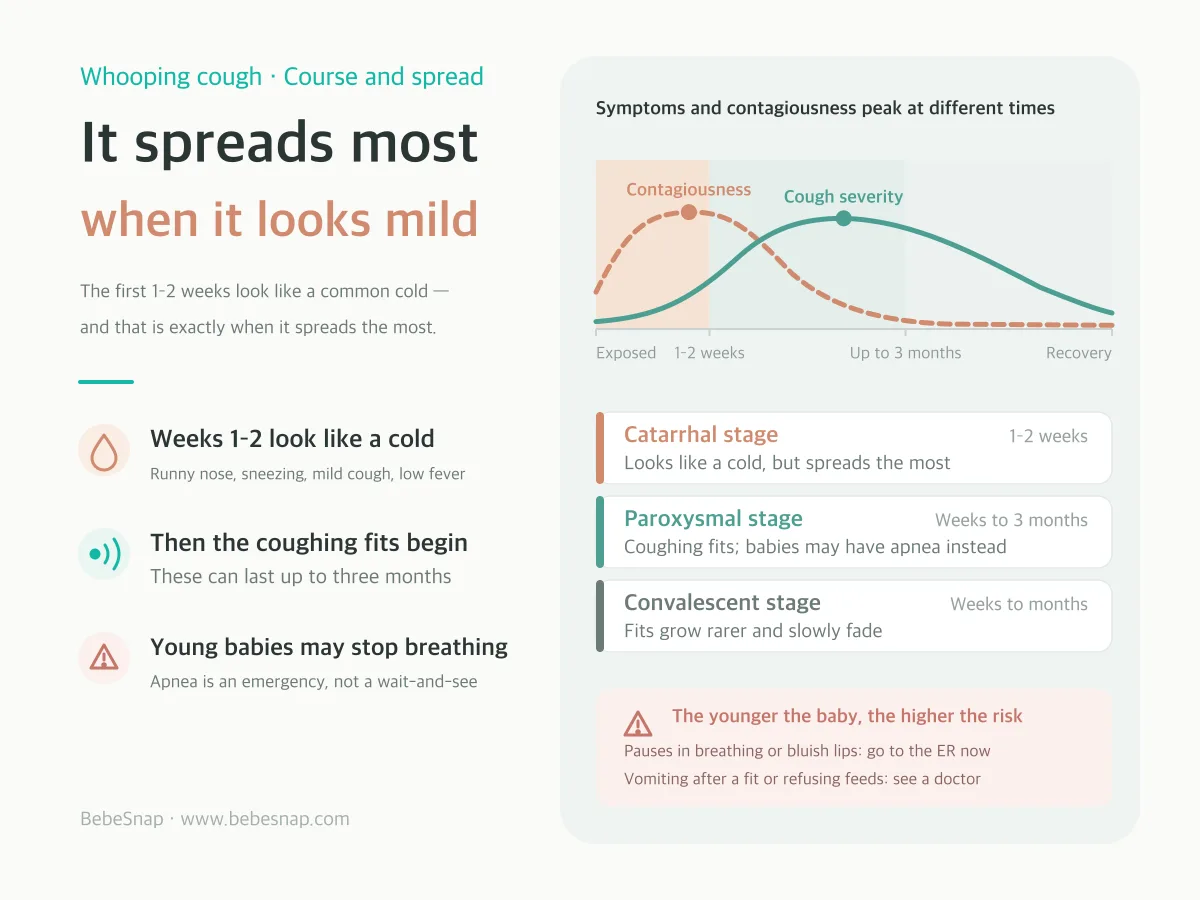
Stage 1, catarrhal, 1~2 weeks
- Starts with a runny nose, sneezing, a mild cough, and a low-grade fever
- Looks essentially identical to an ordinary cold
- And yet this is when the infection spreads most easily
Stage 2, paroxysmal, up to 3 months
- The cough turns into violent fits that are worse at night
- Fits may end with a gasping whoop, or with apnea in young infants
- Vomiting after a fit is common, and the baby looks fine in between
Stage 3, convalescent, weeks to months
- Fits gradually become less frequent and less severe
- Even after recovery, a later cold can briefly bring the cough back
Put the three stages together and the name makes sense. The trap hidden in this sequence is one of timing: parents typically decide to seek care during stage 2, but the period of highest contagiousness is stage 1, which almost everyone mistakes for a cold. That lag is precisely how whooping cough spreads quietly through a household.
💡 Contagiousness is highest for the first 2 to 3 weeks after the cough begins, and peaks during the early 1 to 2 weeks when it still looks like an ordinary cold. In other words, it spreads best when it looks least alarming: so if there's an infant in the house, don't wave off an adult's "just a nagging cough."When does the vaccine start protecting your baby?
Whooping cough is prevented with a pertussis-containing vaccine given on a fixed schedule through early childhood. The American Academy of Pediatrics recommends the series below, with an adolescent booster on top of it.
| Dose | Timing | What it does |
|---|---|---|
| 1st | 2 months | The first protection against pertussis begins |
| 2nd | 4 months | Builds on the first dose |
| 3rd | 6 months | Completes the primary series |
| 4th | 12 to 18 months | Boosts immunity as it starts to wane |
| 5th | 4 to 5 years | Final preschool booster |
| Booster | 11 to 12 years | Restores protection that fades in adolescence |

Reading that table raises the obvious question: what about birth through 2 months? The answer to that question is essentially the whole strategy. A baby who hasn't had the first dose cannot be protected by their own vaccine, so during those weeks the vaccine has to be in the people around the baby instead. That's what the next two sections are about. For the full early-childhood immunization timeline, see our baby vaccination schedule.
How a shot during pregnancy protects a newborn
When you're vaccinated against pertussis during pregnancy, the antibodies your body produces cross the placenta to your baby. Your baby is born already carrying them and lives on that borrowed protection until they can be vaccinated themselves. This is the most direct way we currently have to cover those first vulnerable weeks.
The recommended timing differs slightly by country. The UK's NHS recommends vaccination at around 20 weeks of pregnancy, while the American Academy of Pediatrics recommends the third trimester. The shared reasoning is that antibodies need time to build and transfer before delivery. Ask your own obstetric provider what timing applies to you, because the answer can shift depending on your pregnancy and your other vaccinations; this is a decision that belongs in the exam room.
💡 Vaccination is needed in every pregnancy, not just the first. The antibodies you made carrying your first child don't carry over to the next baby, and your own levels fall over time. So the same conversation has to happen again with a second and third pregnancy.
The adults around your baby need a booster too
When an infant gets whooping cough, parents often wonder where on earth it came from. The answer is usually very close to home. Pertussis commonly reaches a baby from an older sibling or an adult whose vaccination has faded. In adults, whooping cough often shows up as nothing more than a stubborn lingering cough, so the person carrying it assumes it's a cold and keeps holding the baby.
That's the reasoning behind cocooning: surround the infant with immunized people so the infection never has a route in. The American Academy of Pediatrics recommends that every adult in contact with an infant under 1 year receive a pertussis booster, along with the adolescent booster at 11 to 12 years. That means parents, grandparents, any postpartum helper, frequently visiting relatives, and older siblings in daycare.
Practically, the sequence that works best is this: before the birth, check the vaccination status of everyone living in the home and any grandparents who will visit often, and have adults who can't remember their last dose talk to their doctor. Scrambling to arrange this after the baby arrives doesn't leave time for antibodies to develop. And anyone who is coughing (even a mild cough) should keep their distance from the baby.
Antibiotics stop the spread, not the cough
A confirmed case of whooping cough is treated with antibiotics, and this is where most parents are disappointed. Antibiotics don't do much for a cough that has already started. The coughing comes from damage the bacteria left behind, so clearing the bacteria doesn't switch the cough off. The purpose of treatment is not symptom relief but stopping further transmission, a point the NHS states plainly.
That doesn't make antibiotics pointless; they're decisive in two ways. One is that they work best when started early, before the coughing fits are fully underway. That's a concrete reason to be seen sooner rather than later when a cough drags on. The other is that they reliably cut off spread: 5 days after starting an appropriate antibiotic, a person is no longer contagious. If there's a younger sibling at home, those five days are what protect that child. The NHS notes that antibiotics are given when the diagnosis is made within 3 weeks of the cough starting, because past that point the contagious period has largely ended anyway.
Think of isolation in terms of those 5 days. That said, check with your daycare or school and your pediatrician about when your child may return, because policies vary and the answer depends on how your child is doing. Also tell your medical team exactly who lives in the house: once a case is confirmed, preventive measures may be needed for other household members, especially infants and anyone pregnant.
What helps at home, and what never does
There's no way to shut the cough off, so home care is mostly about helping your baby get through the fits and eat and sleep in between. Each piece of it has a line where home care ends and medical care begins.
Skip over-the-counter cough medicine
- Ordinary cough remedies don't work on the paroxysmal cough of pertussis
- In young babies especially, the risks outweigh any benefit
- 👉 If your baby looks distressed enough that you're reaching for medicine, that's the signal to call the doctor instead
Feed smaller amounts more often
- A full stomach plus a coughing fit usually ends in vomiting
- Smaller, more frequent feeds protect the daily total better than large ones
- 👉 If your baby keeps vomiting despite repeated attempts, or wet diapers drop off (fewer than 6 a day for a baby under 1), get seen right away
Position your baby after a fit
- Sit your baby up or turn them on their side so vomit doesn't go into the airway
- Rub their back gently and stay with them until the fit passes
- 👉 If breathing doesn't return during or right after a fit, or lips turn blue, call 911 immediately
Manage the air and irritants
- Remove cough triggers: tobacco smoke, strong fragrances, dust
- Keep the room from getting too dry, and sleep nearby for the night coughing
- 👉 If breathing is fast or you see the ribs pulling in even between coughs, go to the emergency room without waiting
Tracking the cough with BebeSnap
In the exam room, two pieces of information are worth more than anything else you can bring: the date the cough started, and how many fits your baby is having per day. Because antibiotics work best early and the diagnosis window shapes treatment, answering "when did this begin?" precisely can genuinely speed up the decision. The problem is that after several nights of interrupted sleep, that date blurs faster than you'd expect.
Logging it in BebeSnap keeps the picture intact: the day the cough started, the number of fits per day, whether vomiting followed, and whether there were any pauses in breathing. Kept alongside feeding amounts and wet diapers, it also shows you whether things are drifting toward dehydration. And when two parents are trading off night shifts, not having to ask each other "how many times was it last night?" is help in itself.
Frequently Asked Questions (FAQ)
Q: How long does the whooping cough last?
A: It runs in three stages. The catarrhal stage, with a runny nose and mild cough, lasts 1 to 2 weeks. The paroxysmal stage of severe coughing fits can last up to 3 months. Recovery then takes weeks to months more. Together that's why it's called the 100-day cough, and a later cold can briefly bring the cough back.
Q: My baby isn't making the whooping sound. Could it still be whooping cough?
A: Yes. The whoop comes from pulling air hard through a narrowed airway after a fit, and young infants often lack the strength to do that. Instead, they may show apnea: pauses in breathing of several seconds: or cyanosis, a blue tinge to the lips. At any age, either sign means calling 911 right away rather than driving in.
Q: Will antibiotics make the cough better?
A: Not much, once the coughing has started. The main purpose of antibiotics in whooping cough is preventing transmission to others rather than relieving symptoms. They are most effective when started early, before the coughing fits are fully underway, and 5 days after starting an appropriate antibiotic a person is no longer contagious. That's why being seen early matters.
Q: Should I get the whooping cough vaccine during pregnancy?
A: Vaccination in pregnancy passes antibodies across the placenta to your baby, covering the gap until the first dose at 2 months. The UK recommends around 20 weeks of pregnancy and the United States recommends the third trimester. Ask your own obstetric provider about the timing that fits your situation, and note that it's needed in every pregnancy.
References
Check Your Baby's Health from One Photo
AI stool analysis reads color and texture, and keeps every health record in one place.
See what the app does firstMedical Disclaimer: This article is for informational purposes only and does not replace professional medical advice. If you have concerns about your baby's health, please consult a pediatrician.
You Might Also Like
Tomato for Babies: When to Start, Skin and Seeds, and Why Cherry Tomatoes Are Never Served Whole
Apple for Babies: Stage-by-Stage Portions and When Raw Apple Is Safe
Spinach for Babies: When to Start, Why Boiling Matters, and the One Time to Skip It
Potato for Babies: When to Start, Safe Shapes, and Why Never to Blend It
You Might Also Like
Baby Impetigo: Golden Crusts, Antibiotic Treatment, and When Nursery Is Safe Again
Golden-brown crusts spreading across your baby's skin? Impetigo is a common, highly contagious bacterial skin infection in young children. It stops being contagious 48 hours after treatment starts. Here is how to recognise it and when nursery is safe again.

Wonder Weeks Complete Guide: 10 Mental Leap Stages Explained
Is your baby suddenly fussy and not sleeping? It might be a Wonder Week. Learn about the 10 mental leaps and how to handle them.

Alternating Tylenol and Motrin for Baby Fever: What the AAP and NICE Actually Say
The AAP doesn't recommend routine alternating, and NICE says never give both at once. Each drug keeps its own clock (4 to 6 hours for acetaminophen, 6 to 8 for ibuprofen) no matter what else you gave. Here's what a 2024 review of 5,009 children really showed.