Alternating Tylenol and Motrin for Baby Fever: What the AAP and NICE Actually Say
Check Your Baby's Health from One Photo
Get Started FreeIt's 1 a.m., you gave a dose of fever medicine two hours ago, and the number on the thermometer hasn't budged. If you searched "how many hours apart to alternate Tylenol and Motrin" and landed here, here are the three answers you need first. One, no guideline anywhere endorses giving both medicines at the same time. Two, alternating does not shorten each drug's own interval: acetaminophen stays at 4 to 6 hours and ibuprofen at 6 to 8 hours regardless of what else you gave. Three, the "2 to 3 hours apart" figure you keep seeing online is clinical custom passed between practices, not a number any official guideline actually specifies. That third point matters most, because when there's no official standard, the burden of getting it right lands on you.
💡 This article covers intervals and principles, not doses. For how many milliliters to give, follow the product label and your pharmacist or doctor exactly. Parents trying to calculate milligrams themselves is one of the most common starting points for an accidental overdose.What's actually different about Tylenol and Motrin?
The two drugs share a goal but belong to completely different families. Acetaminophen is the ingredient in Tylenol, and it works on the temperature control center in the brain. Ibuprofen is the ingredient in Motrin and Advil, a nonsteroidal anti-inflammatory drug that brings down fever while also reducing inflammation and pain.
That difference is exactly where the idea of alternating came from. Because the two are processed by different pathways in the body, the reasoning goes, you can reach for one while the other's clock is still running. The reasoning holds up: but a plan making sense on paper isn't the same as it being safe at 3 a.m. Before we get to that, look at how differently the two clocks run.
| Category | Acetaminophen | Ibuprofen |
|---|---|---|
| Common brands | Tylenol, Infants' Tylenol | Motrin, Advil |
| Minimum age | From 2 months | From 6 months |
| Interval between doses | 4-6 hours | 6-8 hours |
| Max doses in 24 hours | 5 | 4 |
| How long it lasts | 4-6 hours | 6-8 hours |
| When to avoid it | Liver problems | Dehydration, kidney problems, bleeding risk |
The table says acetaminophen can be used from 2 months, but any fever in a baby under 3 months means calling the doctor before you reach for medicine at all, and the AAP advises giving acetaminophen to children under 2 only with a doctor's guidance on the dose. More on why below.
There's one trap that catches parents constantly. Motrin and Advil are the same ingredient. Giving Motrin and then reaching for Advil two hours later isn't alternating; it's a second dose of ibuprofen, and the 6-hour clock never reset. The same goes for combination products with different brand names. This matters because parents reasonably track brand names, and brand names are the one thing that doesn't tell you what's in the bottle. Reading the active ingredient on the back of the box, every time, is more reliable than remembering which package is which.
Why does every guideline say something different?
If you've found contradictory answers online, it isn't because parents are confusing each other. Major bodies genuinely take different positions.
| Guideline | Position on alternating |
|---|---|
| AAP (2011 clinical report) | Does not recommend routine alternating, citing the risk of dosing and timing errors |
| NICE NG143 (UK) | Never give both at once. Consider alternating only if distress persists or returns before the next dose is due |
| Cochrane review | Alternating may lower temperature somewhat better, but evidence on comfort and safety remains limited |

The American Academy of Pediatrics drew a line in its 2011 clinical report about what fever medicine is even for: the goal is your child's comfort, not a normal number on the thermometer, and alternating the two drugs is not something to do as a matter of routine. Notice that the AAP's main objection isn't effectiveness. It's error. The moment you're using two medicines, you're tracking two clocks, and that arithmetic is exactly what falls apart when you're exhausted in the middle of the night.
NICE guideline NG143 in the UK is more specific. It says not to use antipyretics with the sole aim of reducing body temperature (1.6.5), and it says not to give both drugs simultaneously, consider alternating them only if your child's distress persists or recurs before the next dose is due (1.6.6). In other words, alternating is an exception you fall back on, not the default plan.
So what about the evidence that alternating works better? A 2024 meta-analysis published in the AAP's journal pooled 31 studies covering 5,009 children. It found that dual or alternating therapy lowered temperature more than a single drug at the 4 to 6 hour mark, with no difference in adverse events, and a number needed to treat of 3 to 4. On those numbers alone, alternating looks like the winner.
Then an editorial in the same issue asked the obvious follow-up: is a slightly better temperature reduction clinically meaningful enough to justify asking parents to juggle two medications? This matters because nearly all of these trials were short-term, running hours to a few days under study conditions. They can tell you which approach moves a thermometer faster. They can't tell you whether a tired parent, four nights into an illness, keeps both schedules straight at home. Winning on the thermometer and getting your child through safely are two different outcomes.
That's why this article lands where the AAP's practical caution lands. Managing fever with one medication is the default, and alternating is a conditional approach for when your doctor has specifically instructed it. It's the same answer we gave in our baby fever guide and in how to give medicine to babies.
If you do alternate, these four rules are non-negotiable
For parents whose doctor has walked them through alternating, or who are already doing it, here are the lines that don't move.
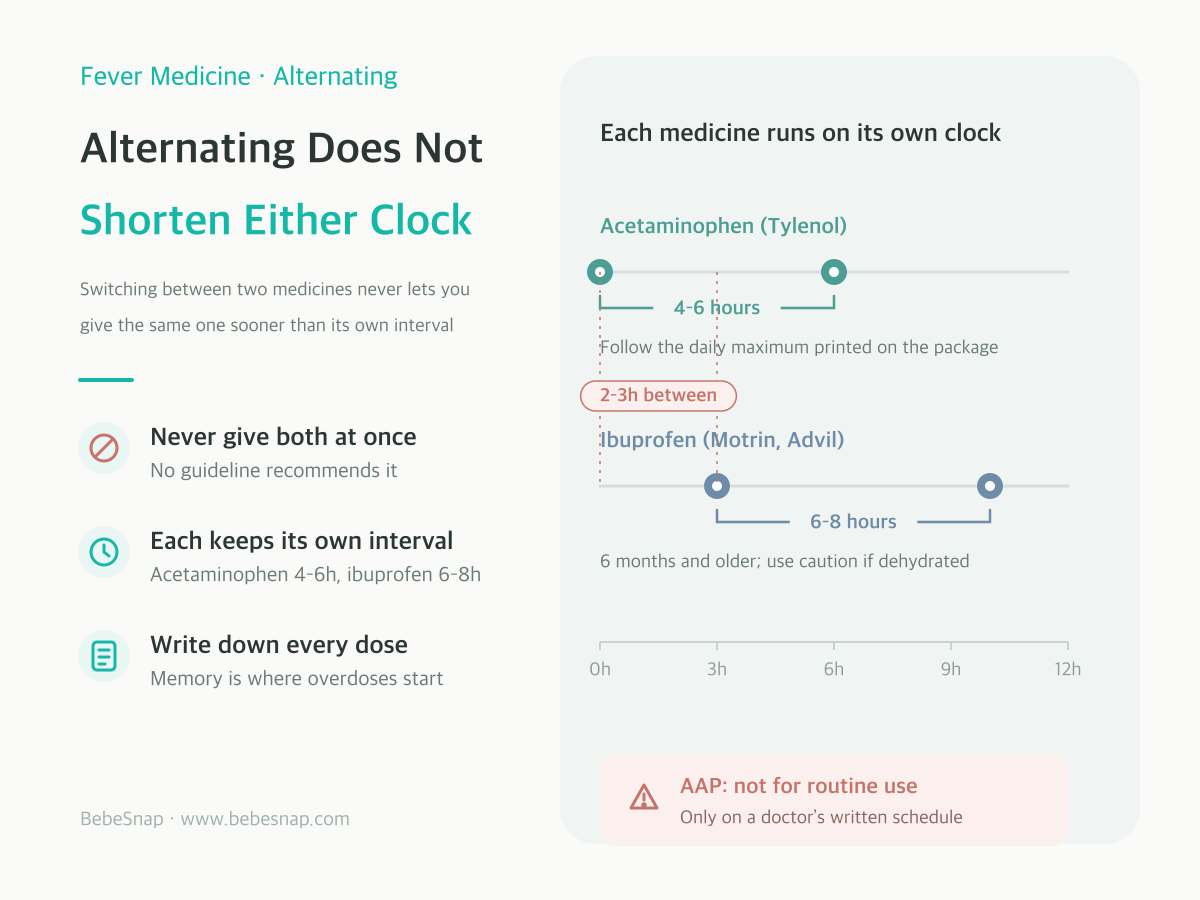
1. Never give both at the same time When a fever won't break, it's tempting to give both and get it over with. No guideline supports this. Giving them together collapses both dosing clocks onto the same moment, and from then on you have no clean way to work out what's due when.
2. Each drug keeps its own clock This is the part parents most often get wrong. Slipping ibuprofen in between doses does not let you give acetaminophen sooner than 4 hours. Each medicine keeps its own full interval no matter what happened in between, which means you're genuinely tracking two separate schedules.
3. The 2-to-3-hour gap is custom, not a standard Many pediatricians and pharmacists suggest at least 2 to 3 hours between the two drugs, but no official guideline specifies that figure. Treat it as a practical floor rather than a rule, and defer to the interval the doctor who examined your child gave you.
4. If you don't write it down, you will lose track At 3 a.m. you genuinely will not remember whether the last dose was the red bottle or the blue one. Logging the time, the drug name, and the amount removes an entire category of accident on its own.
Here's how the timing actually plays out.
- 9:00 p.m., You give acetaminophen.
- 11:30 p.m., Your child is still uncomfortable, so you give ibuprofen. That's 2 hours 30 minutes after the acetaminophen.
- From 1:00 a.m., Acetaminophen becomes available again, 4 hours after that first dose.
- From 5:30 a.m., Ibuprofen becomes available again. The 6-hour rule applies unchanged.
Where the real accidents happen
Most parents worry about the fever not coming down. But the genuinely dangerous moments in this situation happen somewhere else entirely.
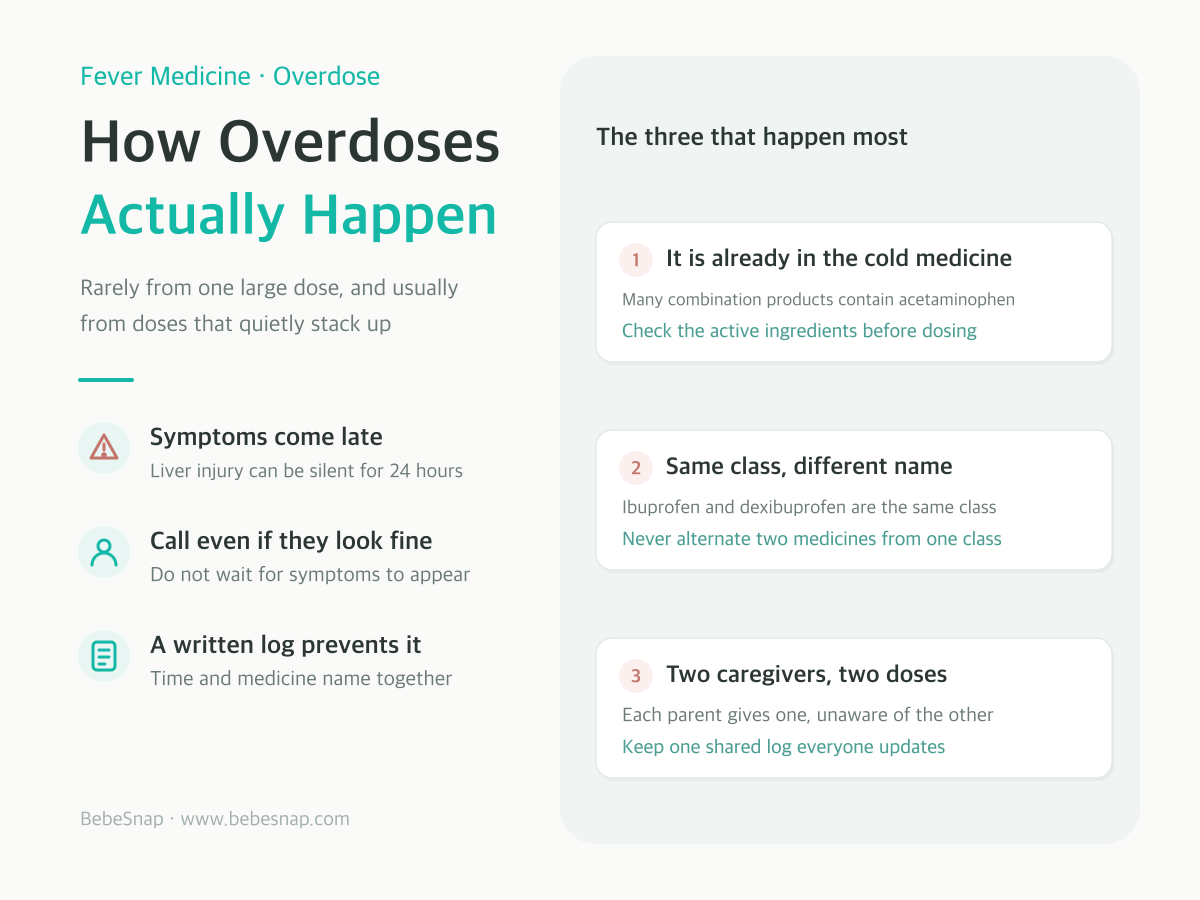
1. An acetaminophen overdose is quiet for the first 24 hours Too much acetaminophen strains the liver. What makes it dangerous is the timeline: for the first 24 hours a child may show nothing at all, or only mild nausea, while liver injury develops and surfaces later. This is why "I think I gave too much, but she seems totally fine" is never reassurance: looking fine is exactly what the early phase looks like.
2. Ibuprofen is risky when your child is dehydrated Ibuprofen affects blood flow to the kidneys. That's usually fine, but not when a child has been vomiting and having diarrhea and is running low on fluids. In studies of children with gastroenteritis, ibuprofen use showed up as an independent risk factor for acute kidney injury. If your child isn't drinking well and wet diapers have dropped off, this is the drug to skip.
3. The most common route is cold medicine In real life, the overdose that actually happens usually isn't from double-dosing the fever reducer. It's from not knowing the cold medicine already contains acetaminophen. Multi-symptom cold and flu products very often include it, and once you add Tylenol on top because the fever came back, what looks like two different medicines to you is the same ingredient twice in your child's body.
⚠️ If your child is taking any cold or multi-symptom medicine, read the active ingredients on the back of the box before adding a fever reducer. If acetaminophen is already in there, that product is a fever reducer, and adding Tylenol means giving the same ingredient twice. The AAP also advises against multi-ingredient cough and cold medicines for children under 6, so check with your pediatrician before using one.The goal is your child's comfort, not the number
Think about the moment that makes you consider alternating in the first place. It's usually something like "I gave medicine and the fever only went from 102.2°F to 100.8°F." But fever reducers only lower temperature by about 1 to 1.5°C in the first place. Not returning to a normal reading isn't a failure of the medicine. That's simply how it works.
Fever itself is a normal immune response to infection, so pushing the number down isn't treating anything. That's why NICE says not to use these drugs with the sole aim of lowering temperature, and why the AAP frames the goal as comfort. Look at your child instead of the thermometer. Whether they're taking fluids, making eye contact and responding, and not going limp tells you far more than any reading does.
One of the biggest reasons parents fear fever is febrile seizures, so this is worth stating plainly: fever reducers do not prevent febrile seizures. Not when given early before a fever climbs, and not when you alternate two drugs to push the temperature lower. If preventing a seizure has been your reason for alternating, that reason on its own doesn't support it. What to do during a febrile seizure is covered in our baby fever guide.
What to do instead of medicine: and what never to do
Before adding a second drug, there's still a lot you can do to make your child more comfortable.
Sponging your child down to lower a fever is no longer recommended by the AAP or NICE, so there's no need to try it. Dress them in a single light layer and resist the instinct to bundle them up under heavy blankets. Because fever burns through fluids quickly, offering breast milk, formula, or water in small amounts frequently matters as much as anything in the medicine cabinet.
The don'ts are just as clear. Cold or ice water makes the body shiver, which drives the temperature back up. Never sponge a child with alcohol. It absorbs through the skin and can cause poisoning in a small child. For the same reason, don't split adult pills or give another child's prescription.
⚠️ Never use rubbing alcohol to bring down a fever. A baby's skin absorbs it readily and it can cause alcohol poisoning. Cold and ice water are also counterproductive, because shivering pushes body temperature back up.When the doctor comes before the medicine
Some situations aren't a question of which drug to alternate. They're a signal to put the medicine down and get your child seen.
The most important one is fever in a baby under 3 months. At this age, a temperature of 100.4°F (38°C) or higher means immediate medical evaluation, without trying a fever reducer first. Guidelines worldwide agree on this, because fever this early can signal a serious bacterial infection. Bringing the temperature down at home can also mask the very signs a clinician needs to see.
Beyond that, don't wait if the temperature reaches 104°F (40°C) or higher, if your child has a seizure, if you see signs of dehydration such as no wet diaper for more than 6 hours or crying without tears, if your child goes limp or is hard to rouse, or if a fever won't come down for more than 24 hours despite medication. Call 911 if a seizure is happening, your child is struggling to breathe, or your child is very hard to wake or doesn't respond to you.
And one more: if you think you gave the wrong dose, call for help immediately even if your child seems fine. As explained above, an acetaminophen overdose can stay silent early on, so appearing well is not evidence of safety. Poison control can advise you over the phone.
⚠️ A baby under 3 months with a temperature of 100.4°F (38°C) or higher needs medical care right away, without a dose of fever reducer first. Fever at this age can signal serious infection, and lowering it at home can hide the signs a doctor needs to see.Logging doses with BebeSnap
Every risk in this article traces back to one thing: the moment your memory of what you gave and when goes fuzzy. That makes a dosing log less of a nice-to-have and more of the single most practical safeguard against an overdose.
Recording the time, the medication, and the amount in BebeSnap means you're not doing mental arithmetic to work out when the next dose is due. Viewed alongside temperature entries, you can see the pattern of a fever rising and falling at a glance, and handing that record to a clinician makes their job considerably easier. It's especially useful when two parents are trading shifts overnight, because neither of you has to ask the other "wait, what did you give her?"
Frequently Asked Questions (FAQ)
Q: How many hours apart should I alternate Tylenol and Motrin?
A: Many pediatricians and pharmacists suggest at least 2 to 3 hours between the two, but no official guideline actually specifies that number; it's clinical custom. What never changes is each drug's own clock: acetaminophen stays at 4 to 6 hours and ibuprofen at 6 to 8 hours, no matter what you gave in between.
Q: Can I give both fever reducers at the same time?
A: No. NICE guideline NG143 explicitly says not to give both simultaneously. Giving them together collapses the two dosing schedules into one moment, and that confusion is precisely how overdoses happen. Alternating should only be considered when your child's distress persists or returns before the next dose is due.
Q: My baby's fever didn't drop after acetaminophen. Should I switch to ibuprofen?
A: Wait 30 to 60 minutes first. Fever reducers typically lower temperature by only about 1 to 1.5°C, so a reading that stays elevated is normal, not a failure. Watch whether your baby is drinking and responsive rather than watching the thermometer. If distress continues, call your doctor before switching drugs.
Q: I think I gave a double dose by mistake. What should I do?
A: Call your doctor or poison control right away, even if your child looks completely fine. An acetaminophen overdose can be silent for the first 24 hours, with liver injury appearing later. Bring your dosing log so the exact timing and amount of every dose is clear.
References
Check Your Baby's Health from One Photo
AI stool analysis reads color and texture, and keeps every health record in one place.
See what the app does firstMedical Disclaimer: This article is for informational purposes only and does not replace professional medical advice. If you have concerns about your baby's health, please consult a pediatrician.
You Might Also Like
Tomato for Babies: When to Start, Skin and Seeds, and Why Cherry Tomatoes Are Never Served Whole
Apple for Babies: Stage-by-Stage Portions and When Raw Apple Is Safe
Spinach for Babies: When to Start, Why Boiling Matters, and the One Time to Skip It
Potato for Babies: When to Start, Safe Shapes, and Why Never to Blend It
You Might Also Like

Baby Impetigo: Golden Crusts, Antibiotic Treatment, and When Nursery Is Safe Again
Golden-brown crusts spreading across your baby's skin? Impetigo is a common, highly contagious bacterial skin infection in young children. It stops being contagious 48 hours after treatment starts. Here is how to recognise it and when nursery is safe again.
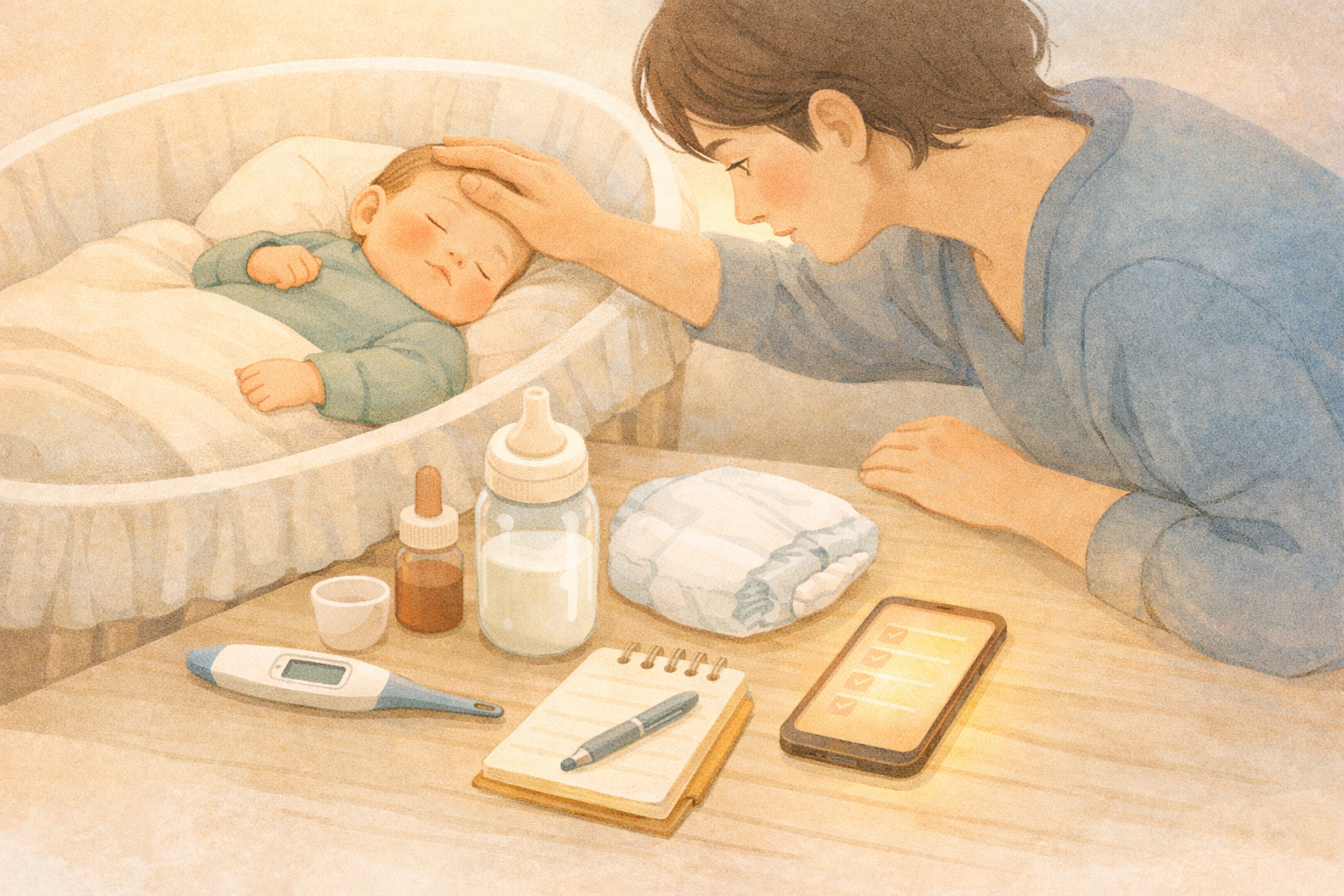
Baby Fever Tracker: What to Record, When to Recheck, and When to Call Your Doctor
Use this baby fever tracker to log temperature, symptoms, fluids, and wet diapers so you know what to record, when to recheck, and when to call your doctor or get urgent help.

Whooping Cough in Babies: Why Newborns Are Most at Risk and When to Get Tdap
Has the cough gone past two weeks? About one in three infants who catch whooping cough ends up hospitalized, and young babies may show apnea instead of coughing. Here's how to cover the gap before the first shot at 2 months.