Baby Fever Tracker: What to Record, When to Recheck, and When to Call Your Doctor
Check Your Baby's Health from One Photo
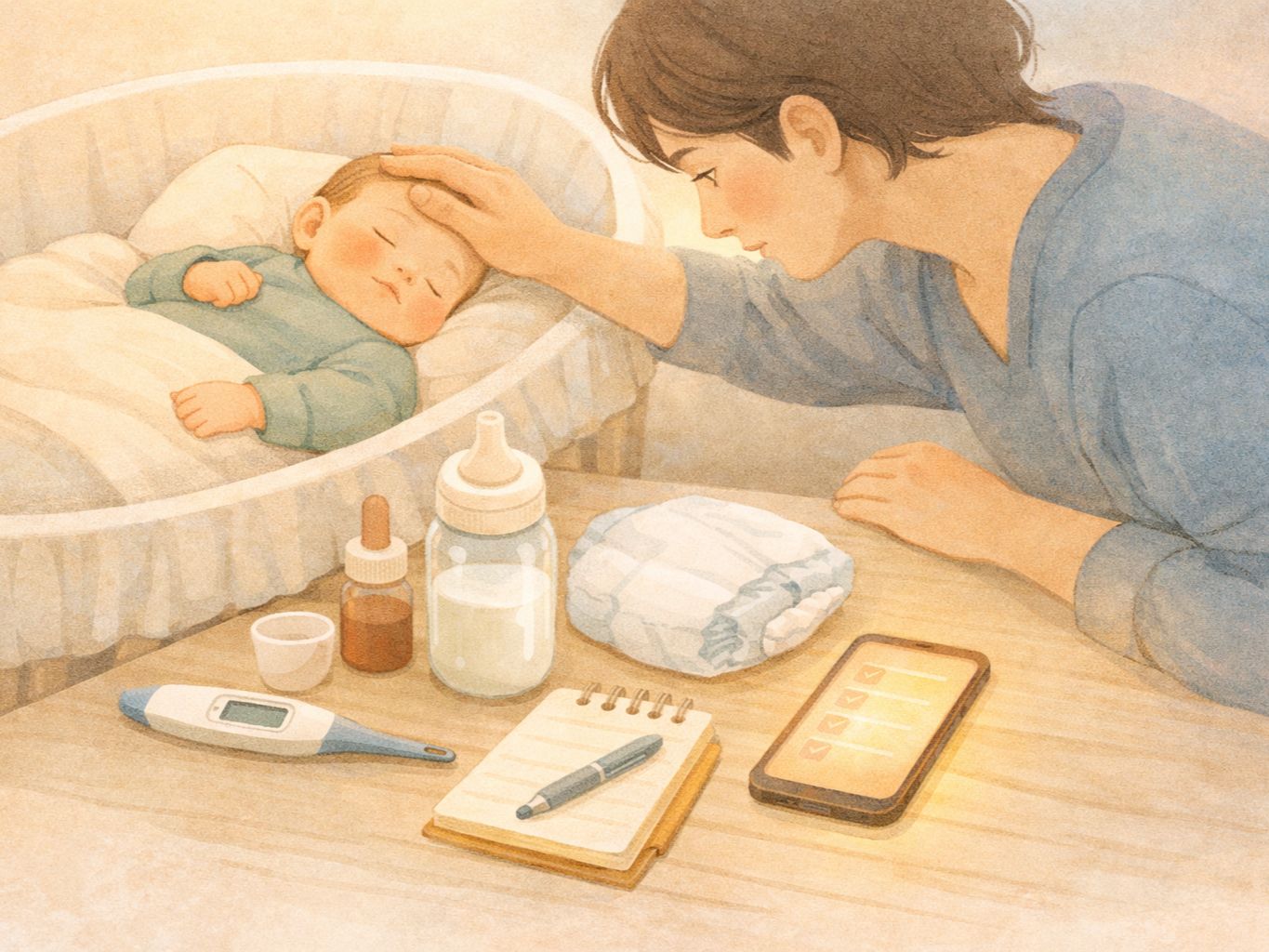
Get Started FreeYou rest your hand on your baby's forehead in the middle of the night and it's warm, and instantly your mind starts racing. What's the temperature? Do I give medicine? Do we need the ER? Then the next day at the doctor's office, you get asked "What time was it, and how high?" and your mind goes blank. That's exactly why a fever is so much easier to handle when you jot down a few things instead of relying on a single number on the thermometer. We're not talking about a detailed chart here: one short line is plenty.
Hold onto one rule above all: if your baby is under 3 months old and has a rectal temperature of 100.4°F (38°C) or higher, call the doctor now, even if your baby still looks calm. And if your baby has trouble breathing, blue or gray color, a seizure, or is very hard to wake, skip the notes and get emergency help first. Keep those two things front of mind, and read the rest at your own pace.
Split It Into Three Buckets and It Gets Less Scary
When a fever hits, the "do we need to go in right now?" panic sets in fast. Sorting the situation into three buckets calms that down because each one comes with a clear next move.
Get emergency help right now if your baby looks short of breath, is sucking the ribs in with each breath, is grunting, has blue lips, is limp and hard to wake, or is having a seizure. Don't stop to write anything: think 911 first, because these signs mean your baby needs help faster than a log can wait for.
Call or be seen the same day for any baby under 3 months with a rectal temperature of 100.4°F (38°C) or higher, or for a baby who can barely drink and keeps vomiting, has clearly fewer wet diapers and a dry mouth, or is very droopy alongside a rash. These don't wait until tomorrow, because dehydration and certain infections move quickly in little ones.
Watch at home and log it only when your baby wakes and responds, breathes comfortably, is still taking some fluids, and keeps making wet diapers. Even then, don't lean on the number alone. If your gut says your baby looks more sick than usual, trust that and call the same day; you don't need a high reading to make the call.
Six Things Worth Jotting Down
A fever log doesn't need to be long. Write these six things in the same order each time and the doctor call gets so much easier, because you're handing over exactly what they're about to ask for.
| What to log | What you write | Why it helps |
|---|---|---|
| Time | When the fever started, when you rechecked | Shows how fast the fever is climbing or settling |
| Temperature and method | The number, and rectal, armpit, or ear | The same number means different things by method |
| How your baby seems | Wakes easily, droopy, calms when held | The whole picture often matters more than the number |
| Fluids | How much they drank, whether they vomited right after | Helps gauge hydration and whether things are worsening |
| Wet diapers | How many over the last half-day to day | Fewer wet diapers can be a dehydration sign |
| Other symptoms | Cough, runny nose, vomiting, diarrhea, rash, breathing changes | Helps the doctor find the cause and set priority |

For example: "8 p.m., armpit 100.8°F, drank about half a feed, two wet diapers, slight cough." That one line makes the phone call go far smoother.
"How often do I recheck?" Matters Less Than "When"
Anxiety makes you want to point the thermometer at your baby every five minutes, but that honestly doesn't help much. Let your baby rest and just pick the right moments to recheck. Three are enough: when your baby feels much hotter, when they look or act different (droopy, breathing harder), and when the doctor asked you to check or you want to see how the fever moved before and after fever medicine. If your baby is comfortable and breathing steadily, checking the temperature and overall state every 2–3 hours is realistic for most families. But if your baby is under 3 months, or you suspect droopiness, breathing changes, repeated vomiting, or dehydration, don't wait out the clock: follow the call-now rules first.
What Number Means the Doctor? The Whole Picture Beats the Digit
Honestly, it's hard to draw a clean "this number means hospital" line, because the very same 100.4°F can mean completely different things depending on how your baby is acting. Still, sorting it ahead of time means less hesitation at 3 a.m.
Call now or be seen the same day for a baby under 3 months with a rectal temperature of 100.4°F (38°C) or higher, a baby who can't keep feeds down, fewer wet diapers and a dry mouth, worsening droopiness or fussiness, or breathing that looks harder than usual.
You can watch at home if your baby wakes and responds, breathes easily, takes some fluids, and keeps making wet diapers. Here's the key part, though: if at any point your baby becomes hard to wake, breathes harder, changes color, or has a seizure, the situation jumps a level instantly. That's a 911 moment: don't wait. A number dipping for a bit doesn't mean the danger has passed.
Say It In This Order and the Call Goes Faster
If two of you are up at night, let one hold the baby and watch breathing and responsiveness while the other pulls up the log. On your own, just jotting this order down is enough. Tell the doctor: age, then when the fever started, then the highest temperature and how you took it, then how much your baby is drinking, then the last wet diaper, then breathing changes, vomiting, or rash.
Like this: "She's 5 months old. The fever started around 2 p.m. today, and at 6 p.m. it was 101.7°F under the arm. She's nursing about half of normal, and she's had three wet diapers today. There's a slight cough but her breathing looks comfortable." A short, time-ordered summary like that lets the doctor read the situation much faster.
When You're Up All Night, Leave Yourself a One-Line Trigger
The deeper into the night it gets, the more you waver, "maybe I'll just watch a little longer." So after a call or visit, write down a single line that says when to call back. Something like "if she vomits twice more, call again," "if wet diapers drop further, seen today," or "if breathing gets hard, 911." This isn't a sentence to soothe yourself; it's a rule so the 3 a.m. version of you makes the same clear call. Your log doesn't have to be perfect. But if your baby hits one of those triggers, don't put it off, even at night: call or get help right away.
How BebeSnap Helps You Keep a Fever Log
- Temperature, feeds, sleep, and diapers all live in one place, so you can pull up the recent trend the moment you call the doctor.
- With family sharing, one parent can care for the baby while the other reads off the last temperature, feeding time, and wet-diaper count.
- On fever days, comparing against the usual record shows how feeding and wet diapers have shifted, making your description more specific and accurate.
Baby Fever Tracker FAQs for Parents
Q: What temperature is a fever in a baby?
A: For young babies, the most important cutoff is a rectal temperature of 100.4°F (38°C) or higher. In a baby under 3 months, that always needs prompt medical attention, even if the baby still looks calm. For older babies, the same 100.4°F can mean different things depending on how your baby is feeding, breathing, and acting, so the whole picture matters as much as the number.
Q: How often should I recheck my baby's fever?
A: Recheck when the result could change what you do next, such as when your baby looks worse, feels much hotter, develops a new symptom, or before you call the doctor. If your baby is under 3 months and already has a rectal temperature of 100.4°F (38°C) or higher, call now instead of waiting to repeat it.
Q: What should I record in a baby fever tracker?
A: Write down six things each time: the time, the temperature with the method used (rectal, armpit, or ear), how your baby seems (alert or droopy), how much they drank and whether they vomited right after, the number of wet diapers, and any other symptoms like cough, runny nose, rash, or diarrhea. Noting the last feed and last wet diaper is especially handy for the doctor call.
Q: When should I call the doctor for my baby's fever?
A: Call 911 now if your baby has trouble breathing, blue or gray color, a seizure, is very hard to wake, or looks limp or floppy. For any baby under 3 months, call a doctor now for a rectal temperature of 100.4°F (38°C) or higher. For older babies, get same-day medical advice if your baby is drinking much less, has clearly fewer wet diapers, repeated vomiting, or worsening sleepiness.
References
Check Your Baby's Health from One Photo
AI stool analysis reads color and texture, and keeps every health record in one place.
See what the app does firstMedical Disclaimer: This article is for informational purposes only and does not replace professional medical advice. If you have concerns about your baby's health, please consult a pediatrician.
You Might Also Like
Apple for Babies: Stage-by-Stage Portions and When Raw Apple Is Safe
Spinach for Babies: When to Start, Why Boiling Matters, and the One Time to Skip It
Potato for Babies: When to Start, Safe Shapes, and Why Never to Blend It
Wonder Weeks Calculator: Your Baby's 10 Mental Leaps From the Due Date
You Might Also Like
Baby Impetigo: Golden Crusts, Antibiotic Treatment, and When Nursery Is Safe Again
Golden-brown crusts spreading across your baby's skin? Impetigo is a common, highly contagious bacterial skin infection in young children. It stops being contagious 48 hours after treatment starts. Here is how to recognise it and when nursery is safe again.
Baby Fine Motor Development Guide: From Grasping to Pincer Grip, Month-by-Month Milestones
Fine motor skills are key to brain development. Babies develop palmar grasp by 6 months and pincer grasp by 9-12 months. Learn milestones and activities for each stage.
Is Your Baby’s Cold Getting Worse? What Parents Should Track at Home
Track breathing, feeding, wet diapers, fever, and the day-by-day pattern so you can tell whether your baby’s cold is improving or needs medical care.