8- to 12-Month-Old Feeding Schedule: What to Feed Your Baby All Day
Stop Trying to Remember Feed Times
Get Started Free"What am I even supposed to feed this kid all day?" Somewhere around 8 months, that question hits most of us. Solids are picking up, but you're not sure when the bottles or nursing fit in anymore, or whether snacks are a thing yet. Take a breath, it's simpler than it looks. At this age, the all-day plan is less about the menu and more about the order, and once the order is set, you're halfway home.
Here's the big picture: three meals with breast milk or formula tucked in between, plus a small snack when a hungry gap opens up. Milk is still pulling real weight nutritionally before the first birthday, so even on days your baby eats like a champ, you don't need to cut feeds. Below, we'll cover how to lock in the order, how to build a single meal, and what to do on the days your baby barely touches food.
Memorize one order and the day runs itself
You don't need a minute-by-minute chart on day one. The one thing that actually helps when you're tired is a repeating order: milk on waking, breakfast a bit later, a snack in the gap, lunch, milk or a snack in the afternoon, dinner, and a feed before bed. That's the whole framework.
| Order | What to do | Quick note |
|---|---|---|
| 1 | Breast milk or formula on waking | The tank is empty after the night, so fill it first. |
| 2 | Breakfast 1 to 2 hours later | Lean on familiar combos: oatmeal, egg, soft fruit. |
| 3 | Lunch around midday | Bridge the gap with a morning snack or short feed. |
| 4 | Afternoon feed, plus a snack if needed | Keep it light enough not to spoil dinner. |
| 5 | Dinner | Lining it up with family dinner makes it easy to repeat. |
| 6 | Breast milk or formula before bed | The feed that closes out the day. |
If a nap slides late, let the meals slide with it. When one meal falls apart, don't drag it out, just pick the rhythm back up at the next slot. If two of you are home, one feeds while the other jots down the last feed and meal times, which cuts way down on the "wait, when did she last eat?" confusion.
Sample schedule around 8 months, when solids are still 2 meals
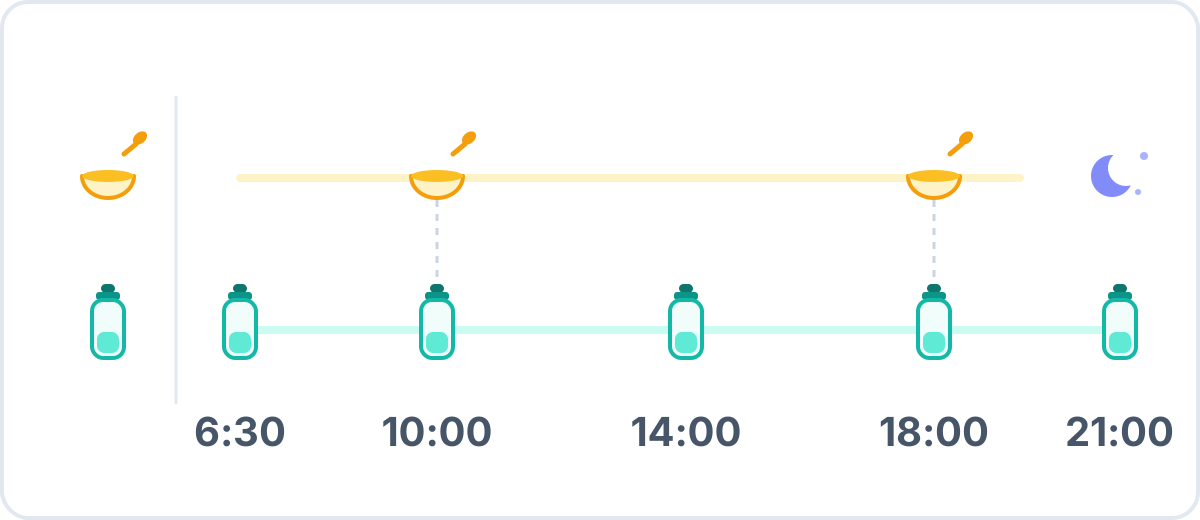
Once the order is set, put clock times on it. Around 8 months many babies are eating 2 solid meals a day and still getting most of their calories from milk, with a feed layered right after each meal and a few more in between.
Here's one version built around a 6:30 wake-up. Treat the times as a shape, not a rule, and slide the whole thing to match your baby's wake-up and naps.
| Time | Formula-fed | Breastfed |
|---|---|---|
| 6:30 | Wake, bottle 1 | Wake, nurse 1 |
| 10:00 | Solids 1, then bottle 2 | Solids 1, then nurse 2 |
| 14:00 | Bottle 3 | Nurse 3 |
| 18:00 | Solids 2, then bottle 4 | Solids 2, then nurse 4 |
| 21:00 | Bottle 5, then bed | Nurse 5, then bed |

Feeds 1, 3, and 5 sit on their own; feeds 2 and 4 ride along after a meal. If you're nursing, don't bother counting, "after solids, plus whenever they ask in between" is close enough.
Combo feeding? Read every milk slot as "offer the breast first, top up with formula if needed." The number of slots and the timing stay exactly the same.
Sample schedule for 9 to 12 months, once solids are 3 meals
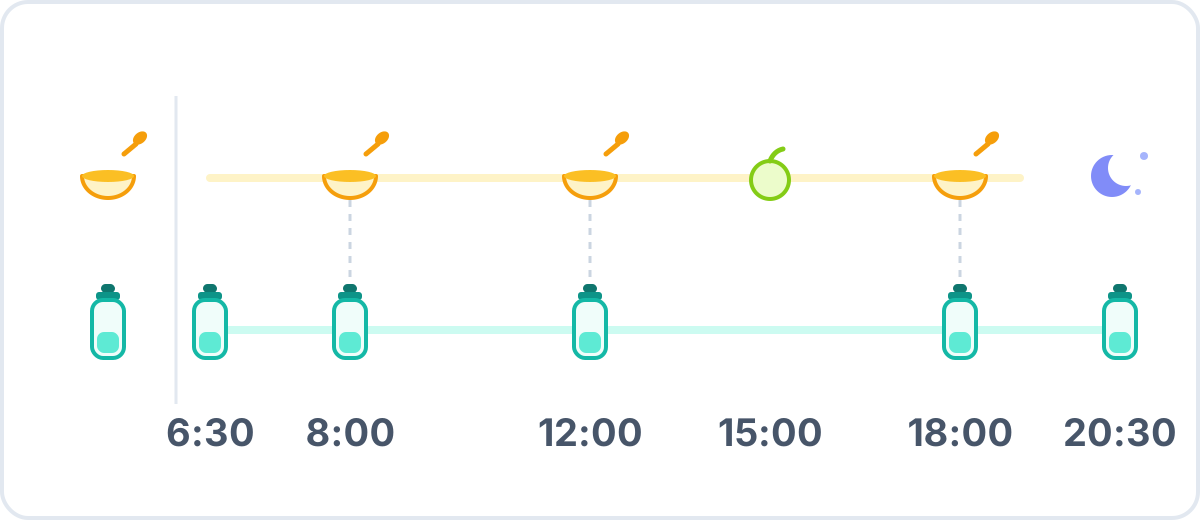
By 9 to 12 months most babies are on 3 meals plus a snack or two, and one of the standalone milk feeds usually drops out to make room. One meal in, one daytime feed out, roughly.
| Time | Formula-fed | Breastfed |
|---|---|---|
| 6:30 | Wake, bottle 1 | Wake, nurse 1 |
| 8:00 | Breakfast, then bottle 2 | Breakfast, then nurse 2 |
| 12:00 | Lunch, then bottle 3 | Lunch, then nurse 3 |
| 15:00 | Snack if needed | Snack if needed |
| 18:00 | Dinner, then bottle 4 | Dinner, then nurse 4 |
| 20:30 | Bottle 5, then bed | Nurse 5, then bed |
Nap length and count will wreck this table regularly. Wake windows and nap targets around this age are covered in the 8-month day and nap schedule.
When and how much milk?
Once the times are settled, the next question is how much per feed. That tracks weight more than age, so calculating beats memorizing a number. The pattern: the number of feeds stays around five a day whether solids are twice or three times, while the volume per feed slowly comes down.
The thing to avoid is cutting milk ahead of your baby. Feed the solids first, then offer as much milk as they want. Keep that order and the drop happens on their schedule, not yours.
To get a daily target from your baby's weight, use the weight-based daily formula calculator. Divide that daily target by the number of feeds to get a per-feed amount.
Moving from 2 meals to 3
The calendar doesn't decide this. Around 9 months is the usual window, but look for these first.
Signs your baby is ready
- They're finishing most of both meals, several days running
- They can mash and swallow food that squashes against the roof of the mouth
- They sit happily through a meal instead of fighting the chair
How to make the switch
- Don't jump straight to three. Add a small dinner first.
- The new meal can stay smaller than the others until it settles in
- Over the next few days, check that milk intake and wet diapers hold steady
If milk and solids both fall off after you add the third meal and your baby seems wiped out, that's not an adjustment period. Drop back to two meals and get them checked.
Don't get stuck on the milk-to-solids ratio
Whether your baby is 8 or 9 months, you don't have to cut or slash feeds just because they're eating three meals some days. At this age, solids are growing but milk is still a key source of calories and nutrition, so there's no magic ratio to hit. Stop trying to force a "this much milk, this much food" split.
The truth is babies move at really different speeds. Some are still milk-heavy at 8 months; others suddenly get fascinated by food around 10 to 11 months. Both are normal. Instead of chasing numbers, watch growth, wet diapers, energy, and stools together. The exception: if milk and solids both drop sharply over a few days and your baby seems wiped out, that's less about adjusting to solids and more a sign to get checked.
Building one meal can stay this simple
A single meal is usually just a grain, a protein, and a vegetable or fruit. Think oatmeal or rice with egg or tofu, shredded meat or fish, and a soft cooked vegetable or fruit on the side. Don't burn yourself out inventing a new recipe every meal, repeating a few combos your baby already eats well is far more sustainable. Variety across the week is plenty.
Add new foods one at a time, not several at once, because that way you can tell what caused a reaction. If your baby has started picking up food, you can offer spoon foods alongside soft finger foods. Just skip or reshape the choking-shaped stuff: whole grapes, whole nuts, popcorn, hard raw veggies, big fruit chunks.
If a new food brings on swelling of the lips or face, repeated vomiting, or a strong cough, stop that food and watch the reaction separately. And don't start a new medicine on your own at home, only follow dosing if a clinician has already given you instructions for your child.
When your baby barely eats, here's how to reset
Teething, exhaustion, a mild cold, constipation, any of these can throw off a day's eating. It's not just your baby. On those days, don't drag a meal out: put down one familiar food and one low-pressure food, and if it's a no, move on to the next feed or meal. The more worn out you are, the more "make less, clean up fast" actually protects the rhythm.
You can keep watching at home when your baby still has energy, takes in some fluids, and makes the usual wet diapers. Keep snacks simple, soft fruit, plain yogurt, soft cheese, cooked veggies, and let your baby practice sips of water from a cup. Just hold off on cow's milk as a main drink before age 1, skip honey until age 1, and don't bother with juice or sweet drinks.
But if your baby barely eats for several days, can't take milk or water well, struggles to swallow, gags hard on certain textures, isn't gaining weight, or shows signs of dehydration or low energy, don't file it under "picky eating." What looks like a food problem can really be mouth pain, a swallowing issue, an infection, or constipation underneath.
Use BebeSnap to steady the day
- Log feeds, solids, and snack times together in BebeSnap so you're not recalculating "hungry or tired?" every single time.
- Jot down confusing reactions, a rash, vomiting, a change in stool after a new food, right away, so you're working from notes instead of guesswork next time.
- When two of you share the log, one feeds while the other checks the last feed time and what's still left to prep, and picks up right where you left off.
Common questions about feeding an 8- to 12-month-old all day
Q: How many meals should my 8-month-old eat each day?
A: Many babies this age are moving toward 3 meals a day, plus 2 to 3 snacks depending on wake time, appetite, and milk intake. Breast milk or formula is still an important part of the day, so count the whole feeding schedule, not solids alone.
Q: What does an all-day feeding schedule look like for a 9-month-old?
A: A common pattern is milk after wake-up, breakfast, a snack if needed, lunch, milk or a snack in the afternoon, dinner, and milk before bed. Use that as a base plan, then shift it around naps rather than trying to force exact times.
Q: Should I give milk before or after solids every time?
A: No. Milk first and solids first can both work. The safer checkpoint is whether your baby is still taking enough milk, making normal wet diapers, and staying comfortable during meals. Ask your pediatrician if milk is crowding out solids all day or intake is dropping.
Q: What if my baby is not eating 3 full meals yet?
A: That can still be normal, especially earlier in this age range or during teething and minor illness. Keep offering regular chances to eat without pressure. Get same-day medical advice if milk intake is falling too, wet diapers are fewer, your baby seems unusually sleepy, or you are worried about weight gain.
References
Stop Trying to Remember Feed Times
Log time, amount, and intervals. BebeSnap turns them into your baby's daily pattern.
See what the app does firstMedical Disclaimer: This article is for informational purposes only and does not replace professional medical advice. If you have concerns about your baby's health, please consult a pediatrician.
You Might Also Like
Wonder Weeks Calculator: Your Baby's 10 Mental Leaps From the Due Date
Baby Weight Gain Calculator: Grams Per Day From Two Weigh-Ins
Baby Impetigo: Golden Crusts, Antibiotic Treatment, and When Nursery Is Safe Again
Baby Mouth Sores (Stomatitis): Causes, How to Tell Them Apart, and Dehydration Signs
You Might Also Like
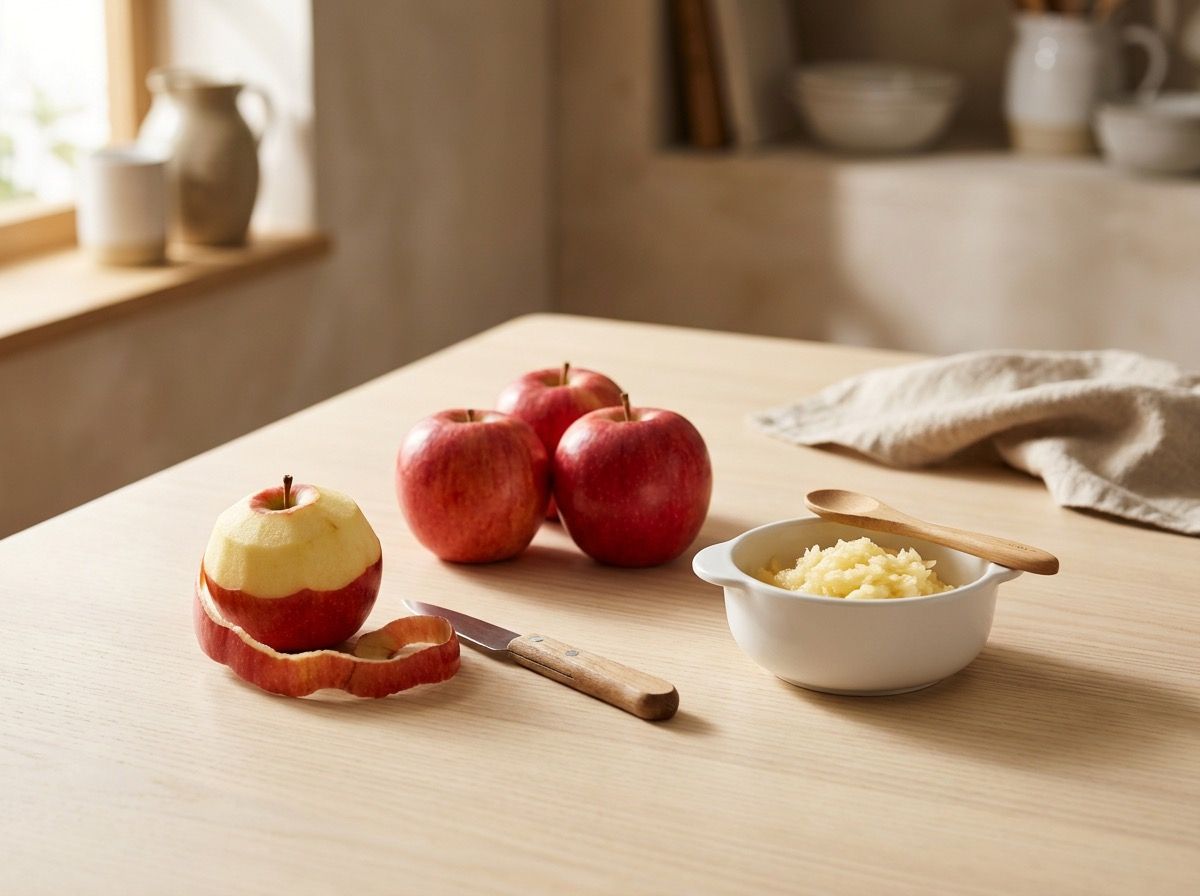
Apple for Babies: Stage-by-Stage Portions and When Raw Apple Is Safe
Apple can start in the first weaning stage, grated and cooked. Portions are 20-30g at 7-8 months and 30-40g at 9-11 months, counted together with vegetables. Front teeth bite, but the molars that grind only start coming in at the end of weaning.

Why Is My Baby Always Sick? Normal Daycare Illness vs. Warning Signs
Sick again two weeks after the last one? Six to ten colds a year is normal for young children, eight to ten during the first two years, and each one runs 7 to 10 days. Here's how to tell that from the few signs that mean something more.
9 to 12 Month Baby Meal Schedule: Sample Feeding Routine for Solids, Milk, and Snacks
Use this 9 to 12 month baby meal schedule to plan 3 meals, 2 to 3 snacks, and regular milk feeds without crowding out breast milk or formula.