Newborn Grunting at Night: What’s Normal, What to Watch, and When to Call

Check Your Baby's Health from One Photo
Get Started FreeThere's something about lying in the dark next to a grunting, snuffly newborn that snaps you wide awake. You find yourself holding your own breath, listening to every little "ennngh," wondering if something's wrong. Here's the reassuring part, mama: newborns are surprisingly noisy sleepers, and most of that grunting is completely normal. The thing that actually matters isn't the sound itself; it's your baby's color, how hard they're working to breathe, and whether they're still feeding like usual. Keep those three in mind and the noise gets a lot less scary.
Honestly, Most Grunting Is Normal
Newborns make way more noise in their sleep than most of us expect. Their nasal passages are teeny, so even a little congestion turns into loud, raspy breathing. They grunt when they're passing gas or pushing out a poop. And because they drift in and out of light and deep sleep all night, they'll scrunch up their faces and whimper without ever really waking up.
So if the noise comes and goes, your baby looks pink and comfortable, their chest moves easily, and they're feeding normally, you're most likely in normal-newborn territory. The one caveat: babies can change fast, so don't just listen: take a look at the whole picture.
Is It Just Grunting, or Is Breathing Hard?
This is the part that trips everyone up. Here's a simple order to check. First, look at your baby's color. Then watch the chest and belly rise and fall, does it look easy? Last, see if they can still feed. A quick "unngh" while pushing out a poop is very different from grunting on every single breath out. That second one can mean your baby is working hard to breathe, so it deserves a faster look.
| Usually fine to watch at home | Time to take a closer look |
|---|---|
| The noise comes briefly, then quiets down | Grunting on every breath, or nearly every one |
| Pink color and good responsiveness | Pale, bluish, or limp and floppy |
| Feeding about as much as usual | Stopping often to catch breath, or barely eating |
| Chest and belly move comfortably | Ribs, the area below the throat, or under the breastbone pulling in |
| Settles and looks at ease when held | Still looks like they're struggling even when held |

If breathing looks really fast, the nostrils flare with each breath, or your baby bobs their head to breathe, don't write it off as a sleep quirk.
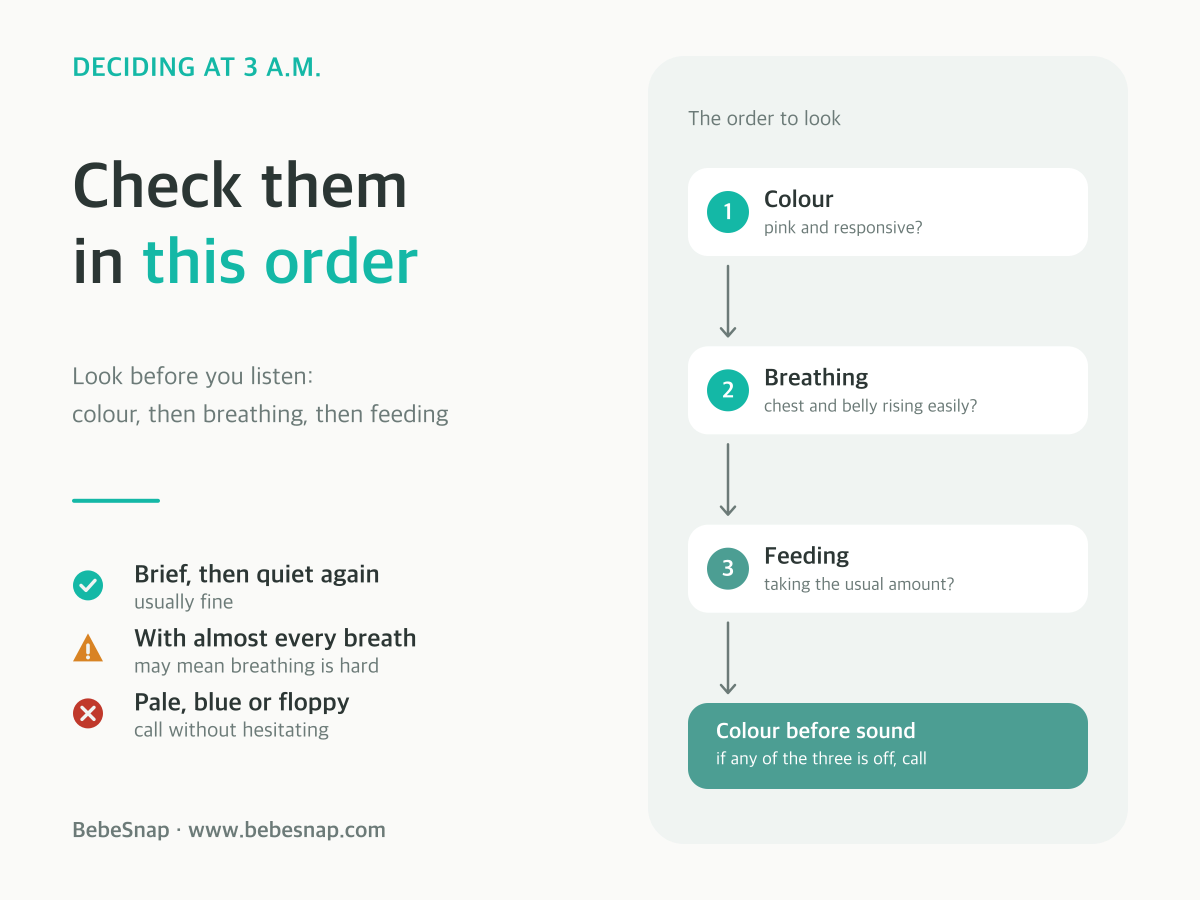
When to Call Right Away, No Second-Guessing
When it's the middle of the night and you're stuck on "should I go in or wait," err on the side of safety. If you see any one of these, call 911 first or head straight to the ER:
- Lips or tongue looking blue
- Grunting with every single breath
- Ribs or the spot under the breastbone pulling in over and over
- Limp, floppy, or hard to wake
- Barely able to take the breast or bottle
- Breathing so fast they obviously look like they're struggling
Even when it's not that urgent, there are times to call the pediatrician the same day: the grunting goes on all night, feeding drops off, wet diapers slow down, the temperature seems off, or your baby just seems more sluggish than usual. And for a baby under 2 months, fever or any change in breathing alongside the grunting is worth checking sooner.
⚠️ If you're even debating whether to take them in, you've probably already hit the point of calling. If your baby looks like they're really struggling, don't lose time driving them yourself: call 911 first.Tonight at Home: What to Check First
At 3 a.m. on no sleep, fewer things to check is better. Just four: color, whether breathing looks hard, whether they're feeding, and whether wet diapers are still coming. Even if it sounds like a stuffy nose, don't talk yourself into waiting if the color is off, feeding is hard, or the chest is pulling in.
It's okay to keep watching at home when the noise is brief, your baby settles a bit when held, feeds well, has good color, and isn't pulling in at the chest. But if the grunting gets more frequent, breathing speeds up, or feeding drops, don't tough it out: call.
If there are two of you, one can hold the baby and watch color and breathing while the other jots down the time, the amount fed, and the last wet diaper, or gets on the phone with the doctor. If you're solo, calling comes before note-taking. A short video is fine, but never let filming delay a 911 call or a visit. And don't force-feed a baby who's clearly working hard to breathe.
What the Doctor Will Look At
At the clinic, the first thing they check is how stable your baby is right now: breaths per minute, oxygen levels, whether the chest is pulling in, temperature, signs of congestion or infection, and whether feeding is holding up. For some babies it's normal newborn noise or a simple stuffy nose; for others, they'll want to rule out a lung or airway issue, an infection, or dehydration.
You don't need to figure out the diagnosis yourself. Just walking through it in order helps a lot: when it started, whether it happens on every breath, whether feeding has dropped, whether the color changed, and whether wet diapers are down. If you caught a short video, show it: but not having one won't slow anything down.
What to Jot in the App Tonight
- Logging feed times and amounts shows fast whether the breathing changes line up with before or after feeds.
- Adding wet-diaper counts helps you tell if feeding is dropping off.
- A quick note of when you got worried, any color change, and whether the chest pulled in gives you something to hand the doctor right away.
Questions parents ask about newborn grunting at night
Q: Is newborn grunting at night normal while sleeping?
A: Often, yes. Many newborns grunt during active sleep, gas, or stooling. If your baby stays pink, looks comfortable between noises, and feeds close to usual, the noise is often normal. If the grunting comes with hard breathing, poor feeding, color change, fever, or a baby who is hard to wake, get medical help promptly.
Q: How can I tell normal newborn grunting from a breathing problem?
A: Look at your baby, not just listen. Brief grunting during sleep or straining can be normal. Grunting with every breath, fast breathing, chest pulling, color change, or trouble feeding needs prompt medical assessment.
Q: My newborn grunts and strains all night but seems okay. Should I worry?
A: If your baby looks comfortable, wakes to feed, and has normal color and wet diapers, this is often part of normal newborn adjustment. Keep watching for any shift in breathing effort, feeding, color, or alertness. Call your pediatrician the same day if this pattern is new, getting more frequent, or you are concerned your baby seems different from usual.
Q: When should I call the doctor for newborn grunting at night?
A: Call the pediatrician the same day if the grunting is new, happening more often, making feeds harder, or comes with repeated vomiting, fewer wet diapers, worsening congestion, or lower alertness. For any baby under 3 months, a rectal temperature of 100.4°F (38°C) or higher needs urgent medical advice right away. Get urgent help now for color change, chest pulling, grunting with every breath, or a baby who is hard to wake.
References
Check Your Baby's Health from One Photo
AI stool analysis reads color and texture, and keeps every health record in one place.
See what the app does firstMedical Disclaimer: This article is for informational purposes only and does not replace professional medical advice. If you have concerns about your baby's health, please consult a pediatrician.
You Might Also Like
Apple for Babies: Stage-by-Stage Portions and When Raw Apple Is Safe
Spinach for Babies: When to Start, Why Boiling Matters, and the One Time to Skip It
Potato for Babies: When to Start, Safe Shapes, and Why Never to Blend It
Wonder Weeks Calculator: Your Baby's 10 Mental Leaps From the Due Date
You Might Also Like
Baby Impetigo: Golden Crusts, Antibiotic Treatment, and When Nursery Is Safe Again
Golden-brown crusts spreading across your baby's skin? Impetigo is a common, highly contagious bacterial skin infection in young children. It stops being contagious 48 hours after treatment starts. Here is how to recognise it and when nursery is safe again.
Newborn Hearing Screening Guide | OAE vs ABR, Refer Results & Baby Hearing Milestones
Got a 'refer' result on your newborn's hearing screening? About 1-3 in every 1,000 babies are born with hearing loss, but early detection before 6 months can lead to near-normal language development.
Before You Call the Pediatrician: What Symptoms and Details to Track for Your Baby
Use this 5-minute checklist to track your baby's temperature, breathing, feeding, wet diapers, and symptom timeline before you call the pediatrician.