Potato for Babies: When to Start, Safe Shapes, and Why Never to Blend It
Stop Trying to Remember Feed Times
Get Started FreeYou want to give your baby potato, and every search result hands you another recipe. None of them answer the part you were actually worried about: how much of the sprout to cut away, whether a green patch means the whole potato goes in the bin, and why your baby keeps gagging on it. This guide starts there. The short version: potato is fine from the first purees, and the risk is not the potato but the sprouts, the green patches, and very small tubers.
When potato can start
In the UK, solid foods start at around 6 months. Potato is not a food to delay. There is no scientific basis for thinking that postponing a particular food prevents allergy, so the usual advice is to introduce new foods one at a time and watch.
Offer a new food as one small spoonful, then build up as your baby takes it.
Shape matters more than smoothness
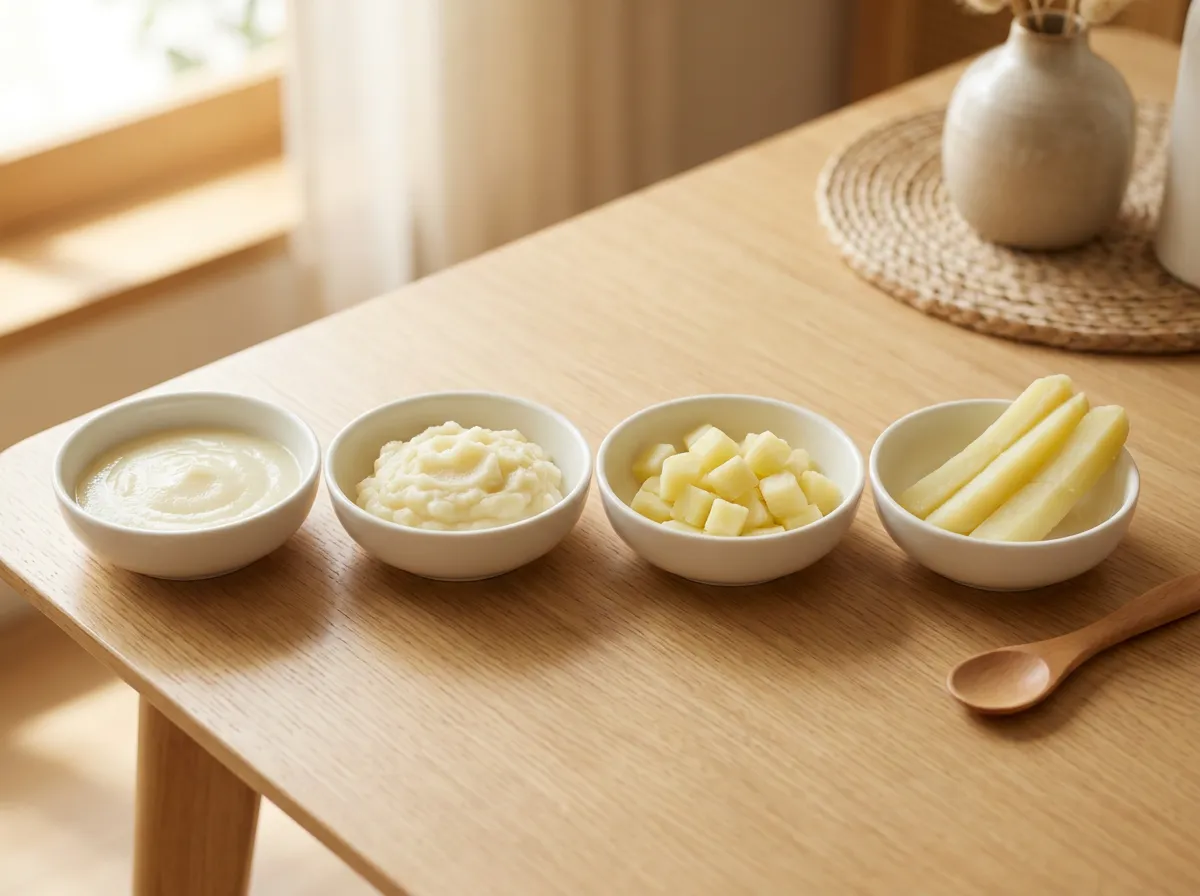
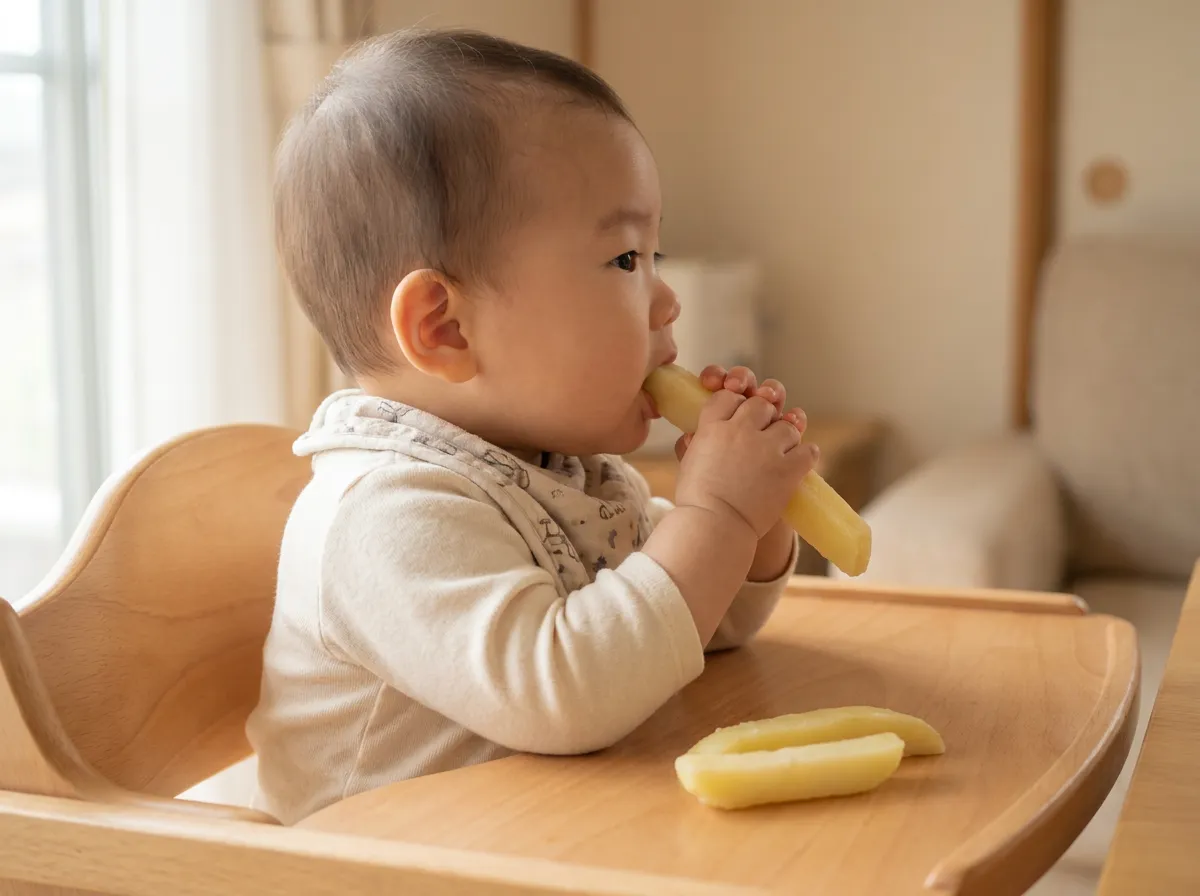
This is where UK guidance differs from a lot of what you will read elsewhere. From around six months, babies grip with the whole fist and eat from the top of it, so a soft wedge about the length of an adult finger is easier to hold than small pieces, and the NHS suggests soft, cooked sticks like this as first foods. The AAP's examples use soft, small pieces instead, so either shape works as long as it squashes easily.
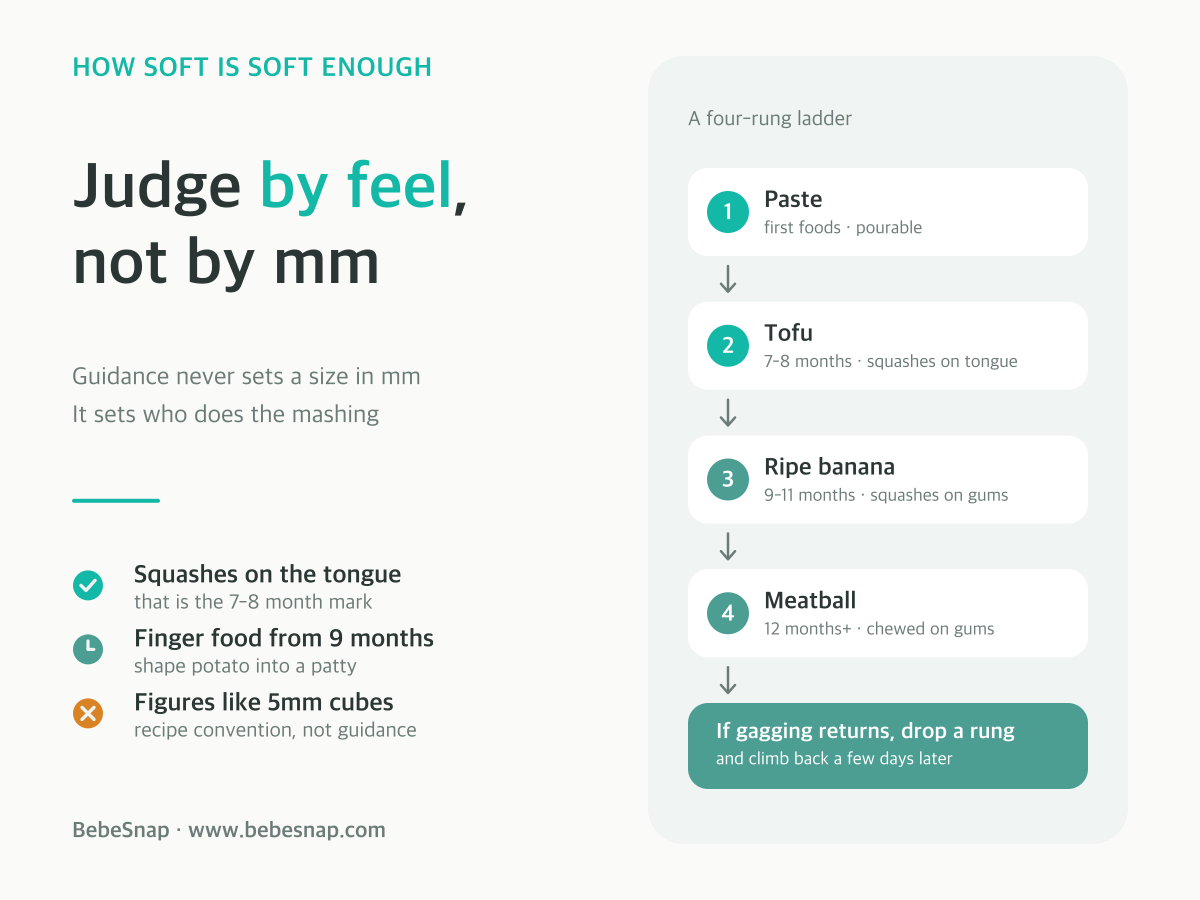
| Age | Shape | How soft |
|---|---|---|
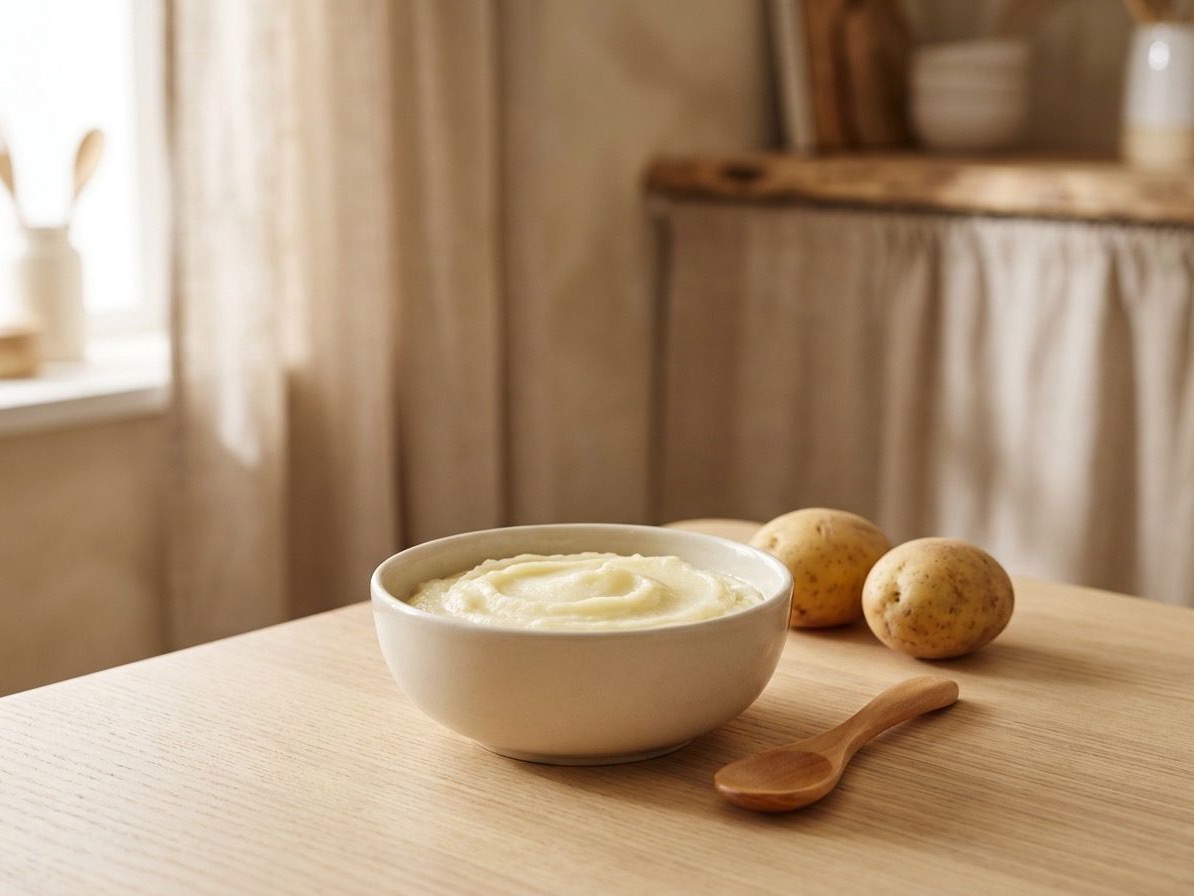
| Around 6 months | Smooth mash, or a finger-length wedge | Squashes easily between your fingers |
| 7 to 8 months | Thicker mash with soft lumps | About the firmness of tofu |
| 9 to 11 months | Pieces the baby can pick up with finger and thumb | Like a ripe banana |
| 12 months and older | Finger foods, spoon practice | Firm enough to hold together |
Green patches and sprouts
Potatoes contain solanine and chaconine, natural compounds that the plant makes to defend itself. In ordinary edible flesh the level averages about 7.5mg per 100g, which is not a concern. In parts that have turned green it exceeds 100mg per 100g, more than thirteen times that.
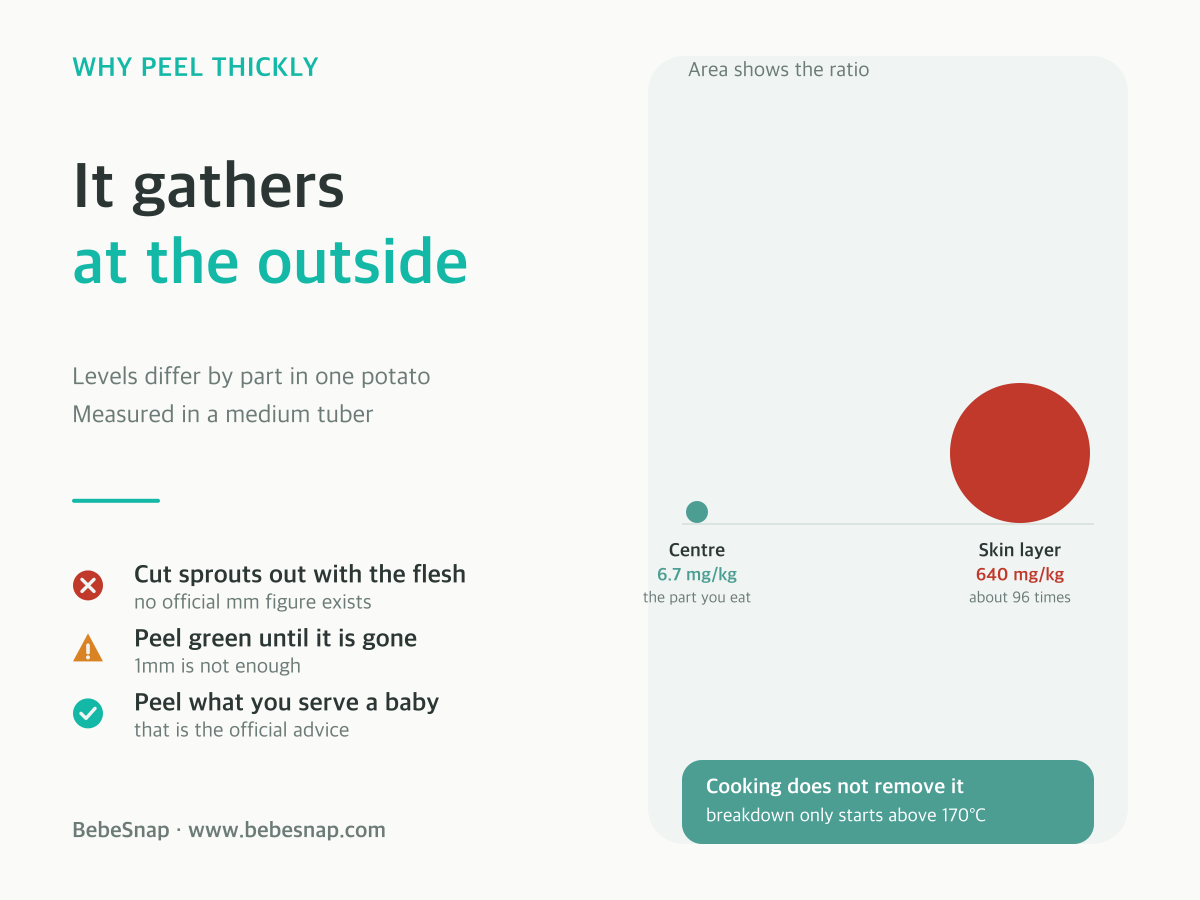
A Tokyo laboratory measured the difference across the tuber: in one variety the skin layer held 640mg per kg while the centre held 6.7mg, roughly 96 times more at the outside. Two other varieties showed 330 against 12, and 280 against 8.6.
Five rules cover it.
1. Do not buy potatoes that have sprouted or gone green. Sorting at the shop is the most reliable filter.
2. Cut sprouts out with the flesh around them. No official guidance gives a millimetre figure for how far around the sprout to cut.
3. Peel potatoes you serve to a baby. Adults can eat well-grown potatoes with the skin on, but where you want to reduce the compounds further, as with a small child, removing the skin is the advice.
4. Peel green areas away until the green is gone. A 1mm peel lowers levels in a normal potato, but that figure applies to potatoes with no sprouts and no greening. Do not apply it to a green patch.
5. Skip very small potatoes. In the same survey the smallest grade, around 30g, held 410mg per kg whole, against 180mg for a 100g potato.
⚠️ Cooking does not remove it. These compounds only start to break down above 170°C, and boiling, steaming and microwaving all sit near 100°C. Trimming is the only step that helps.Keep the risk in proportion. Poisoning from potato glycoalkaloids is genuinely rare, and the recorded cases cluster around home-grown and school-grown tubers rather than shop-bought ones. In one Japanese case six primary school children who ate immature potatoes about 3cm across and 20g each had nausea and vomiting within fifteen minutes to an hour. Normal-sized supermarket potatoes with no sprouts or green are low in these compounds, and poisonings from them are rarely reported. If your baby vomits or has diarrhea or stomach pain in the half day after eating potato, see a doctor promptly, and call 911 (or your local emergency number) if they struggle to breathe, have a seizure, or are floppy or hard to wake.
Why potato makes babies gag
Potato cools into something sticky that absorbs saliva and clumps in the mouth. That is a swallowing problem, not a taste problem.
The cause is starch. Mash a potato once it has cooled and the cells no longer separate cleanly, so you press harder, the cell walls tear, starch leaks out and the mash turns to glue. Mash it while it is hot and the cells come apart whole.
🔑 This makes potato the one baby food you should never put through a blender. Every other vegetable is fine to blend. Potato is not, and the change cannot be undone. Press it through a fork or a sieve while it is still hot.To fix a batch that has gone sticky: warm it to bring back heat and moisture, then loosen it with cooking water or stock. Only use the cooking water if you peeled the potato and cut away any sprouts and green before boiling; solanine and chaconine dissolve in water, so water from unpeeled potatoes may carry some of them. Water from peeled potatoes also returns some of what leached out during boiling, since potassium falls from 410mg to 340mg per 100g and vitamin C from 28mg to 18mg when potato is boiled in water.
Gagging and choking are different events. Noisy, red-faced and pushing food forward is gagging. Silent, unable to cry or breathe, or turning blue or pale means choking. Shout for help, start back blows at once (alternating with chest thrusts for a baby under one, or abdominal thrusts for a child over one), and call 911 (or your local emergency number) if the blockage does not come out. Gagging on solids walks through telling them apart.
Cutting and serving safely
| Risky | Safer |
|---|---|
| Cold, dry mash | Warmed mash with moisture restored |
| Stiff mash made without liquid | Loosened with cooking water or stock |
| Anything put through a blender | Pressed through a fork while hot |
| A boiled potato stick that crumbles | Mashed, shaped into a patty and browned |
| Very small, immature potatoes | Medium size or larger |

A baby's airway is under 1cm across, about half an adult's. "I cut it to 1cm so it is fine" does not hold at an age with no molars.
Potato is awkward as a first finger food precisely because it crumbles in the hand. Mashing it, shaping it into a patty and browning the outside holds it together. That is our reading of how potato behaves rather than a line from any official guidance.
Salt is the other thing to watch
Mashed potato in most English-language kitchens means butter, milk and salt. Babies under 12 months should have less than 1g of salt a day, and 1 to 3 year olds a maximum of 2g. Take the baby's portion out before you season the rest, loosen it with water or unsalted homemade stock rather than stock cubes or gravy, and leave crisps and chips off the menu entirely.
Preparing and freezing
Choose medium or larger with no sprouts and no green. Cut sprouts out with the surrounding flesh, peel green away until it is gone, peel the skin, boil or steam, press while hot without kneading, loosen with cooking water or stock, then portion and freeze.
Soaking in water reduces discolouration and surface starch. It is not a safety step against glycoalkaloids.
Freeze it mashed rather than in chunks, since cubes come back watery and grainy. Potato flesh is about 79.8% water, and that water forms ice crystals that push the tissue apart from the inside. Reheat until steaming hot all the way through, then stir, let it cool and check the temperature before serving. Never refreeze something you have thawed, and use it within a week.
What about allergy
Potato is not among the foods that most commonly trigger reactions in babies, and it does not appear on the standard allergen labelling lists. What matters more than the odds is how you introduce it: one spoonful, then watch.
If you see a reaction, stop and have a doctor assess it rather than testing again yourself. Call 911 (or your local emergency number) straight away if your baby's lips, mouth or face swell, they struggle to breathe or start wheezing, their skin or lips turn blue, gray or pale, or they become floppy or stop responding like they normally do.
Track how your baby takes potato with BebeSnap
- Log the date and amount of each new food so you can narrow down the cause if a reaction appears
- Record gagging, rashes or vomiting with a photo to show at an appointment
- Note when you moved up a texture so the next step does not slip
Frequently Asked Questions (FAQ)
Q: When can my baby eat potato?
A: Potato can start with the first solid foods, at around six months in UK guidance, once your baby is taking purees. It is not a food to delay, because there is no evidence that postponing a particular food prevents allergy. Begin with one small spoonful of smooth mash, or a soft wedge about the length of an adult finger if you are letting your baby self-feed, and build up from there.
Q: My potato has a green patch. Can I just cut it off?
A: Cut it away until no green remains, and peel thickly rather than thinly. Green areas exceed 100mg of glycoalkaloids per 100g against an average of 7.5mg in normal flesh, and one laboratory measured the skin layer at 640mg per kg against 6.7mg in the centre, roughly 96 times more. If a potato is extensively green or heavily sprouted, discard it. Peel any potato you serve to a baby.
Q: Why does my baby gag on mashed potato?
A: Potato turns sticky as it cools and absorbs saliva, so it clumps and is hard to swallow. Warm it through to bring back heat and moisture, then loosen it with water from peeled, boiled potatoes or with unsalted stock. Never use a blender, because the cell walls break and the starch sets into glue that cannot be reversed. Press the potato through a fork or sieve while it is still hot instead.
Q: Does cooking destroy the glycoalkaloids in potato?
A: No. Solanine and chaconine only begin to break down above 170°C, and boiling, steaming and microwaving all sit near 100°C, so cooking does not remove them. The compounds have to be trimmed away before cooking. Cut out sprouts with the flesh around them, peel green areas until the green is gone, and remove the skin from potatoes you serve to a baby.
References
- NHS Start for Life - Weaning
- Japan Ministry of Agriculture, Forestry and Fisheries - Solanine and chaconine Q&A
- NHS - How to stop a child from choking
- NHS - Anaphylaxis
- NHS - Children's food: safety and hygiene
- EFSA - Glycoalkaloids in potatoes: public health risks assessed
- Health Canada - Glycoalkaloids in Foods
- Food Standards Agency - Home food fact checker
- Tokyo Metropolitan Institute of Public Health - Solanine
- USDA FoodData Central - Potato
Stop Trying to Remember Feed Times
Log time, amount, and intervals. BebeSnap turns them into your baby's daily pattern.
See what the app does firstMedical Disclaimer: This article is for informational purposes only and does not replace professional medical advice. If you have concerns about your baby's health, please consult a pediatrician.
You Might Also Like
Kaup Index (Baby BMI): How to Calculate It and What's Normal by Age
Wonder Weeks Calculator: Your Baby's 10 Mental Leaps From the Due Date
Baby Weight Gain Calculator: Grams Per Day From Two Weigh-Ins
Baby Impetigo: Golden Crusts, Antibiotic Treatment, and When Nursery Is Safe Again
You Might Also Like
Tomato for Babies: When to Start, Skin and Seeds, and Why Cherry Tomatoes Are Never Served Whole
Tomato can start at 5-6 months once the skin and seeds are removed and it is cooked. Portions run 20-30g at 7-8 months and 30-40g at 9-11 months, counted together with fruit. Cherry tomatoes are the one vegetable Japan's childcare guidance names by name as something not to serve whole.
Spinach for Babies: When to Start, Why Boiling Matters, and When to Skip It
Spinach can start with first purees. Everyone says to boil it, but nobody says why: oxalic acid for the taste, and nitrate, which leafy greens carry a lot of. Boiling cuts nitrate by 30 to 40 percent, and there are times when you should skip spinach.
Apple for Babies: Stage-by-Stage Portions and When Raw Apple Is Safe
Apple can start in the first weaning stage, grated and cooked. Portions are 20-30g at 7-8 months and 30-40g at 9-11 months, counted together with vegetables. Front teeth bite, but the molars that grind only start coming in at the end of weaning.