Baby Impetigo: Golden Crusts, Antibiotic Treatment, and When Nursery Is Safe Again

Check Your Baby's Health from One Photo
Get Started FreeSmall blisters appeared on your baby's face or arms, burst, and dried into sticky golden-brown crusts. Within a day or two they have spread to the other arm. This is very likely impetigo. The name may be unfamiliar, but it is one of the most common skin infections in young children in summer, and because it is highly contagious it needs handling differently from an ordinary rash.
What impetigo is
Impetigo is a superficial bacterial skin infection, most common in young children and most common in warm weather. It is caused by bacteria, usually Staphylococcus aureus, sometimes Streptococcus pyogenes.
That it is bacterial rather than viral is the important part. This is not a rash you wait out. It is one you stop with antibiotics.
The two forms
| Bullous | Non-bullous | |
|---|---|---|
| Cause | Toxin from staph bacteria | Bacteria entering through broken skin |
| How it starts | Soft blisters form | A scratch or graze gets infected |
| Appearance | Yellow fluid oozes and hardens into a scaly border around a scab | Sores burst and leave crusty golden-brown patches |
| Where | Trunk, nappy area | Face and hands most often |

The NHS describes the non-bullous crusts memorably: they look like cornflakes stuck to the skin. Once you have seen it, you recognise it.
💡 The crust colour is the clue. Eczema and heat rash go red, dry and rough. Impetigo goes golden, sticky and spreading. If it is spreading fast, think impetigo first.Telling it apart from other rashes
- Eczema: itchy and dry, in skin folds such as elbows and behind the knees. Scaly rather than golden-crusted, and it does not race across the body in days.
- Heat rash: tiny bumps where sweat collects. It settles within a few days once the child cools down, and it does not spread by touch.
- Chickenpox: appears all over at once and comes with fever. Impetigo usually starts in one spot without fever.
Why it spreads so fast
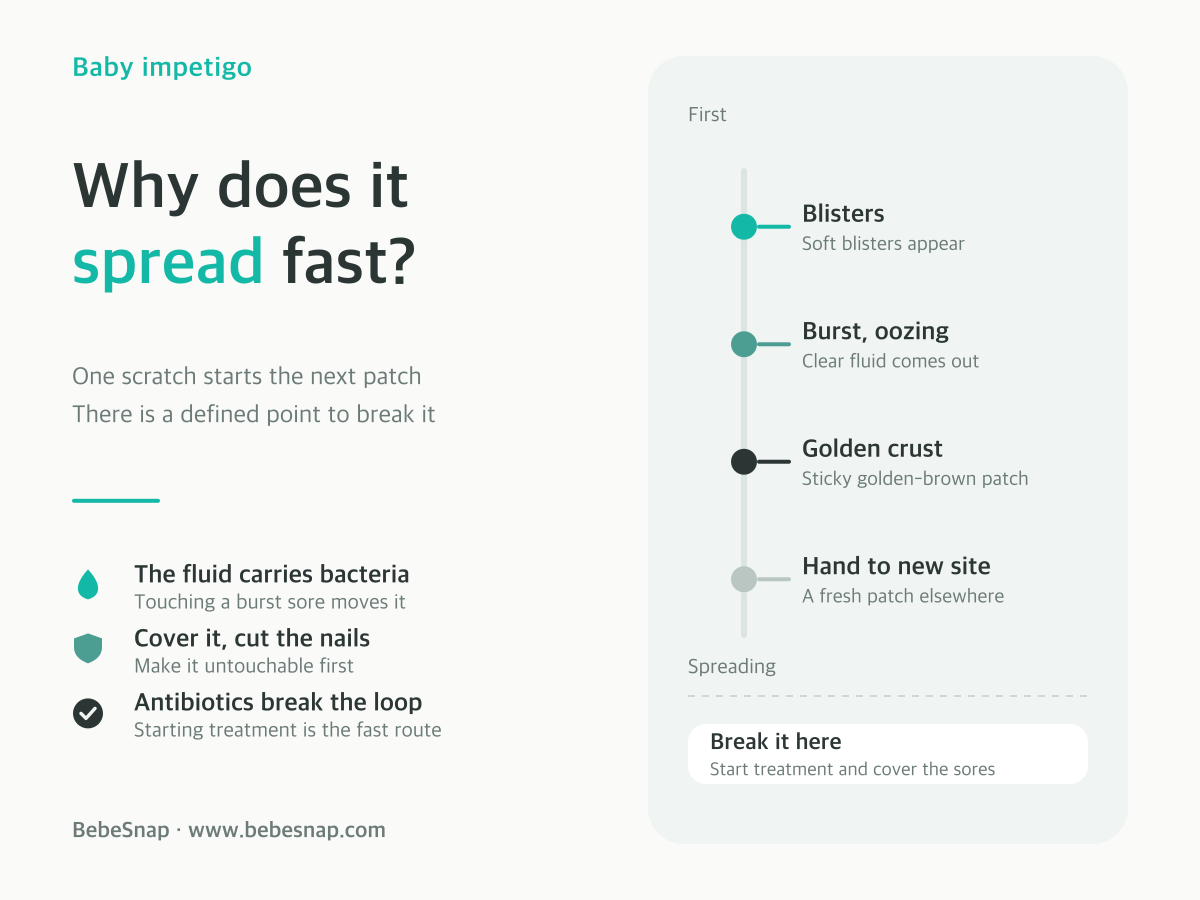
Impetigo is very contagious. When a child touches the sores and then touches somewhere else, a new patch starts there. It also spreads through towels, bedding and clothes. If there are siblings, separate the towels and bedding first.
Treatment
Mild cases are treated with hydrogen peroxide cream or an antibiotic cream. The NHS notes that antibiotic tablets are used for babies and for children with weakened immune systems.
💡 Do not stop the cream or the tablets early, even if the skin looks better. Surviving bacteria restart the infection. Finish the full course.When nursery is safe again
The NHS guidance is that impetigo stops being contagious 48 hours after starting hydrogen peroxide cream or antibiotics. Without treatment, it stays contagious until the patches dry out and crust over, which takes much longer.
So the fastest route back to nursery is not waiting. It is starting treatment.
Stopping it spreading at home
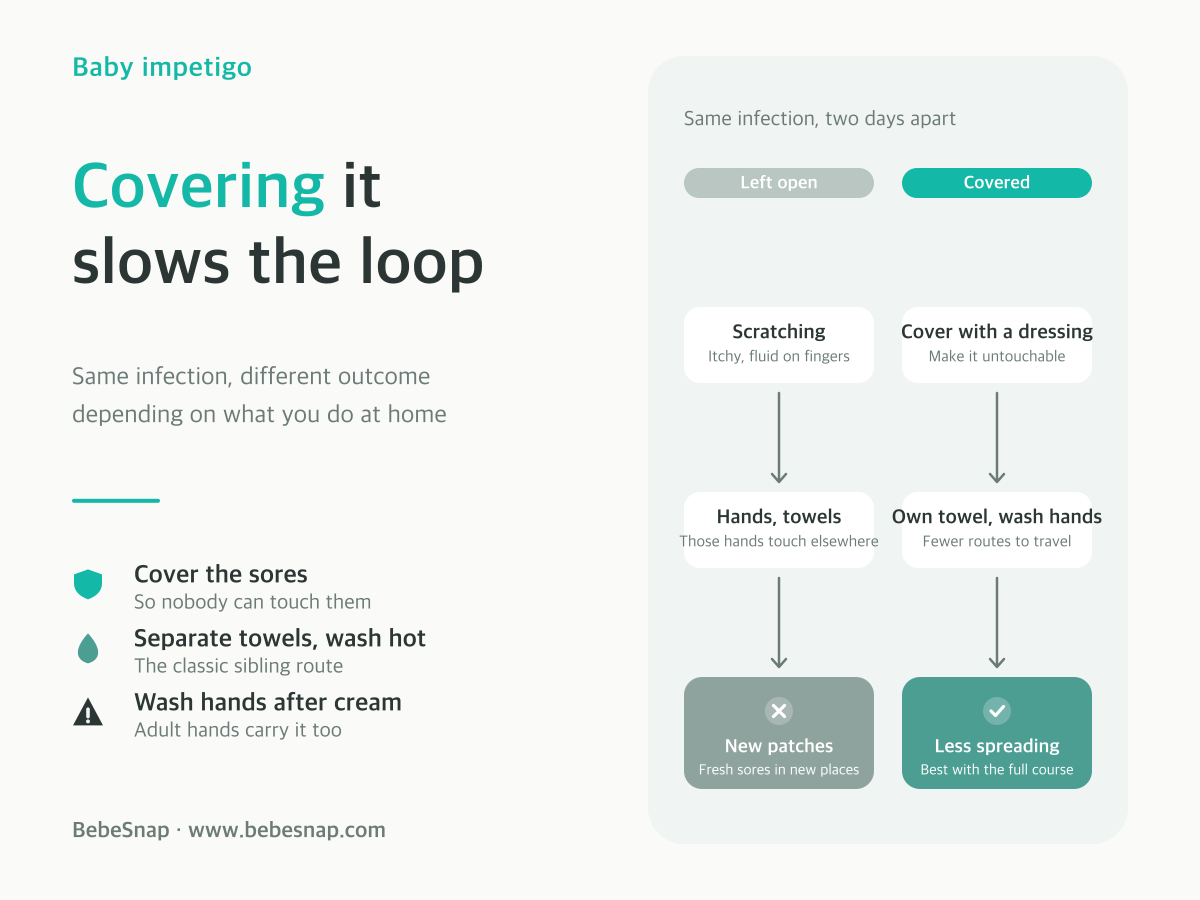
Cover the sores: a light dressing stops both the child touching them and the sores touching everything else.
Keep nails short: scratching is how the next patch begins.
Separate towels and bedding, wash hot: shared towels are the classic sibling route.
Wash hands: the child's and yours, and always after applying cream.
Skip swimming for now: water is another way it reaches other children.
When to see a doctor
- Your child is 11 months or younger: see a GP rather than self-treating
- The sores keep spreading despite treatment
- There is fever or your child seems unwell
- Impetigo keeps coming back
- You are breastfeeding and have sores on your breasts
Tracking skin problems with BebeSnap
- Use AI skin analysis to keep a dated record of how the patches change, and show the doctor the actual progression
- Log temperature so a developing fever does not slip past you
- Log medication so you know exactly which day of the antibiotic course you are on
- Keep separate records per child so you can see when a sibling picked it up
Frequently Asked Questions (FAQ)
Q: How do I tell impetigo from eczema?
A: Look at the crust and the speed. Impetigo leaves sticky golden-brown crusts after blisters or pustules burst, and it spreads to new areas within days because the child transfers it by touch. Eczema is dry and itchy, tends to sit in skin folds such as the elbows and behind the knees, and does not travel across the body that quickly. If you are unsure, getting it looked at is faster than guessing.
Q: When can my child go back to nursery?
A: The NHS advises that impetigo stops being contagious 48 hours after starting hydrogen peroxide cream or antibiotics. Untreated, it stays contagious until the patches have dried and crusted over, which takes considerably longer. Starting treatment promptly is therefore the fastest way back to nursery. Keep the sores covered even after returning.
Q: Does my baby definitely need antibiotics?
A: Mild, limited impetigo is often treated with hydrogen peroxide cream or antibiotic cream alone. Wider or more severe infection is treated with antibiotic tablets, and the NHS notes tablets are used for babies specifically. Whichever is prescribed, finish the whole course, because stopping when the skin looks better lets the remaining bacteria restart the infection.
Q: How do I stop it spreading to siblings?
A: Give each child their own towel and bedding and wash everything at a high temperature. Keep the affected child's nails short and cover the sores so they cannot be touched. Wash your own hands every time you apply cream. Because the fluid and crusts carry the bacteria, it is also worth avoiding shared baths and swimming for the time being.
References
Check Your Baby's Health from One Photo
AI stool analysis reads color and texture, and keeps every health record in one place.
See what the app does firstMedical Disclaimer: This article is for informational purposes only and does not replace professional medical advice. If you have concerns about your baby's health, please consult a pediatrician.
You Might Also Like
Tomato for Babies: When to Start, Skin and Seeds, and Why Cherry Tomatoes Are Never Served Whole
Apple for Babies: Stage-by-Stage Portions and When Raw Apple Is Safe
Spinach for Babies: When to Start, Why Boiling Matters, and When to Skip It
Potato for Babies: When to Start, Safe Shapes, and Why Never to Blend It
You Might Also Like

Baby Mouth Sores (Stomatitis): Causes, How to Tell Them Apart, and Dehydration Signs
Is your baby drooling and refusing to eat? Mouth ulcers usually heal in 10 to 14 days and the pain eases within 3 to 4 days. Here is how to tell the common causes apart and the dehydration signs that mean you should call a doctor.

Baby Iron Deficiency Anemia | Blood Test Results, Iron Supplements & Treatment Guide
Hemoglobin below 11g/dL signals anemia in babies. Learn how to read ferritin, MCV, and other blood test values, plus iron supplement dosing, side effects, and follow-up schedules.

Baby UTI Symptoms: When Fever Is the Only Sign, and Why the Urine Test Comes First
Fever with no cough, no runny nose, nothing else? In children under 2, fever is often the only sign of a urinary tract infection. Here is why an unexplained fever deserves a urine test, how the sample is collected, and what treatment looks like.