Late Afternoon Nap: How Late Is Too Late, and When Do Babies Drop the Third Nap?
See Your Baby's Sleep Pattern Emerge
Get Started FreeWhen your baby starts nodding off in the late afternoon, it's hard to know whether a nap now will push bedtime too late. Many babies start dropping this late nap, the third nap of the day, between 6 and 9 months. In a study that followed 172 children from 6 months to 7 years, two naps a day was well established by 9 to 12 months. How late is too late depends on your baby's bedtime rather than the clock, because most babies aged 6 to 12 months are ready for bed somewhere between 6 pm and 10 pm. In a Japanese study of 50 toddlers about 1.5 years old, the later a nap ended, the later they fell asleep at night.
💡 Many babies drop the late afternoon nap between 6 and 9 months, and two naps a day is well established by 9 to 12 months. Set the cutoff by your baby's bedtime. If bedtime slips later on days with a late nap, it's time to shorten or drop it.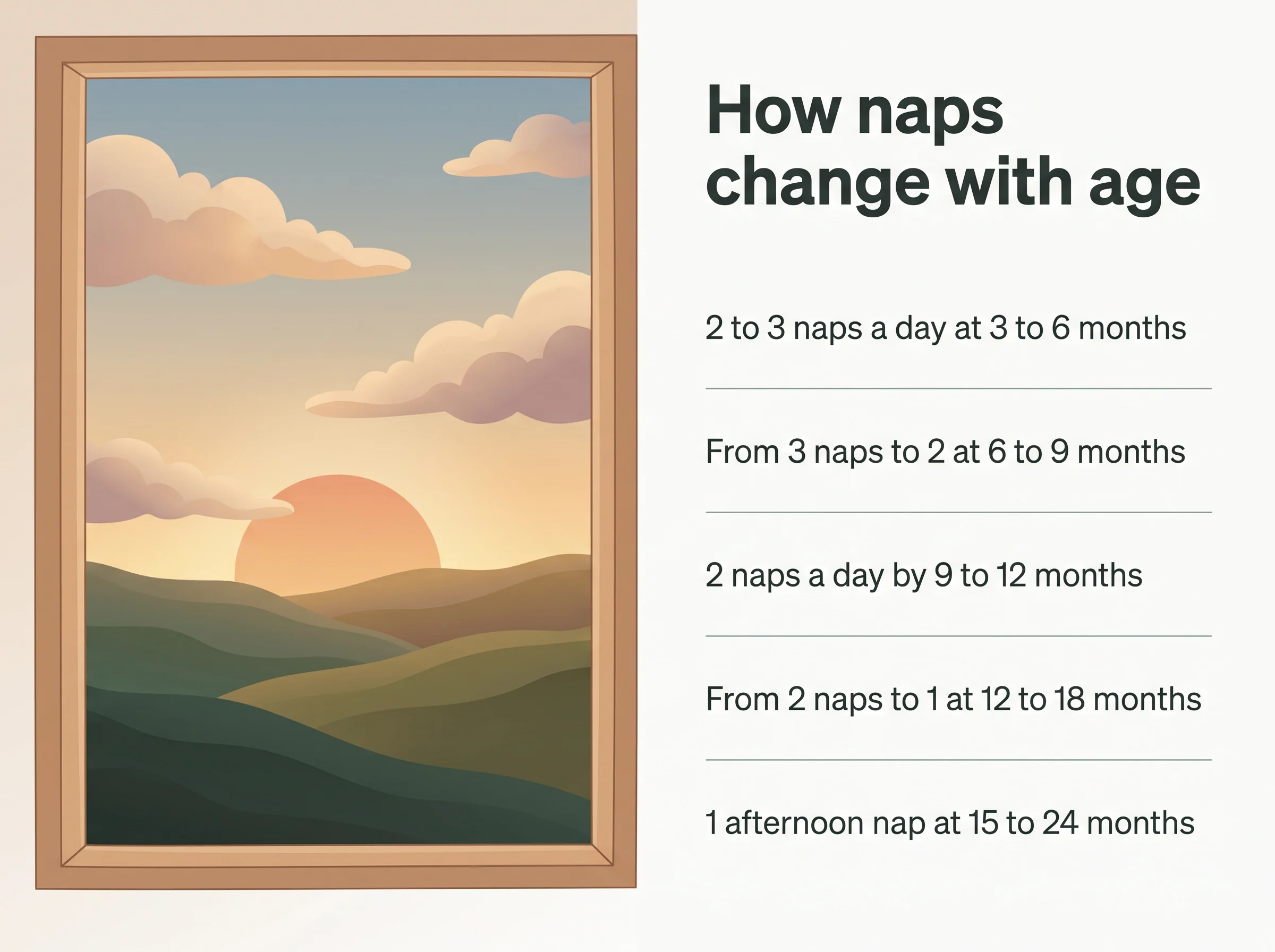
When Do Babies Drop the Third Nap?
The late afternoon nap is the short nap a baby takes before evening, the last of three naps a day. The number of naps drops as babies grow. This table brings together what health organizations and research say about nap counts by age.
| Age | Naps |
|---|---|
| 3 to 6 months | 2 to 3 a day, each up to 2 hours |
| 6 to 9 months | May drop from 3 to 2 |
| 9 to 12 months | 2 a day, well established |
| 12 to 18 months | From 2 to 1 |
| 15 to 24 months | 1 in the afternoon |

Australia's Raising Children Network says babies aged 3 to 6 months might start moving toward a pattern of 2 to 3 daytime sleeps of up to 2 hours each. The Sydney Children's Hospitals Network (SCHN) says babies may drop from three naps to two at 6 to 9 months, and that the change can take a while to get used to.
In pediatrician Marc Weissbluth's 1995 study, which followed 172 children from 6 months to 7 years, two naps a day was well established by 9 to 12 months and one afternoon nap by 15 to 24 months. New Zealand's Plunket says toddlers will likely be ready to move from two naps to one between 12 and 18 months.
Babies vary a lot, though. Raising Children Network says most babies aged 6 to 12 months are still having 2 to 3 naps of between 30 minutes and 2 hours, and Nemours KidsHealth says babies aged 8 to 12 months will likely still take two naps a day. In the 172-child study, the number of naps a baby took at 6 months made no difference to their later nap patterns. There's no need to worry about whether your 6-month-old takes two naps or three.
Babies aged 4 to 12 months need 12 to 16 hours of sleep a day, including naps (American Academy of Sleep Medicine, endorsed by the AAP). Nemours says babies aged 4 to 7 months take at least two naps a day, with about 3 to 4 hours of daytime sleep in total.
How Late Is Too Late for a Nap?
Let your baby's bedtime, not the clock, set the cutoff. Raising Children Network says most babies aged 6 to 12 months are ready for bed between 6 pm and 10 pm. Bedtimes can differ by up to four hours, so the right time to end the late nap differs too.
Research suggests that a nap that ends late can push bedtime later. In a 2016 Japanese study, researchers fitted 50 toddlers about 1.5 years old with activity monitors for 7 days. The later a nap ended, the later the children fell asleep and the shorter their night sleep was. Longer naps had the same effect. The researchers suggested that naps starting early in the afternoon, with their length kept in check, may help toddlers sleep longer at night. KidsHealth New Zealand also says a long or late nap can leave a toddler not ready for bed until late at night. Both sources are about toddlers rather than babies on three naps, but they show how a late nap and bedtime are linked.
Here's how to fit the late nap in:
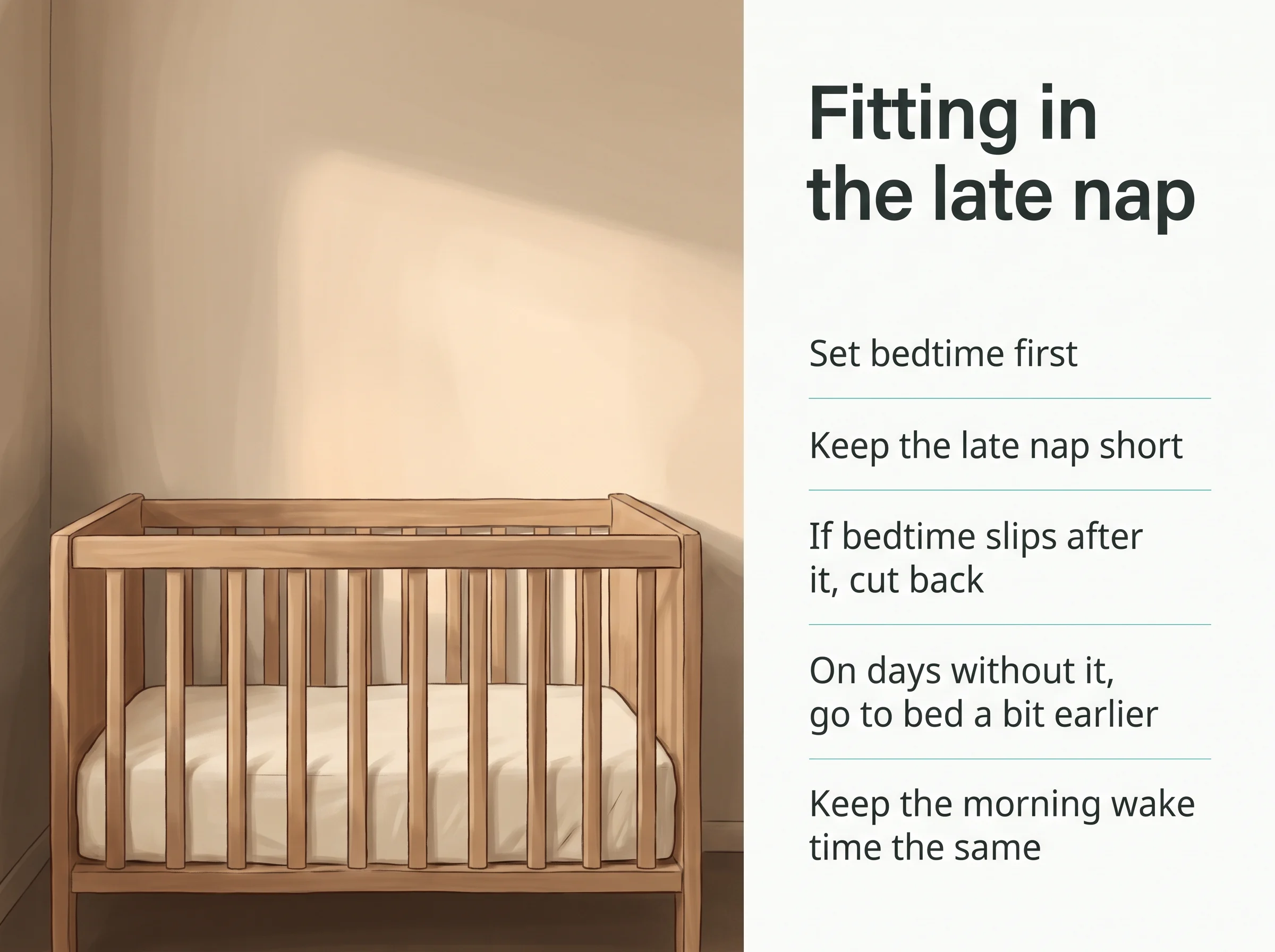
- Set bedtime first: Keeping the same waking time, mealtimes, nap time and play times every day helps children feel secure and makes bedtime smoother (AAP). Once bedtime is set, you know when the late nap needs to end.
- Keep the late nap short: Long naps can push bedtime later (KidsHealth New Zealand and the Japanese study).
- Track a week of sleep: If you're concerned, Raising Children Network suggests charting when your baby falls asleep and wakes up for 5 to 7 days. Checking what time your baby fell asleep after a late nap shows what works for your baby.
- Watch your baby's mood: A baby who is awake and content is probably getting enough sleep. A baby who is awake and grizzly might need more (Raising Children Network).
Signs It's Time to Drop the Late Nap
As babies get older, they sleep less during the day and stay awake longer between naps (Raising Children Network). These signs suggest it may be time to drop the third nap:
- Your baby naps well otherwise but fights the late nap: Plunket says that when a toddler goes down easily for one nap but the other is generally a struggle, they're ready to move from two naps to one. The same sign can apply to the third nap.
- Bedtime gets later after a late nap: This matches research linking late naps with falling asleep later (the Japanese study and KidsHealth New Zealand).
- Your baby stays happy until bedtime without it: Being awake and content is a sign of enough sleep (Raising Children Network). If your baby is grizzly and unsettled in the evening without the nap, they may still need it.
Babies can also keep themselves awake when something interesting is happening or when they're somewhere bright and noisy (Raising Children Network). Don't decide based on one busy day; watch for a few days.
How to Drop the Late Nap
- Go gradually: Moving from three naps to two can take a while to get used to (SCHN). When toddlers drop from two naps to one, Plunket suggests moving the nap by 30 minutes every few days and says it may take a few weeks to settle into the new routine.
- On days without it, go to bed a bit earlier: If your child gives up a nap, Nemours suggests setting an earlier bedtime.
- Offer a rest if the evening is a struggle: The remaining naps may be shorter than usual during the change. Plunket suggests a rest or a catnap to help a toddler get through to bedtime without getting overtired.
- Keep the morning wake time the same: Waking at the same time every day helps (AAP). A later bedtime doesn't usually make children wake up later (Plunket).
Where Should the Late Nap Happen?
The late nap sometimes happens during errands or on the drive home. If your baby falls asleep in a car seat, stroller, swing, infant carrier or sling, move them to a firm, flat sleep surface on their back as soon as possible (AAP). Place your baby on their back for every nap, just like at night, with nothing else in the sleep space.
If Your Toddler Takes One Nap
Once your child is down to one nap, the concern shifts from an evening nap to an afternoon nap that runs late. In the Japanese study, toddlers about 1.5 years old woke from their naps at 3:13 pm on average, and the later they woke, the later they fell asleep at night. KidsHealth New Zealand also says a long or late nap can mean a toddler isn't ready for bed until late.
See toddler sleep hours from 1 to 2 years for daily totals, and when kids stop napping for dropping the nap altogether.
Compare Late Naps and Bedtimes with BebeSnap
When you're deciding whether to drop the late nap, compare days with and without it: what time your baby fell asleep at night. Log when your baby falls asleep and wakes up in the BebeSnap app to see the day's sleep at a glance, and show the log to your pediatrician if they ask for a sleep diary.
- Nap count: how many naps your baby took today
- Average bedtime: when your baby usually falls asleep
- Today's total sleep: naps and night sleep added together
- Family sharing: everyone who cares for your baby sees the same log
👉 See how BebeSnap sleep tracking works
Frequently Asked Questions (FAQ)
Q: How late can a baby nap in the evening?
A: It depends on your baby's bedtime rather than a set clock time. Most babies aged 6 to 12 months are ready for bed between 6 pm and 10 pm, so the cutoff varies (Raising Children Network). In a Japanese study of 50 toddlers, the later a nap ended, the later they fell asleep. If bedtime slips after a late nap, shorten or drop it.
Q: When do babies drop the third nap?
A: Babies may drop from three naps to two between 6 and 9 months (Sydney Children's Hospitals Network), and in a study of 172 children, two naps a day was well established by 9 to 12 months. Many babies aged 6 to 12 months still take 2 to 3 naps, so the timing varies (Raising Children Network).
Q: Should my baby go to bed earlier on days without the late nap?
A: Yes. If a child gives up a nap, Nemours suggests setting an earlier bedtime. Keep the morning wake time the same and move bedtime a little earlier instead. A later bedtime doesn't usually make children wake up later the next morning (Plunket).
Q: Does a late afternoon nap affect a toddler's bedtime?
A: It can. In a Japanese study of 50 toddlers about 1.5 years old, naps ended at 3:13 pm on average, and the later a nap ended, the later the child fell asleep and the shorter their night sleep. KidsHealth New Zealand also says a long or late nap can leave a toddler not ready for bed until late.
References
- Raising Children Network - Baby Sleep Patterns at 2-12 Months
- Sydney Children's Hospitals Network - Sleep Recommendations for Babies (0-12 Months)
- Weissbluth, Sleep (1995) - Naps in Children: 6 Months to 7 Years
- Nakagawa et al., Scientific Reports (2016) - Daytime Nap Controls Toddlers' Nighttime Sleep
- Nemours KidsHealth - Baby Sleep: 8- to 12-Month-Olds
- Nemours KidsHealth - Sleep and Your 4- to 7-Month-Old
- Nemours KidsHealth - Naps
- Whānau Āwhina Plunket - Sleep: 1-2 years
- KidsHealth New Zealand - Normal Sleep: Toddlers 1 to 3 Years
- AAP HealthyChildren - Healthy Sleep Habits: How Many Hours Does Your Child Need?
- AAP HealthyChildren - A Parent's Guide to Safe Sleep
See Your Baby's Sleep Pattern Emerge
Track sleep and watch wake windows and night stretches appear as clear graphs.
See what the app does firstMedical Disclaimer: This article is for informational purposes only and does not replace professional medical advice. If you have concerns about your baby's health, please consult a pediatrician.
You Might Also Like
Kaup Index (Baby BMI): How to Calculate It and What's Normal by Age
Wonder Weeks Calculator: Your Baby's 10 Mental Leaps From the Due Date
Baby Weight Gain Calculator: Grams Per Day From Two Weigh-Ins
Baby Impetigo: Golden Crusts, Antibiotic Treatment, and When Nursery Is Safe Again
You Might Also Like
Baby Crying in Sleep: Why It Happens and Whether You Should Pick Them Up
Is your baby crying in their sleep with their eyes closed? Babies spend a lot of time in light, active sleep, and newborn sleep cycles last about 40 minutes, so whimpers and short cries are common. In an overnight video study, about 1 in 4 babies woke and settled back to sleep with no help from a parent. Here is when a short pause is fine, when to go in right away, and how to respond at each age.

Baby Eye Discharge & Conjunctivitis Guide: Causes, Home Care & When to See a Doctor
Yellow or green discharge in your baby's eye? From blocked tear ducts (6-20% of newborns) to bacterial and viral conjunctivitis, learn how to tell the difference and when to see a doctor.
6-Month Sleep Regression: Why Your Baby Is Waking Again and How Much Sleep They Need
Is your 6-month-old waking at night again? About 4 in 10 babies this age don't yet sleep 6 hours straight, and the AAP says it is normal for a 6-month-old to wake and fall back asleep within a few minutes. Babies 4 to 12 months need 12 to 16 hours of sleep a day, naps included. Here are the common causes, what helps, and how to keep sleep safe once your baby rolls.