How Much Sleep Does a 1- to 2-Year-Old Need? Toddler Sleep Hours, Naps and Bedtime
See Your Baby's Sleep Pattern Emerge
Get Started FreeOnce your child turns one, naps start to shift and bedtime can turn into a negotiation, so it's natural to wonder whether they're getting enough sleep. Children aged 1 to 2 need 11 to 14 hours of sleep in 24 hours, naps included. That's the American Academy of Sleep Medicine (AASM) recommendation, endorsed by the American Academy of Pediatrics (AAP). Most toddlers sleep 10 to 12 hours at night and 1 to 2 hours during the day, and many drop from two naps to one between 12 and 18 months. To set bedtime, start from the time your child wakes up and count backward.
💡 Ages 1 to 2: 11 to 14 hours of sleep a day, naps included. Typically 10 to 12 hours at night plus 1 to 2 hours of naps, with two naps becoming one between 12 and 18 months. The usual pattern matters more than any single day.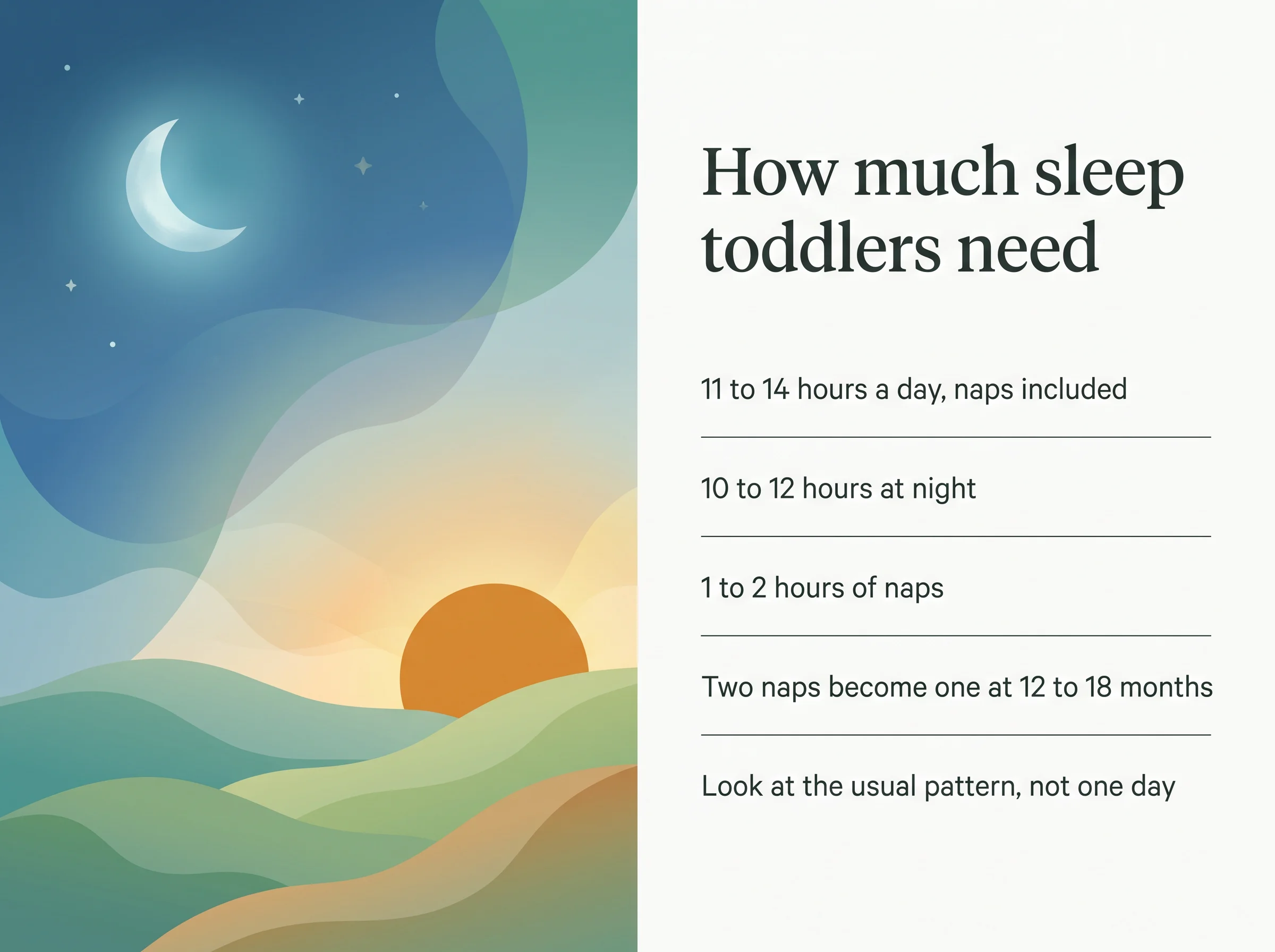
How Many Hours Should a 1- to 2-Year-Old Sleep?
The AASM recommends that children 1 to 2 years old sleep 11 to 14 hours per 24 hours, including naps, on a regular basis. The AAP supports these guidelines. The figure is a 24-hour total, so if your toddler still naps, add nap time to night sleep.
| Age | Sleep per 24 hours (including naps) |
|---|---|
| 4 to 12 months | 12 to 16 hours |
| 1 to 2 years | 11 to 14 hours |
| 3 to 5 years | 10 to 13 hours |

Sleeping this amount regularly is linked with better attention, behavior, learning, memory and emotional regulation. Regularly sleeping less is associated with attention, behavior and learning problems, and regularly sleeping more than recommended may also be linked with health problems. If you're worried your child sleeps too little or too much, the AASM suggests asking your pediatrician about a possible sleep disorder.
Night Sleep and Naps: 10 to 12 Hours at Night, 1 to 2 by Day
KidsHealth, run by the Paediatric Society of New Zealand, says toddlers usually sleep around 10 to 12 hours at night and 1 to 2 hours during the day. Whānau Āwhina Plunket, a New Zealand child health service, says toddlers are likely to be ready to move from two naps to one between 12 and 18 months. Some still need two naps at 12 to 18 months, and by age 3 a child may have one nap or none at all (KidsHealth).
- One nap becomes a struggle: if your toddler goes down easily for one nap but resists the other most days, they're likely ready for one nap a day (Plunket).
- Shift it gradually: move the nap about 30 minutes later every few days until it lands around lunchtime. The single nap may be shorter at first, and it can take a few weeks to settle (Plunket).
- Not too long, not too late: a long nap, or one late in the day, can keep your toddler awake until late at night (KidsHealth).
For nap timing by age, see our baby nap schedule. For a toddler who fights naps, see nap refusal.
What Time Should a Toddler Go to Bed? Count Back From Wake-Up
The recommendation is a number of hours, not a clock time, so start from wake-up. A toddler who wakes at 7 a.m. and sleeps 10 to 12 hours at night should be asleep between 7 and 9 p.m.
- A later bedtime rarely means a later wake-up: Plunket notes that putting a toddler to bed later doesn't usually make them wake later. They may wake just as early and be grumpy from too little sleep.
- The same wake time every day: the AAP suggests keeping the same waking time on weekdays and weekends, along with regular meal, nap and play times, to help your child feel secure and make bedtime smoother.
- Bright mornings, active days: expose your child to bright light at wake-up time, and give them physical activity and fresh air during the day (AAP).
If your toddler is up before dawn, see early morning waking.
Daily Habits That Help Toddlers Sleep
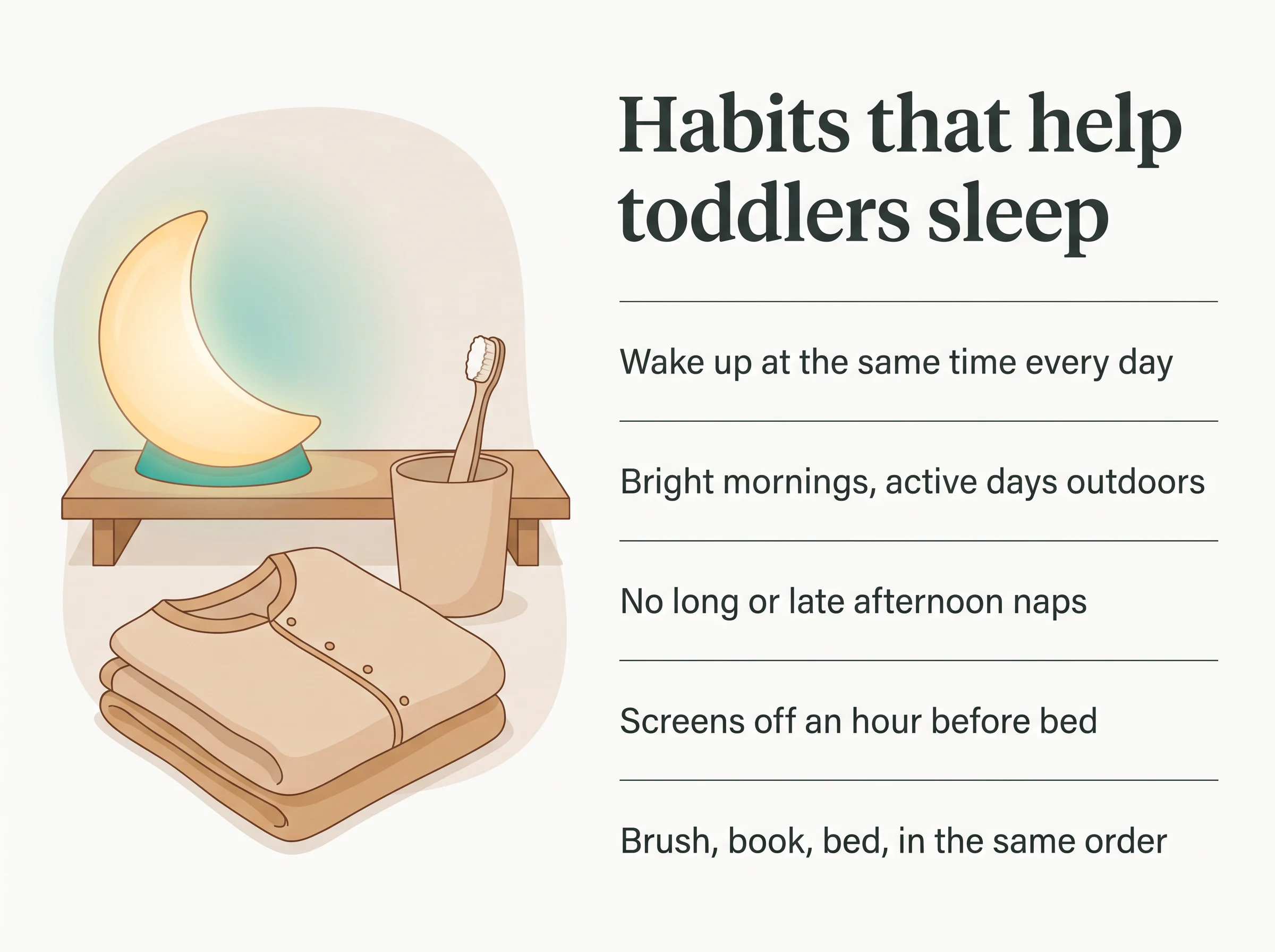
- Screens off an hour before bed: the AAP recommends turning off all screens at least 60 minutes before bedtime and keeping TVs, tablets and phones out of children's bedrooms.
- The same bedtime routine every night: for young children, a simple routine such as brush, book, bed helps (AAP). Keep it the same on weekends too (KidsHealth).
- A dark, quiet room: keeping the room dark and reducing loud noise can help a toddler settle (KidsHealth).
For building a routine step by step, see our baby bedtime routine.
When to Talk to Your Pediatrician
- Snoring or breathing pauses: frequent snoring, problems breathing during the night, daytime sleepiness, trouble paying attention and behavior problems can be signs of sleep apnea. The AAP says to let your pediatrician know right away.
- Call 911: if your child's breathing stops for more than 20 seconds, their skin turns pale, bluish or grayish, or there's a change in muscle tone, a fever or other signs of illness, call 911 or your local emergency number (AAP).
- Too little or too much sleep: if you're concerned your child regularly sleeps too little or too much, ask your pediatrician about a possible sleep disorder (AASM).
If night waking suddenly increases around the first birthday, see 12- and 18-month sleep regressions. For snoring, sleep talking and night terrors, see unusual sleep behaviors.
Track Daily Sleep with BebeSnap
When naps and night sleep are logged separately, adding up the day's total gets tedious. Log when your toddler falls asleep and wakes up in the BebeSnap app, and you can see the daily total of naps plus night sleep right away.
- Today's total sleep: naps and night sleep added together
- Nap count: how many naps your child took today
- Average bedtime: when your child usually falls asleep
- Family sharing: everyone who cares for your child sees the same log
👉 See how BebeSnap sleep tracking works
Frequently Asked Questions (FAQ)
Q: How many hours a day should a 1-year-old sleep?
A: The AASM, endorsed by the AAP, recommends 11 to 14 hours per 24 hours for children aged 1 to 2, naps included. Most toddlers sleep about 10 to 12 hours at night and 1 to 2 hours during the day. Look at your child's usual pattern rather than a single night.
Q: How much night sleep does a 2-year-old need?
A: Many 2-year-olds sleep 10 to 12 hours at night, and together with a nap the daily total should fall within 11 to 14 hours. A toddler who wakes at 7 a.m. would be asleep between 7 and 9 p.m. If your child regularly sleeps less or more than this, talk with your pediatrician.
Q: When do toddlers go from two naps to one?
A: Often between 12 and 18 months, according to New Zealand's Plunket. A sign of readiness is going down easily for one nap but resisting the other most days. Move the nap about 30 minutes later every few days until it settles around lunchtime, and expect shorter naps for a few weeks.
Q: If I put my toddler to bed later, will they sleep in?
A: Usually not. Plunket notes that a later bedtime doesn't usually lead to a later wake-up, so your child may simply get less sleep and be grumpy. Choose a steady wake-up time, then count back 10 to 12 hours of night sleep to set bedtime.
References
- American Academy of Sleep Medicine - Recommended Amount of Sleep for Pediatric Populations (2016)
- AAP HealthyChildren - Healthy Sleep Habits: How Many Hours Does Your Child Need?
- AAP HealthyChildren - Sleep Apnea in Children: Detection & Treatment
- KidsHealth New Zealand - Normal Sleep: Toddlers 1 to 3 Years
- Whānau Āwhina Plunket - Sleep: 1-2 years
See Your Baby's Sleep Pattern Emerge
Track sleep and watch wake windows and night stretches appear as clear graphs.
See what the app does firstMedical Disclaimer: This article is for informational purposes only and does not replace professional medical advice. If you have concerns about your baby's health, please consult a pediatrician.
You Might Also Like
Kaup Index (Baby BMI): How to Calculate It and What's Normal by Age
Wonder Weeks Calculator: Your Baby's 10 Mental Leaps From the Due Date
Baby Weight Gain Calculator: Grams Per Day From Two Weigh-Ins
Baby Impetigo: Golden Crusts, Antibiotic Treatment, and When Nursery Is Safe Again
You Might Also Like
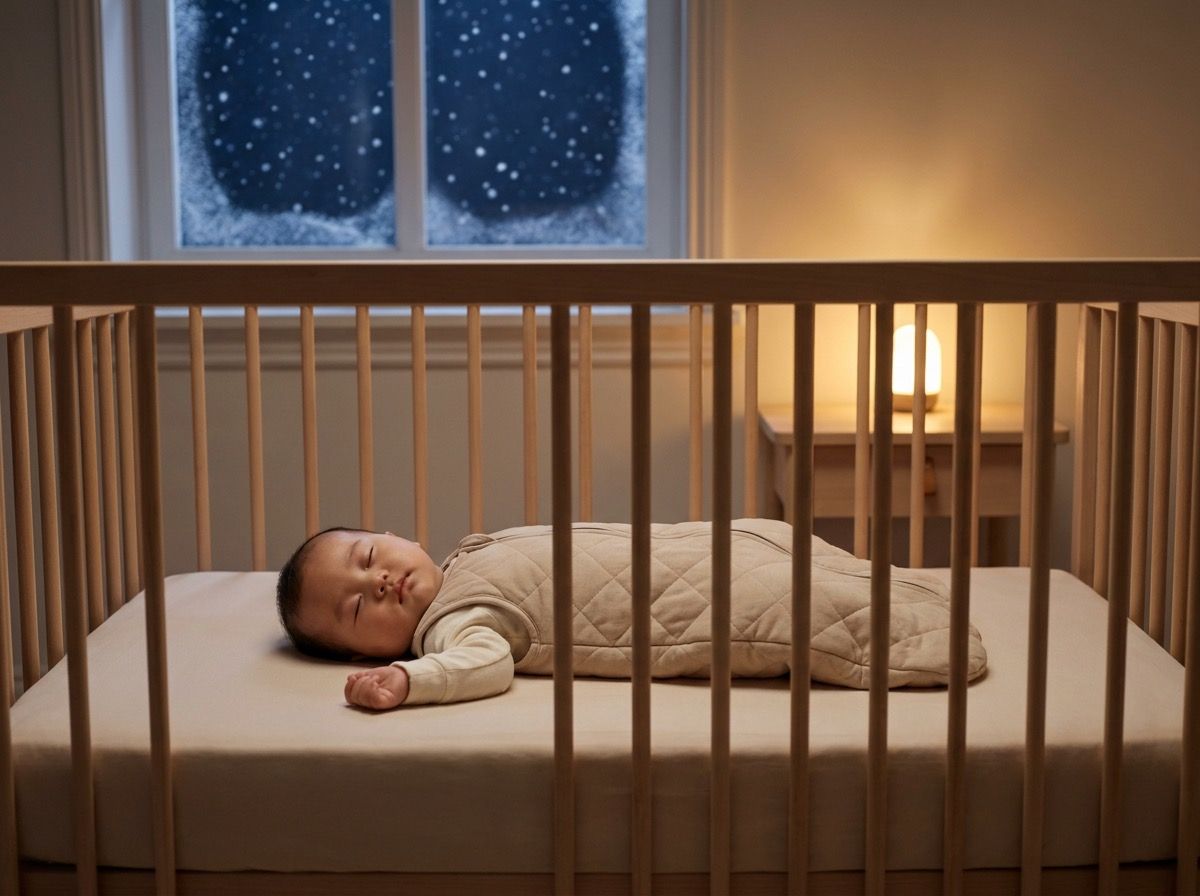
Keeping Baby Warm at Night in Winter: Layers, Sleep Sacks, Heating Pads and Cold Hands
Keep your baby warm at night with layers or a sleep sack instead of blankets: no more than one layer more than you'd wear (AAP). Skip hats indoors, heating pads and hot water bottles, and check the chest or back of the neck, not cold hands.

Toddler Tantrums: Why They Happen and How to Respond in the Moment
Tantrums aren't bad behavior; they're a normal part of brain development from ages 1–3. Common myths, a 4-step response, prevention, and red flags.
When Can a Newborn Use a Pacifier? Sleep Time, SIDS, Falling Out and When to Stop
Formula-fed babies can start a pacifier anytime; breastfed babies should wait until feeding is going well, usually 3 to 4 weeks (AAP). Offer it at naps and bedtime to lower SIDS risk, leave it out if it falls out, and aim to stop by 36 months.