10-11 Month Baby Development Guide: Milestones, Activities & Feeding
Keep Every Growth Milestone
Get Started FreeThe 10-11 month stage is one of the most exciting periods in your baby's first year. Every day brings something new, pulling to stand, cruising along furniture, saying "mama" or "dada" with meaning, and picking up tiny pieces of food with a precise pincer grasp. Your baby is growing physically, cognitively, and socially at an incredible pace. But remember: every baby develops on their own timeline. Rather than comparing your child to others, celebrate the milestones your baby reaches in their own time. This guide covers everything about 10-11 month development: motor milestones, cognitive growth, language, social-emotional changes, sleep, feeding, play ideas, and when to talk to your pediatrician.
Physical Development (Gross Motor)
At 10-11 months, your baby is learning to navigate the world on two feet.
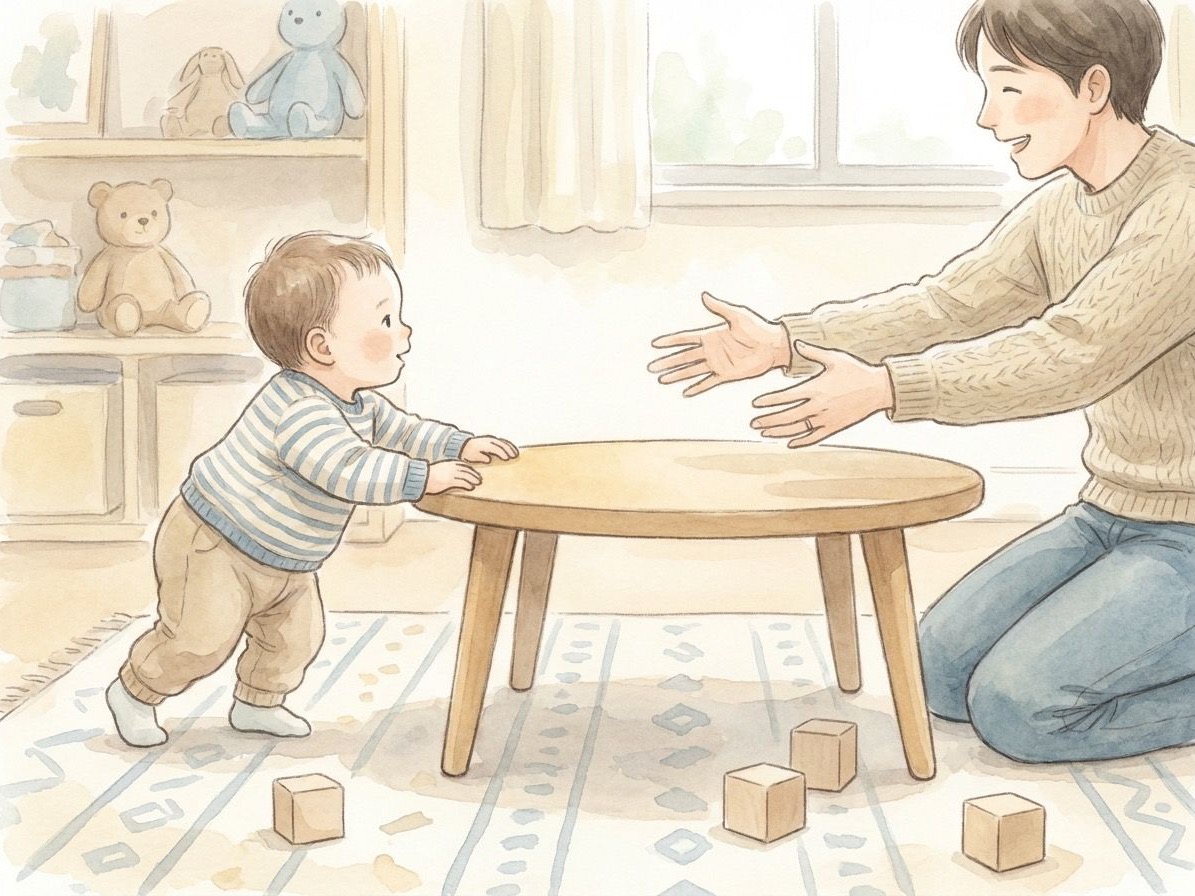
Pulling to stand, cruising, and first steps
- Most babies can pull themselves to a standing position using furniture, people, or anything within reach
- Once standing, many begin cruising, walking sideways while holding onto furniture for support
- Some babies may stand unsupported for a few seconds around 11 months, and a few may even take their first independent steps
- The age for first independent walking ranges widely from 9 to 18 months; there is enormous individual variation
Diverse crawling styles
- Babies move in all sorts of ways: classic hands-and-knees crawling, army crawling (belly crawling), scooting on their bottom, or bear-walking on hands and feet
- Some babies skip crawling entirely and go straight to pulling up and cruising
Balance and coordination
- Can sit independently and use both hands freely while seated
- Transitions smoothly between positions: sitting to crawling, crawling to sitting, crawling to standing
- Can squat down to pick up an object from the floor and stand back up
Physical Development (Fine Motor)
This is the age when hand and finger skills take a major leap forward.
Pincer grasp development
- Your baby can now pick up small objects precisely between the thumb and index finger
- At 10 months, you will see an immature pincer grasp (using finger pads); by 11-12 months, a mature pincer grasp (using fingertips) develops
- Babies use this skill to self-feed small pieces of food like cereal, soft fruit, and vegetables
Hand manipulation skills
- Transfers objects from one hand to the other
- Enjoys putting objects into containers and taking them out again
- Attempts to stack 2-3 blocks
- Tries to turn pages in a book (several pages at a time)
- Reaches for spoons and cups during mealtimes
Cognitive Development
Curiosity is exploding. Your baby's brain is developing rapidly during this period.
Object permanence matures
- Your baby fully understands that objects continue to exist even when hidden from view
- Actively searches for hidden toys, lifting cups, pulling cloths away
- This cognitive milestone is also the root of separation anxiety (your baby now knows that when you leave the room, you still exist somewhere, and they want you back)
Cause and effect understanding
- Understands that pressing a button produces a sound and repeats the action intentionally
- Knows that dropping an object makes it fall, and deliberately drops things over and over to test this
- Begins to understand the function of everyday objects (holds a toy phone to their ear, pretends to brush hair with a comb)
Imitation skills
- Watches adults closely and copies their actions (clapping, waving, blowing kisses)
- Imitates simple play actions (peekaboo, pat-a-cake)
- Mimics everyday activities like sweeping, talking on the phone, or stirring food
Language Development
The door to first words is opening.
Expressive language
- May begin saying meaningful first words like "mama" and "dada" directed at the correct parent
- Babbling takes on the rhythm and intonation of real conversation (conversational babbling)
- Points at objects and vocalizes to communicate wants
- Uses gestures: shaking head for "no," waving for "bye-bye"
Receptive language (understanding)
- Understands "no" and responds (may pause or look at you)
- Turns when their name is called
- Follows simple instructions: "wave bye-bye," "clap your hands"
- Looks at familiar objects when you name them ("Where is the ball?" prompts baby to look for the ball)
Social and Emotional Development
Emotions are becoming richer and more complex.
Separation anxiety (peak period)
- 10-11 months is the peak of separation anxiety for most babies
- Your baby may cry intensely when you leave the room or are out of sight
- This is a completely normal developmental phase; it actually proves that object permanence is maturing
- It typically eases between 18 and 24 months
Stranger wariness
- Shows caution or fear around unfamiliar people
- May hide behind a parent, cling, or cry when approached by strangers
- Smiles at familiar people but stiffens or turns away from those they do not know
Social interaction
- Begins to "share" by handing toys to others
- Shows interesting objects to parents ("Look at this!")
- Shows interest in other babies but plays alongside them rather than together (parallel play)
- Responds to praise with smiles and to scolding with sadness or tears
Sleep Patterns
| Category | 10 Months | 11 Months |
|---|---|---|
| Total sleep | 13-15 hours | 13-15 hours |
| Nighttime sleep | 10-12 hours | 11-12 hours |
| Naps | 2 naps, 2.5-3.5 hours total | 2 naps, 2-2.5 hours total |
| Wake windows | 2.5-3.5 hours | 3-4 hours |
| Sleep disruptions | Separation anxiety may cause night waking | May resist naps (attempt to drop to 1 nap) |
Sleep tips
- Maintain a consistent bedtime routine (bath, book, feed, sleep)
- When separation anxiety is intense, provide extra physical closeness and comfort before bed
- If your 11-month-old starts resisting naps, do not rush to drop to one nap; most babies are not ready for the 2-to-1 nap transition until 14 to 18 months
Feeding and Nutrition
At 10-11 months, your baby is in the late weaning stage, discovering the joy of self-feeding.
Finger food stage
- Self-feeds soft cooked vegetables, fruit pieces, cheese cubes, and more using the pincer grasp
- With the pincer grasp now refined, even small pieces of food can be picked up independently
- Expose your baby to a wide variety of textures and flavors
Meal structure
- 3 solid meals per day plus 1-2 snacks
- Breast milk or formula intake decreases to about 500-700ml per day
- Most nutrition now comes from solid foods rather than milk
Self-feeding skills
- Attempts to use a spoon (still messy and inaccurate)
- Practices drinking from a cup (straw cup or open cup)
- Throwing food on the floor is a normal part of exploring cause and effect
| Food group | Recommended finger foods | Size and preparation |
|---|---|---|
| Vegetables | Carrots, broccoli, sweet potato, potato | Well-cooked, cut into small 1cm pieces |
| Fruits | Banana, strawberry, watermelon, cooked pear | Soft, small pieces (cook firm fruit like pear until soft) |
| Protein | Tofu, chicken breast, beef, egg | Shredded or mashed finely |
| Grains | Soft rice, pasta, bread | Bite-sized pieces |
| Dairy | Cheese, plain yogurt | Small pieces or spoon-fed |

Play Activities by Development Domain
Here are play ideas organized by the developmental area they support.
Gross motor play
- Cruising encouragement: Place a favorite toy at one end of the sofa so your baby cruises toward it
- Push toys: Push walkers, carts, or wagons to practice walking with support
- Obstacle course: Create a small course with cushions and pillows for climbing and crawling over. Stay right beside your baby the whole time, since a baby who slips between pillows may not be able to get out and could smother, and put the cushions away afterward
- Ball play: Sit facing each other and roll a ball back and forth
Fine motor play
- Container play: Put small toys into a basket and let your baby take them out and put them back
- Stacking blocks: Offer large blocks and encourage stacking 2-3 at a time
- Board books: Read together and let your baby practice turning the thick pages
- Finger painting: Use baby-safe paint for sensory exploration with fingers
Cognitive and language play
- Peekaboo: Hide your face behind a cloth and reveal it (reinforces object permanence)
- Find the toy: Hide a toy under one of three cups and let your baby find it
- Read-aloud: Point to pictures and name animals, objects, and colors
- Songs with motions: Sing action songs like "Head, Shoulders, Knees, and Toes" or "Itsy Bitsy Spider"
Social-emotional play
- Pretend play: Use toy phones, dolls, and kitchen sets for early role-playing
- Give and take: Hand a toy to your baby, say "thank you," and practice exchanging
- Mirror play: Make funny faces in front of a mirror and let your baby imitate
Developmental Red Flags to Watch For
Every baby develops at their own pace, but consult your pediatrician if you notice any of the following.
- Cannot sit independently by 11 months
- Makes no attempt to pull to stand or hold onto furniture
- No babbling or very few vocalizations
- Does not respond to their own name
- Avoids eye contact or shows no interest in social interaction
- Uses only one hand exclusively and ignores the other
- Has lost skills they previously had (developmental regression)
- Uses only one side of the body (crawls using only one arm or leg)
Track Growth with BebeSnap
Do not let your baby's precious milestones slip by unrecorded. BebeSnap helps you track them all.
- Growth and milestone tracking: Record milestones across all domains, gross motor, fine motor, language, cognitive, and social-emotional
- Feeding log: Track 3 meals plus snacks and milk intake to understand your baby's nutrition patterns
- Sleep log: Record naps and nighttime sleep to optimize your baby's sleep routine
- AI development consultant: Have questions about your baby's development? Ask the AI chatbot
FAQ
Q: My baby is 11 months old and still not crawling. Should I be worried?
A: Not necessarily. Not all babies crawl. Some scoot on their bottom, bear-walk, or skip crawling entirely and go straight to pulling up and walking. As long as your baby is mobile in some way and other gross motor milestones (sitting, pulling to stand) are on track, there is typically no cause for concern.
Q: Separation anxiety is so intense that I cannot even use the bathroom. What should I do?
A: The 10-11 month period is the peak of separation anxiety, and it is a sign that your baby's cognitive development is progressing normally. Say "Mommy is going to the bathroom, I will be right back" and leave briefly. Never sneak away: disappearing without warning can actually worsen anxiety. Most babies naturally improve between 18 and 24 months.
Q: My baby has not said any words yet. Is this a delay?
A: The timing of first words varies enormously. Most babies say their first meaningful words between 12 and 18 months. If your 10-11 month old is not saying words yet but babbles with varied intonation, responds to their name, and understands simple instructions, their language development is within normal range. Keep talking to them!
Q: My baby keeps throwing food on the floor. Should I discipline them?
A: At this age, food throwing is part of cognitive development; your baby is experimenting with cause and effect ("When I drop this, it falls down"). Rather than discipline, calmly say "Food is for eating" and end the meal if throwing continues. Offer a separate ball-throwing activity to satisfy the urge to throw.
Q: Is it okay to use a baby walker?
A: Both the AAP and most pediatric organizations advise against seated baby walkers. They pose a serious risk of stairway falls and injuries and may actually delay normal walking development. Instead, use a push walker (a toy your baby pushes while walking behind it), which is safe and helps build walking skills naturally.
References
Keep Every Growth Milestone
Log height, weight, and milestones. The growth curves are drawn for you.
See what the app does firstYou Might Also Like
Tomato for Babies: When to Start, Skin and Seeds, and Why Cherry Tomatoes Are Never Served Whole
Apple for Babies: Stage-by-Stage Portions and When Raw Apple Is Safe
Spinach for Babies: When to Start, Why Boiling Matters, and the One Time to Skip It
Potato for Babies: When to Start, Safe Shapes, and Why Never to Blend It
You Might Also Like
Wonder Weeks Calculator: Your Baby's 10 Mental Leaps From the Due Date
Enter your due date and get all 10 leap dates. They land at weeks 5, 8, 12, 19, 26, 37, 46, 55, 64 and 75, each lasting 1 to 2 weeks.

12-Month Baby Development: Walking, First Words, 1-Year Checkup
Happy first birthday! Learn about 12-month motor, language, cognitive, and social development milestones.
9-Month Baby Development: Crawling, First Words, Separation Anxiety
At 9 months, babies crawl and start saying first words like 'mama' and 'dada'. Learn about development and safety tips.