How to Increase Breast Milk Supply: 7 Evidence-Based Methods for Low Milk Production

Stop Trying to Remember Feed Times
Get Started Free"I don't think I'm making enough milk..." If you're a breastfeeding mother, chances are this worry has crossed your mind. In fact, about 50% of mothers who stop breastfeeding early cite "low milk supply" as the reason. But here's the surprising truth: true insufficient milk production affects less than 5% of all mothers. For the vast majority, milk supply can be successfully increased with the right techniques. This comprehensive guide covers the science behind milk production and 7 evidence-based methods to boost your breast milk supply, from optimizing feeding frequency to power pumping.
How Breast Milk Production Works: Supply and Demand
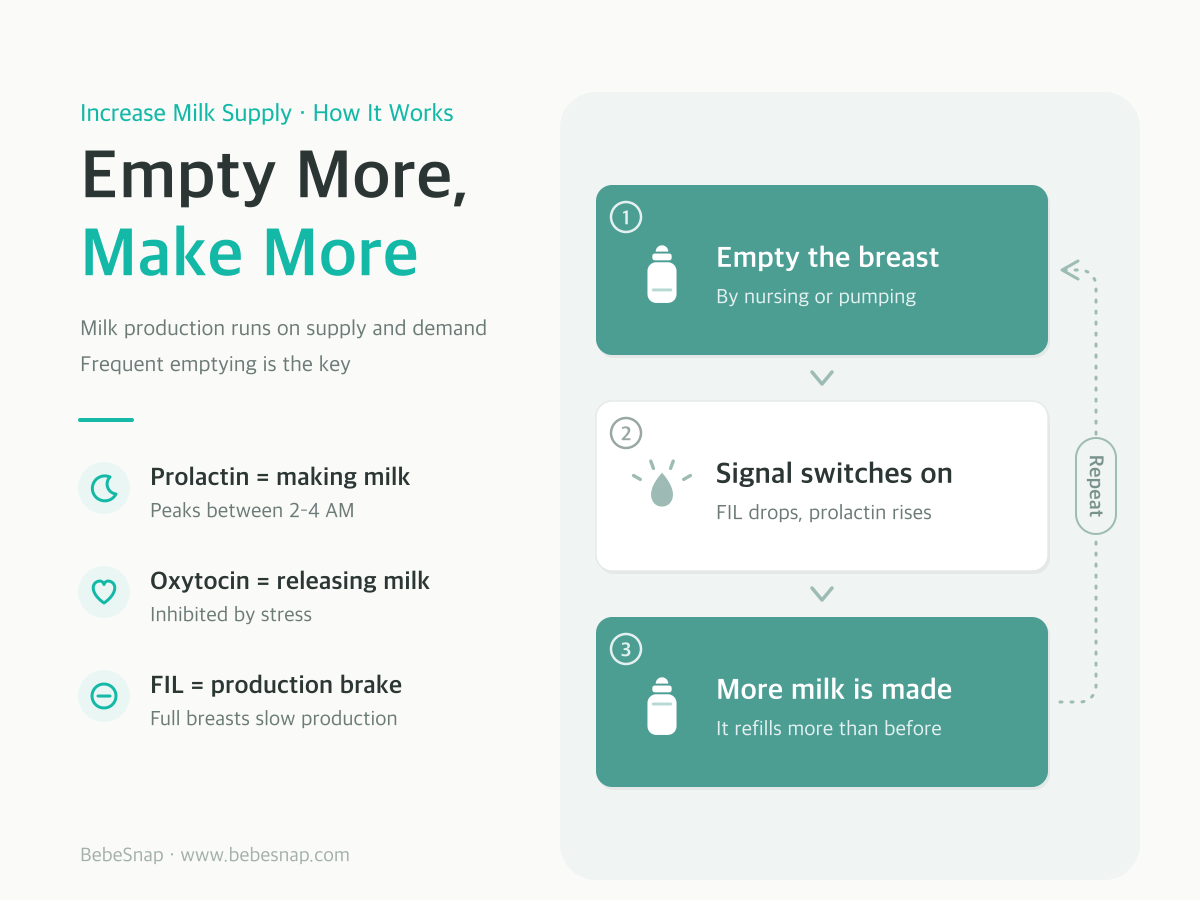
Breast milk production operates on a simple but powerful supply-and-demand principle. The more milk is removed from the breast (demand), the more the body produces (supply). Two key hormones drive this process.
Prolactin
- The hormone responsible for making milk
- Released when baby suckles or when you pump
- Peaks between 2 and 4 AM, making nighttime feeding especially important
- Higher feeding/pumping frequency means more prolactin release
Oxytocin
- The hormone responsible for releasing milk (the let-down reflex)
- Triggered by baby's suckling, skin-to-skin contact, or even thinking about your baby
- Can be inhibited by stress, anxiety, or pain
FIL (Feedback Inhibitor of Lactation)
- When breasts are full, FIL concentration rises and slows production
- When breasts are emptied, FIL decreases and stimulates production
- This is why frequent emptying is the key to increasing supply
True Low Supply vs Perceived Low Supply
Many mothers believe they aren't producing enough milk, but in most cases, this is a perceived insufficiency. Understanding the difference is critical.
Perceived Low Supply (the majority of cases)
- Baby wants to feed frequently → Normal! Newborns have tiny stomachs and need frequent feeds
- Breasts feel softer than before → A natural change as supply regulates
- Pumping output seems low → A pump is less efficient than a baby's suck
- Baby is fussy after feeding → Could be tiredness, overstimulation, or other reasons besides hunger
True Low Supply (less than 5% of mothers)
- History of breast surgery (especially reduction)
- Insufficient glandular tissue (tubular breasts)
- Hormonal conditions (thyroid disorders, PCOS)
- Sheehan's syndrome (significant postpartum hemorrhage)
- Prior breast radiation therapy
How to Tell If Your Baby Is Getting Enough Milk
To objectively determine whether your baby is receiving sufficient milk, monitor these key indicators.
| Indicator | Normal (Sufficient Milk) | Needs Attention (Possible Low Supply) |
|---|---|---|
| Wet diapers | 6 or more per day after day 5 | Fewer than 6 per day, concentrated urine |
| Stools | 3-4 yellow, seedy stools per day after day 4 | Significant decrease in frequency, dark color |
| Weight gain | Regains birth weight by 2 weeks, then gains 150-200g (5-7 oz) per week | Has not regained birth weight by 2 weeks |
| Feeding pattern | 8-12 feeds per 24 hours, audible swallowing | Frequent feeding but never seems satisfied |
| Baby's behavior | Content after feeding, appropriately active | Persistently fussy, lethargic |
Method 1: Increase Feeding Frequency (8-12 Times/Day)
The most fundamental and effective way to boost milk supply is to increase the number of times milk is removed from the breast.
AAP recommends: 8-12 feeds within 24 hours
- Newborns: Feed every 2-3 hours, including waking for nighttime feeds
- Allow at least 10-15 minutes per breast for effective emptying
- After baby finishes one side, offer the other
- Cue-based feeding: Watch for hunger cues (rooting, hand-to-mouth, head turning) and feed immediately
- Crying is a late hunger cue, ideally, start feeding before baby reaches this point
Method 2: Optimize Latch and Positioning
No matter how frequently you feed, if the latch isn't effective, the breast won't be properly emptied, and the supply signal weakens.
Signs of a good latch:
- Baby's mouth opens wide before latching
- Most of the areola is inside baby's mouth (especially the lower part)
- Lips are flanged outward (fish-lip shape)
- Chin touches the breast
- Rhythmic swallowing sounds are audible
- Minimal or no pain during feeding (mild initial discomfort is normal)
Effective breastfeeding positions:
- Cradle hold: Most common position; baby's tummy against your tummy
- Cross-cradle hold: Great for newborns or latch difficulties
- Football (clutch) hold: Ideal after C-section or with larger breasts
- Side-lying: Comfortable for nighttime feeds and postpartum recovery
- Laid-back(biological nurturing): Helpful for fast let-down; baby leads the latch
Method 3: Power Pumping
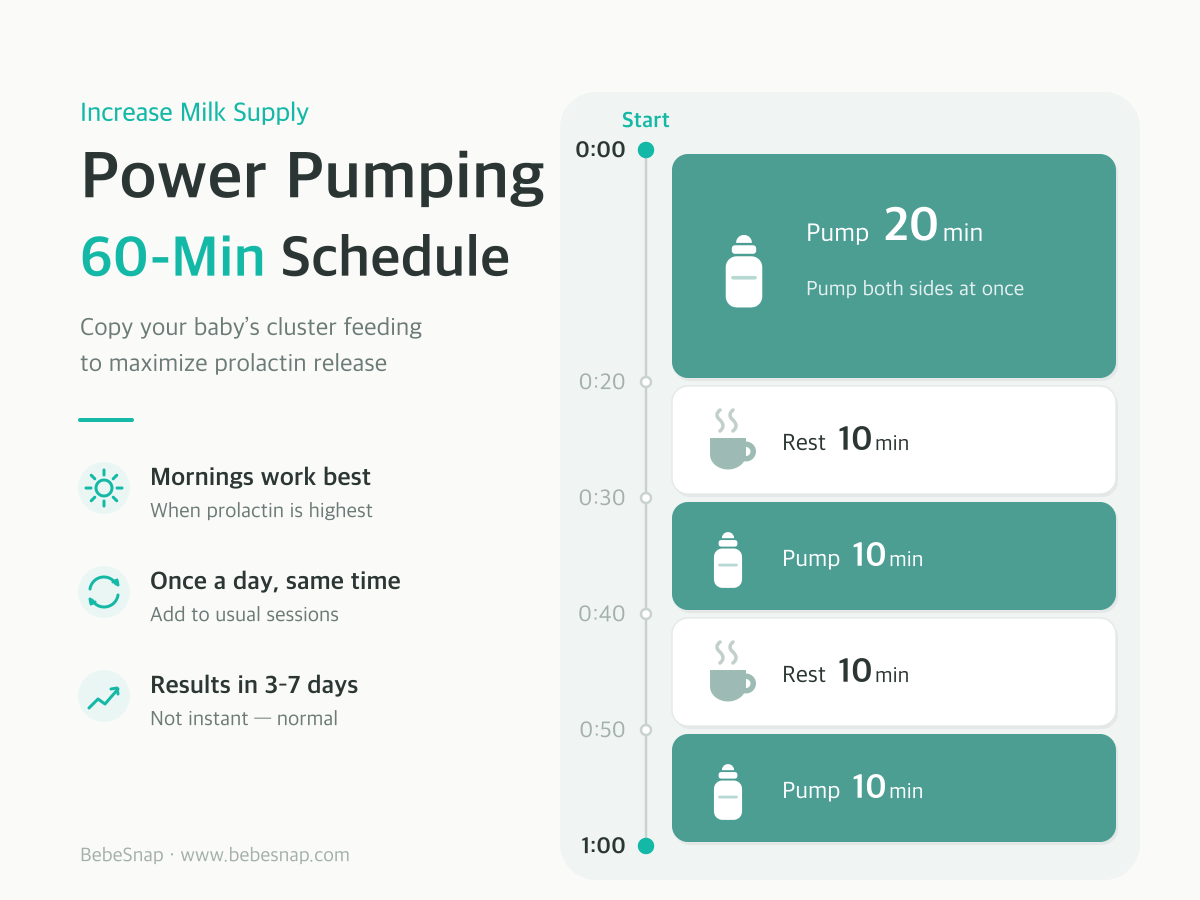
Power pumping mimics a baby's cluster feeding during growth spurts by using a breast pump. It maximizes prolactin stimulation to significantly boost milk production.
Power pumping schedule:
| Step | Duration | Activity |
|---|---|---|
| Step 1 | 20 minutes | Pump |
| Step 2 | 10 minutes | Rest |
| Step 3 | 10 minutes | Pump |
| Step 4 | 10 minutes | Rest |
| Step 5 | 10 minutes | Pump |

Total time: 1 hour
Power pumping tips:
- Do it once a day, ideally at the same time each day
- Morning sessions tend to be most effective due to higher prolactin levels
- Double pumping (both breasts simultaneously) is more efficient
- Don't expect results in 2-3 days: it typically takes 3-7 days to see an increase
- Power pumping should be in addition to your regular feeding/pumping schedule, not a replacement
Method 4: Maintain Nighttime Feeding/Pumping
It's tempting to skip nighttime feeds for much-needed rest, but nighttime feeding is crucial for maintaining milk supply.
- Prolactin (the milk-making hormone) peaks between 2 and 4 AM
- Feeding or pumping during this window produces more prolactin than at other times
- Skipping feeds for more than 6 hours at night can lead to a noticeable drop in supply
- Aim to maintain at least one nighttime feed or pump session
Tips for easier nighttime feeds:
- Use a bedside bassinet (co-sleeper) so you don't have to fully get up
- Keep lights dim with a soft nursing light to avoid fully waking up
- Set up your environment so you can fall back asleep quickly after feeding
- Tag-team with your partner: you pump, partner bottle-feeds the expressed milk
Method 5: Nutrition, Hydration, and Rest
About 88% of breast milk is water. Your nutritional status and fluid intake directly impact milk production.
Hydration:
- Aim for 2.5-3 liters of fluids per day
- Drink a glass of water every time you breastfeed
- Sip regularly, don't wait until you feel thirsty
- Limit caffeine to 200-300mg per day (about 1-2 cups of coffee)
Nutrition:
- Breastfeeding requires roughly 500 extra calories per day
- Eat balanced meals: protein, healthy fats, complex carbohydrates
- Foods considered galactagogues (milk-boosting): oatmeal, nuts, sesame seeds, brewer's yeast, fenugreek
- Scientific evidence for specific foods dramatically increasing supply is limited: a balanced diet matters most
Rest and stress management:
- Stress and fatigue inhibit oxytocin (the let-down hormone)
- "Sleep when baby sleeps"; this advice exists for good reason
- Ask for help and reduce household burdens where possible
- In the U.S., the PUMP Act (2022) requires employers to provide reasonable break time and a private space for pumping
Common Causes of Decreased Supply and Solutions
If your milk supply has suddenly dropped, check for these common causes.
| Cause | Why It Happens | Solution |
|---|---|---|
| Longer intervals between feeds | Increased FIL suppresses production | Increase feeding/pumping frequency |
| Introducing formula supplements | Less direct breastfeeding = less demand | Breastfeed first, then supplement; pump in between |
| Excessive pacifier use | Hunger cues may be missed | Check for hunger cues before offering pacifier |
| Menstrual cycle returns | Hormonal shifts cause temporary dip | Supply usually recovers in 1-2 days; maintain frequency |
| Stress and fatigue | Oxytocin release is inhibited | Prioritize rest and stress management |
| Poor latch | Breast isn't effectively emptied | Correct latch; consult a lactation specialist |
| Certain medications/herbs | Some suppress prolactin | Inform your doctor that you are breastfeeding |
Related Articles
- 👉 Complete Breastfeeding Guide for New Moms
- 👉 Mixed Feeding Guide
- 👉 Breast Engorgement Relief Guide
- 👉 Breast Milk Storage Guide
- 👉 Bottle Refusal Solution Guide
Track Your Feeding with BebeSnap
The first step to managing milk supply is accurate feeding records. Use the BebeSnap app to systematically track your breastfeeding patterns.
- Feeding Time and Frequency Tracking: Record feeding duration and frequency for each breast to ensure you're hitting 8-12 sessions per day
- Feeding Pattern Analysis: Use recorded data to identify your feeding intervals and optimize your nursing schedule
- AI Parenting Consultant: Got questions about low milk supply? Ask our AI chatbot anytime
- Growth Tracking: Monitor your baby's weight changes to confirm adequate milk intake
Frequently Asked Questions
Q: How do I know if my milk supply is truly low?
A: The most reliable indicators are baby's weight gain and diaper count. After day 5, look for 6 or more wet diapers per day and a weight gain of 150-200g (5-7 oz) per week. Low pump output or softer breasts alone are not reliable indicators of low supply.
Q: How does power pumping work?
A: Pump for 20 minutes → rest 10 minutes → pump 10 minutes → rest 10 minutes → pump 10 minutes, totaling 1 hour. Do it once daily at the same time, and results typically appear within 3-7 days. Power pump in addition to your regular feeding schedule, not as a replacement.
Q: Are there foods that boost milk supply?
A: Oatmeal, nuts, sesame seeds, brewer's yeast, and fenugreek are commonly cited galactagogues. However, scientific evidence for dramatic supply increases from specific foods is limited. The most important factors are a balanced diet, adequate hydration (2.5-3 liters per day), and frequent breastfeeding.
Q: How can I maintain my supply after returning to work?
A: The key is pumping every 3-4 hours at work. Use double pumping to save time, and store expressed milk in the refrigerator or freezer. Breastfeed directly before leaving for work and after returning home. On weekends, increase feeding frequency to help maintain and boost supply.
References
Stop Trying to Remember Feed Times
Log time, amount, and intervals. BebeSnap turns them into your baby's daily pattern.
See what the app does firstMedical Disclaimer: This article is for informational purposes only and does not replace professional medical advice. If you have concerns about your baby's health, please consult a pediatrician.
You Might Also Like
Wonder Weeks Calculator: Your Baby's 10 Mental Leaps From the Due Date
Baby Weight Gain Calculator: Grams Per Day From Two Weigh-Ins
Baby Impetigo: Golden Crusts, Antibiotic Treatment, and When Nursery Is Safe Again
Baby Mouth Sores (Stomatitis): Causes, How to Tell Them Apart, and Dehydration Signs
You Might Also Like

Tomato for Babies: When to Start, Skin and Seeds, and Why Cherry Tomatoes Are Never Served Whole
Tomato can start at 5-6 months once the skin and seeds are removed and it is cooked. Portions run 20-30g at 7-8 months and 30-40g at 9-11 months, counted together with fruit. Cherry tomatoes are the one vegetable Japan's childcare guidance names by name as something not to serve whole.

Infant Colic Symptoms & Causes | Complete Guide to Soothing Your Baby
Colic is crying for 3+ hours a day, 3+ days a week, for 3+ weeks in a healthy baby: affecting about 20% between 2 weeks and 4 months. Here are the symptoms, causes, and soothing tips.

Baby Cup Training Guide: When to Start, Cup Types & Bottle Weaning Tips
Start cup training at 6 months. Compare open cups, straw cups, sippy cups & 360 cups. Step-by-step guide by age plus bottle weaning strategies for 12-18 months.