Baby Fine Motor Development Guide: From Grasping to Pincer Grip, Month-by-Month Milestones
Keep Every Growth Milestone
Get Started FreeThere's something truly magical about watching your baby's tiny hands discover the world, gripping your finger, reaching for a toy, picking up a cheerio. These seemingly small actions are actually major signs of brain development. The area of the brain dedicated to hand control occupies the largest portion of the motor cortex, which means every grasp, pinch, and grab your baby makes is helping build critical neural pathways. From the reflexive grip at 3 months to the palmar grasp at 6 months and the pincer grip by 9–12 months, your baby's fine motor skills evolve at an astonishing rate. This guide walks you through each milestone and the best activities to support your baby's development at every stage.
What Are Fine Motor Skills? Fine Motor vs Gross Motor
Fine motor skills involve the precise movements of small muscles in the hands, fingers, and wrists. In contrast, gross motor skills use larger muscles in the arms, legs, and torso for big movements like crawling and walking.
| Category | Fine Motor | Gross Motor |
|---|---|---|
| Muscles used | Fingers, wrists, hands | Arms, legs, torso |
| Key actions | Grasping, pinching, drawing, pressing buttons | Rolling, crawling, walking |
| Brain area | Largest region of motor cortex | Relatively smaller region of motor cortex |
| Development timing | Refines gradually after gross motor develops | Develops before fine motor |
Fine motor and gross motor skills aren't competitors; they're partners in development. For example, when your baby does tummy time (gross motor) and reaches for a toy (fine motor), both skill sets are working together. This is why a well-rounded approach to play and movement is so important.
💡 The hand area occupies the largest portion of the brain's motor cortex. That's why your baby's hand movements are one of the best indicators of overall brain development!Fine Motor Milestones: 0–3 Months
This period marks the transition from reflexive movements to intentional ones: a foundational shift in your baby's development.
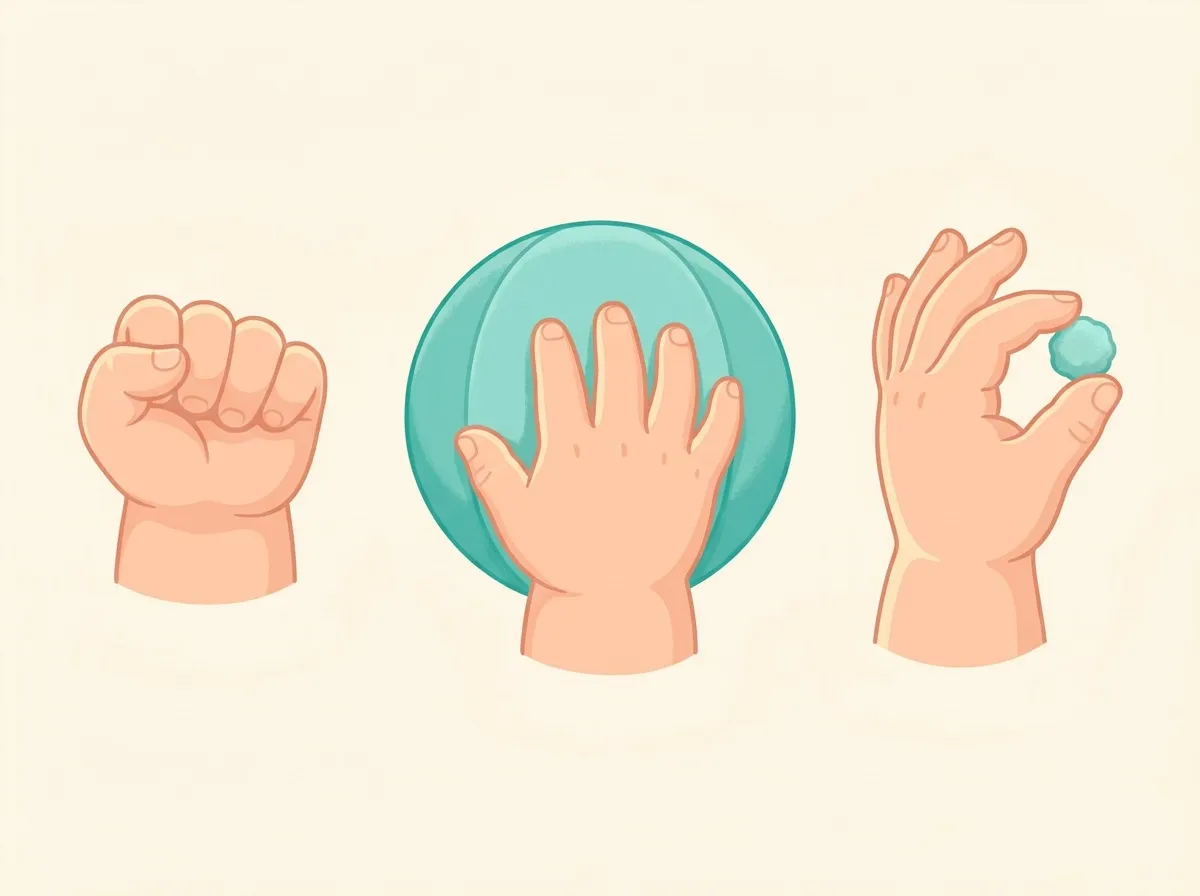
0–1 month: Grasp reflex
- When something touches baby's palm, they automatically grip it tightly (grasp reflex)
- This is a primitive reflex, not an intentional movement
- Baby's fists are clenched most of the time
2–3 months: From fists to open hands
- The grasp reflex gradually begins to fade
- Baby starts consciously opening and closing their hands
- They begin reaching toward objects in their line of sight (though not accurately yet)
- Bringing both hands together at midline (hand clasping)
Fine Motor Milestones: 4–6 Months
This is when intentional grasping truly begins: a major leap in fine motor development.
4–5 months: Reaching and grabbing
- Baby intentionally reaches for and grabs objects they can see
- They wrap their entire palm around objects (beginning of palmar grasp)
- Starting to transfer objects from one hand to the other
- Bringing objects to the mouth for exploration
6 months: Palmar grasp established
- Palmar grasp (wrapping the whole hand around objects) becomes stable and reliable
- Can hold an object in each hand simultaneously
- Explores objects by shaking, banging, and mouthing them
- Attempts to grab larger objects like cups with both hands
👉 Check out our 6-Month Baby Development Guide for a complete overview of this exciting stage.
💡 Around 6 months, babies put everything in their mouths, and that's completely normal! Mouthing (oral exploration) is a vital part of sensory development, because the mouth is one of the most nerve-rich areas of the body. Just make sure all objects are safe and clean.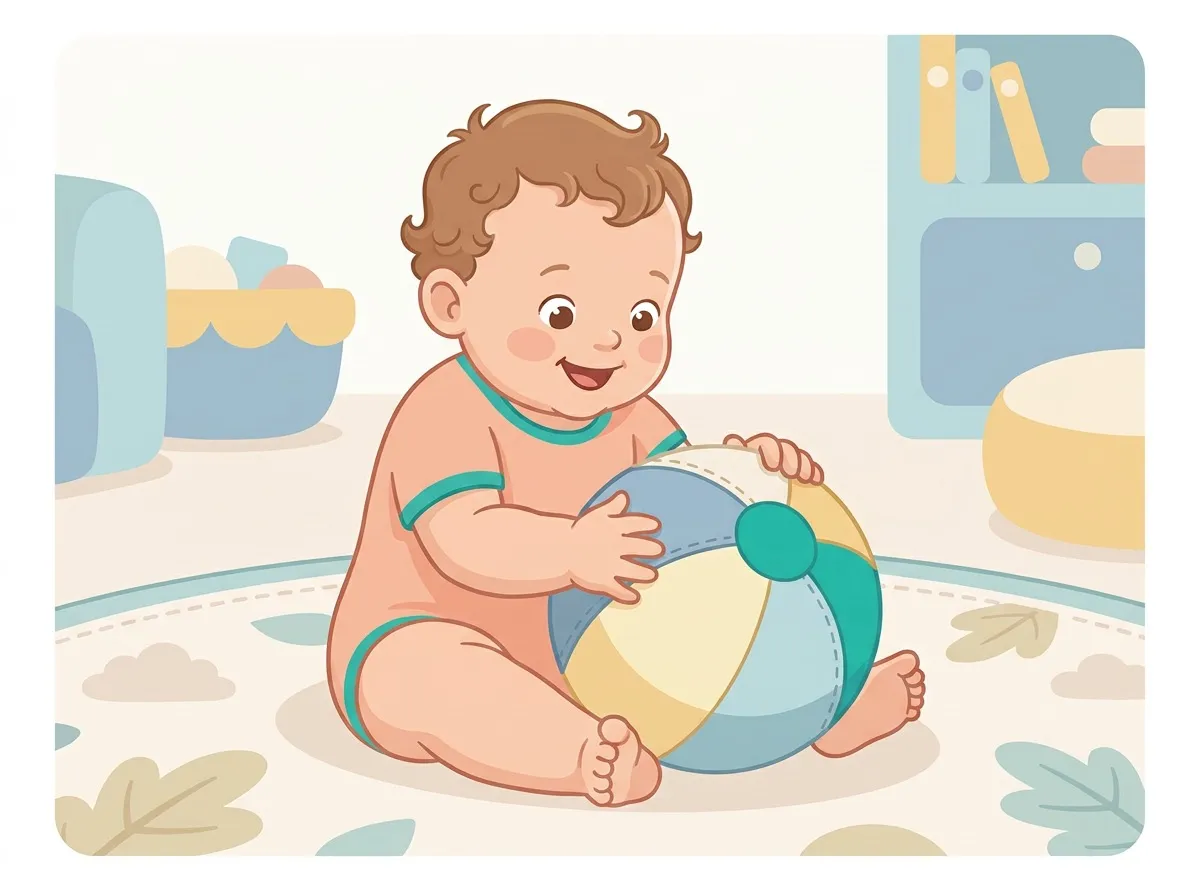
Fine Motor Milestones: 7–9 Months
The highlight of this stage? The beginning of the pincer grasp: one of the most important fine motor milestones!
7–8 months: From raking to pinching
- Raking grasp: using all fingers to scoop or rake small objects toward them
- Growing interest in smaller objects
- Intentionally dropping objects and watching what happens (this is learning, not misbehavior!)
- Trying to poke holes with fingers and press buttons
👉 Learn more in our 7–8 Month Baby Development Guide.
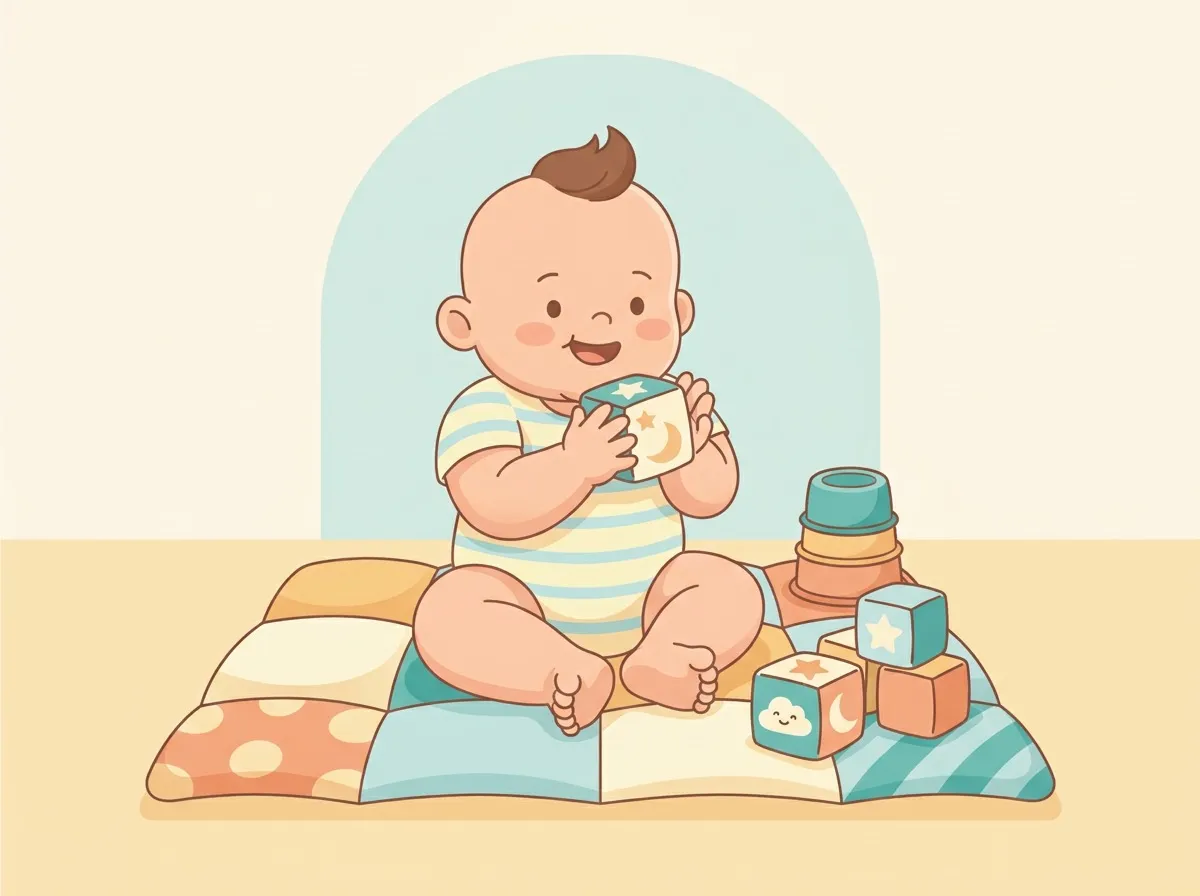
9 months: Pincer grasp begins
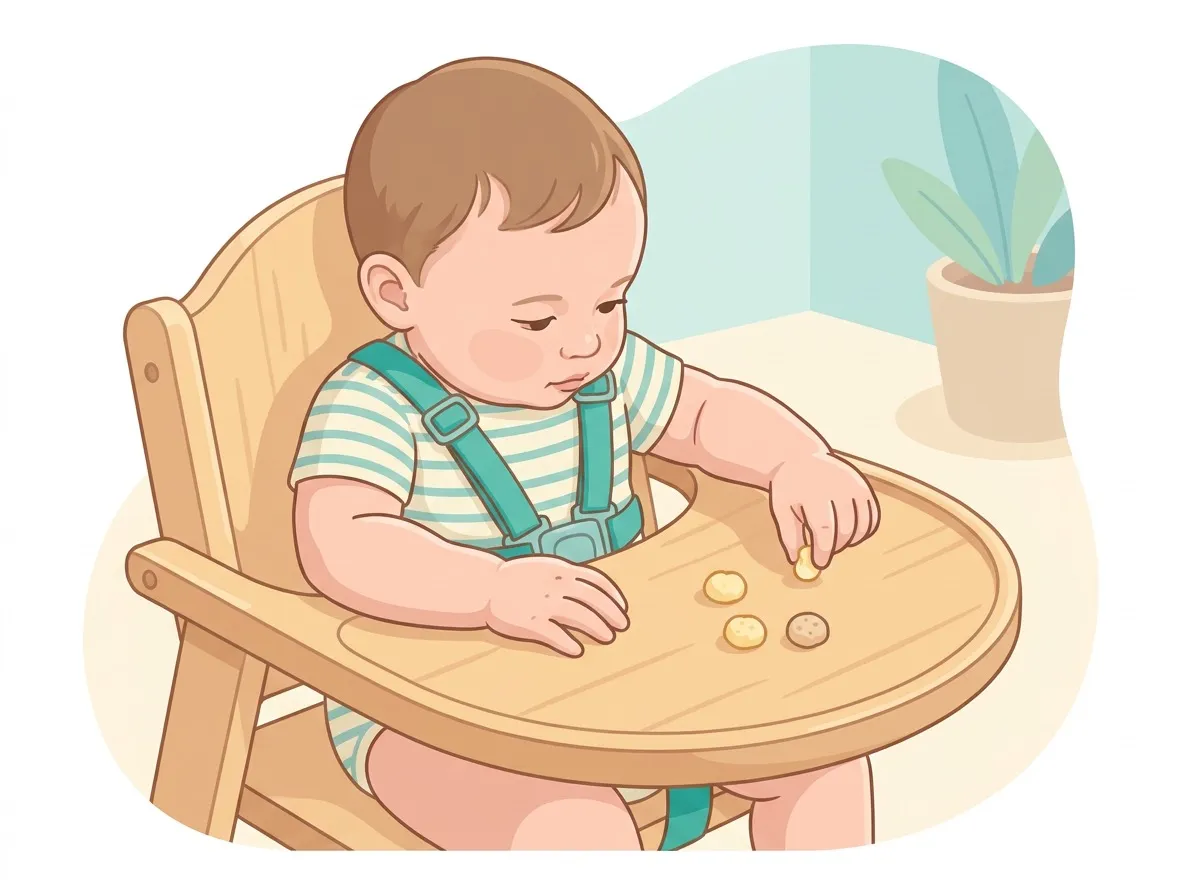
- Inferior pincer grasp: using the pads (not tips) of the thumb and index finger to pick up small items
- Attempting to self-feed by picking up small snacks like cereal puffs
- Putting objects into containers and taking them out
- Grabbing book pages and trying to turn them (usually several at once)
👉 See our 9-Month Baby Development Guide for the full picture.
💡 The pincer grasp is one of the most precise things the human hand can do! Picking up small objects between the thumb and index finger is the foundation for tool use and eventually writing, making it one of the most significant milestones in your baby's development journey.Fine Motor Milestones: 10–12 Months
Fine motor skills become increasingly precise as your baby transforms into a little explorer and problem solver.
10–11 months: Mature pincer grasp
- Mature (neat) pincer grasp: picking up tiny objects using the tips of the thumb and index finger
- Can pick up very small items like bread crumbs
- Trying to place objects in specific spots with intention
- Pointing with the index finger begins
12 months: Stacking and scribbling
- Starts trying to stack blocks (stacking two usually comes around 12–15 months)
- Some babies hold a crayon and begin scribbling
- Attempts to turn book pages one at a time (still clumsy)
- Tries drinking from a cup and holding a spoon
- Begins simple shape-sorting activities
👉 Visit our 12-Month Baby Development Guide for milestones around baby's first birthday.
| Age | Key Fine Motor Milestone | Grasp Type |
|---|---|---|
| 0–2 months | Grasp reflex, fist clenching | Reflexive grasp |
| 3–4 months | Intentional reaching, hands opening | Whole-hand grasp |
| 5–6 months | Palmar grasp established, transferring objects | Palmar grasp |
| 7–8 months | Raking grasp, intentional dropping | Raking grasp |
| 9 months | Pincer grasp begins, container play | Inferior pincer grasp |
| 10–12 months | Mature pincer grasp, banging blocks together | Mature pincer grasp |

Fine Motor Activities & Toys by Age
Here's a month-by-month guide to the best activities and toys for supporting your baby's fine motor development.
| Age | Recommended Activities | Recommended Toys | Development Benefit |
|---|---|---|---|
| 0–3 months | Placing rattles in hand, finger play | Soft rattles, wrist rattles | Tactile stimulation, grip practice |
| 4–6 months | Handing objects, texture play | Texture books, O-ball, stacking cups | Palmar grasp, bilateral coordination |
| 7–9 months | Lid opening/closing, put-in/take-out play | Stacking blocks, nesting cups, drum | Pincer grasp, hand-eye coordination |
| 10–12 months | Block stacking, scribbling, shape sorting | Crayons, shape sorters, stacking rings | Mature pincer grasp, problem solving |
Safety reminders during play:
- Never give babies anything small enough to fit entirely in their mouth (small balls, marbles, toy parts, coins): choking hazard!
- Keep play sessions fun and pressure-free, stop when baby loses interest
- Praise and encouragement build confidence and motivation
Finger Foods and Fine Motor Development
Mealtime and fine motor development go hand in hand, literally. Self-feeding is one of the best fine motor workouts your baby can get!
Age-based finger food guide:
6–8 months: Palmar grasp eating
- Offer soft foods cut into stick shapes (sweet potato, banana, avocado)
- Size should be big enough for baby to grip with their whole palm and bring to their mouth
- Soft, mashable textures are key
9–12 months: Pincer grasp eating
- Offer small, soft pieces of fruit, well-cooked vegetables, and cereal puffs
- Baby practices picking up food with thumb and index finger
- Introduce varied textures to encourage more precise grasping
Signs of Fine Motor Delay and When to Consult
Every baby develops at their own pace, but certain signs warrant a conversation with your pediatrician.
⚠️ Consult a specialist if you notice:- No attempt to grasp objects by 4 months
- Cannot transfer objects between hands by 9 months
- No attempt to pick up small objects by 9 months
- Pincer grasp has not developed by 12 months
- Uses only one hand and completely ignores the other (before 12 months)
- Loss of previously acquired skills (regression)
- Brief, repeated spasms (a quick head nod with both arms lifting), often in clusters: these may be infantile spasms, so call your pediatrician right away
Important things to know:
- For premature babies, use the adjusted age when evaluating milestones
- Early detection leads to more effective early intervention
- Slower development doesn't always mean there's a problem, but if you're concerned, don't wait. Consulting early gives you peace of mind and gives your baby the best chance for support
Everyday Tips to Boost Fine Motor Skills
You don't need fancy toys to promote fine motor development. Everyday activities are some of the best practice!
1. Mealtime opportunities
- Let baby hold a spoon (even if they can't scoop yet!)
- Practice drinking from a cup
- Allow self-feeding with finger foods
2. Bath time practice
- Grabbing floating toys
- Pouring water from small cups
- Catching soap bubbles (use gentle body wash)
3. Getting dressed activities
- Pulling off socks
- Pulling large zippers up and down
- Putting on and taking off hats
4. Playtime tips
- Tearing paper (watch that baby doesn't eat it)
- Sticking and peeling stickers
- Threading beads too big to fit in the mouth on a string (with supervision)
👉 Learn proper tummy time techniques in our Tummy Time Guide.
Track Development with BebeSnap
Document every fine motor milestone with the BebeSnap app and watch your baby's incredible progress.
- Milestone Tracking: Record precious firsts (first palmar grasp, first pincer grip, first block stack) with dates and notes
- AI Development Consultation: Ask our AI chatbot whether your baby's fine motor development is on track and what activities to try next
- Comprehensive Growth Tracking: Monitor fine motor, gross motor, language, and social development all in one place
Frequently Asked Questions
Q: When does the pincer grasp develop?
A: Most babies develop the inferior pincer grasp (using the pads of the thumb and index finger) around 9 months. By 10–12 months, this typically refines into a mature pincer grasp (using the fingertips). However, there's natural variation: as long as it develops by 12 months, it's within the normal range.
Q: What should I do if my baby's fine motor skills seem delayed?
A: First, if your baby was premature, evaluate based on their adjusted age. If the pincer grasp hasn't developed by 12 months, if your baby only uses one hand, or if they've lost skills they previously had, consult your pediatrician. Early intervention is the most effective approach, because the brain is most adaptable during the first few years of life.
Q: What are the best toys for fine motor development?
A: Choose age-appropriate toys: soft rattles for 0–3 months, texture books and O-balls for 4–6 months, stacking blocks and nesting cups for 7–9 months, and crayons and shape sorters for 10–12 months. You don't need expensive toys: everyday household items like spoons, cups, and containers are excellent fine motor tools too.
Q: Which is more important, fine motor or gross motor skills?
A: Both are equally important! Gross motor skills provide the foundation for fine motor skills, while fine motor skills are directly connected to brain development. For example, building arm strength through crawling (gross motor) enables precise hand movements (fine motor) later. The two types of development complement each other, so focus on supporting both rather than prioritizing one over the other.
References
Keep Every Growth Milestone
Log height, weight, and milestones. The growth curves are drawn for you.
See what the app does firstYou Might Also Like
Tomato for Babies: When to Start, Skin and Seeds, and Why Cherry Tomatoes Are Never Served Whole
Apple for Babies: Stage-by-Stage Portions and When Raw Apple Is Safe
Spinach for Babies: When to Start, Why Boiling Matters, and the One Time to Skip It
Potato for Babies: When to Start, Safe Shapes, and Why Never to Blend It
You Might Also Like
Wonder Weeks Calculator: Your Baby's 10 Mental Leaps From the Due Date
Enter your due date and get all 10 leap dates. They land at weeks 5, 8, 12, 19, 26, 37, 46, 55, 64 and 75, each lasting 1 to 2 weeks.
Baby's First Dental Visit: When to Go and How to Care for Baby Teeth
Take your baby to the dentist by age 1 or within 6 months of the first tooth. AAP-recommended oral care guide for parents.
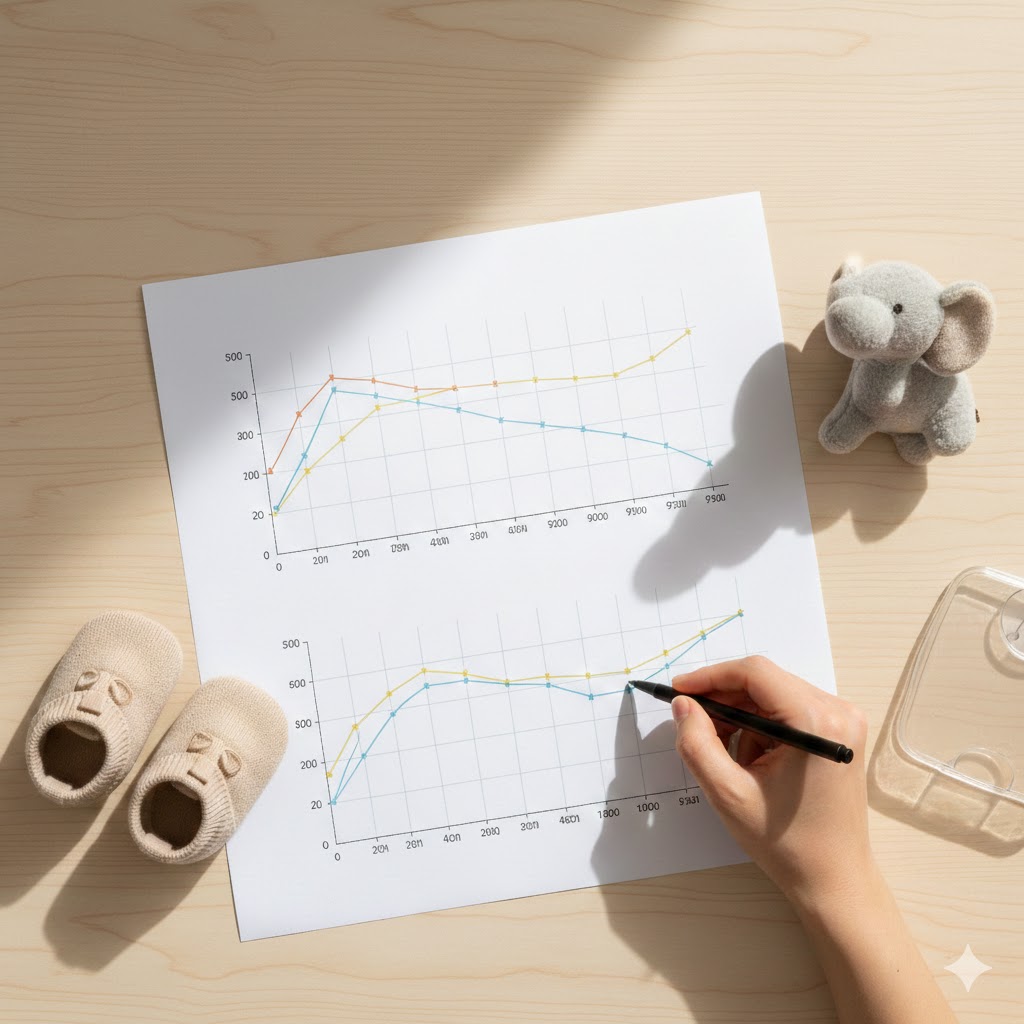
How to Read Baby Growth Charts | Percentiles Explained, Weight & Height by Age
Growth chart percentiles rank your baby among 100 infants of the same age. On the WHO charts used for babies under 2, the 2nd and 98th percentile lines are the screening cut-offs, and growth trends matter more than a single measurement.