13-18 Month Toddler Development Guide: Walking, Language Explosion & Milestone Checklist
Keep Every Growth Milestone
Get Started FreeThe birthday cake crumbs are barely swept up, and your baby is already a different person. One day they are pulling up on furniture; the next day they are walking across the room; the day after that, they are saying "no!" to everything. The 13-18 month period is one of the most dramatic transformations in a child's life: the transition from baby to toddler. This guide covers every developmental domain: gross motor, fine motor, language, cognition, and social-emotional milestones, along with play activities for each area and the critical 18-month developmental screening checklist.
13-18 Month Development at a Glance
Development during this period is astonishingly fast. But remember: every child develops at their own pace. The milestones below represent what most children achieve, not a rigid deadline.
| Domain | 13 Months | 15 Months | 18 Months |
|---|---|---|---|
| Gross motor | Cruising, first steps | Walking independently | Running attempts, stair climbing |
| Fine motor | Stacking 2 blocks | Attempting spoon use | Stacking 3-4 blocks, scribbling |
| Language | 1-3 words | 3-10 words | 10-50 words, two-word combos emerging |
| Cognitive | Finds hidden objects | Points to body parts | Symbolic play, shape sorting |
| Social-emotional | Peak separation anxiety | Attention-seeking behaviors | "No!" autonomy, tantrums begin |

Gross Motor: From Walking to Running
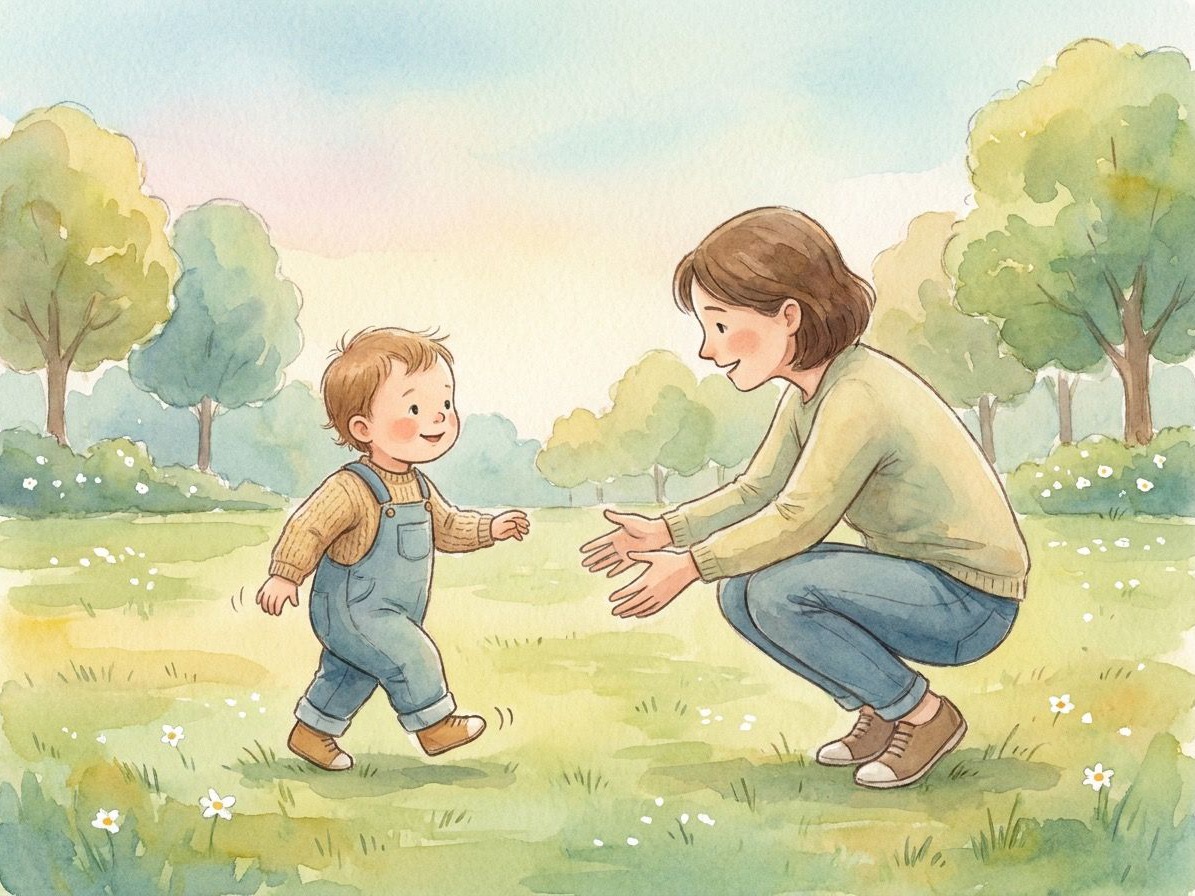
The most visible change during this period is walking. Most babies take their first independent steps between 9 and 15 months, with nearly all walking by 18 months.
13-14 months: first steps
- Cruising along furniture transitions to taking 1-2 independent steps
- Falling is completely normal, the diaper provides natural padding
- Feet may turn inward or outward; this usually self-corrects
15-16 months: confident walking
- Walking independently with growing confidence
- Can carry objects while walking
- Bends down to pick up things from the floor without falling
- Attempts to kick a ball
17-18 months: running and climbing
- Fast walking or early running attempts
- Climbing stairs while holding the railing, one step at a time
- Climbing onto furniture (sofas, chairs)
- Dancing to music
Activities to support gross motor development
- Push toys (toy shopping carts, push walkers)
- Ball rolling and kicking games
- Free walking and running in open, safe spaces
- Low slides and tunnel crawling
- Dance parties to favorite songs
Fine Motor: Stacking, Scribbling, and Spoon Skills
The precision of your toddler's hand movements develops rapidly during this period. Fine motor skills lay the foundation for later writing, drawing, and self-care tasks.
Fine motor milestones during this period
- Stacking 2-4 blocks
- Scribbling with a crayon or marker
- Turning book pages (several at a time)
- Attempting to use a spoon (messy but important!)
- Drinking from a cup with two hands
- Picking up small objects with thumb and forefinger (pincer grasp)
- Putting objects in and taking them out of containers
Activities to support fine motor development
- Block stacking: build towers and knock them down (repeat endlessly)
- Large crayons on big paper for free scribbling
- Sticker play: start with large stickers that are easy to peel
- Large bead threading (choose beads too big to fit whole in your child's mouth and labeled for their age, always supervise, and put beads and string away after play)
- Playdough: squeeze, tear, and flatten
- Pouring practice: water from cup to cup
Language: The Word Explosion Begins
The 13-18 month period marks the beginning of the "vocabulary explosion." It often starts slowly with just a word or two, then suddenly accelerates as your toddler approaches 18 months.
Language development trajectory
- 13 months: 1-3 meaningful words beyond "mama" and "dada"
- 15 months: 3-10 words, understands simple instructions ("bring the ball," "sit down")
- 18 months: 10-50 words, beginning to combine two words ("more milk," "daddy go")
Receptive vs. expressive language
- Your toddler understands far more than they can say
- An 18-month-old may comprehend 200-300 words but only express 10-50
- "Understanding but not saying" is perfectly normal at this stage
How to boost language development
- Narrate your day: "Now we're changing your diaper," "Time to eat lunch"
- Label what your child points to: "Oh, a dog! You see the dog!"
- Read together: 15 minutes a day makes a significant difference
- Respond to babbling as if it were conversation
- Sing songs and nursery rhymes: repetitive patterns support language learning
- Limit screen time: the AAP recommends no screen media for children under 18 months (except video calls)
Cognitive Development: Your Little Scientist
Your toddler is no longer just observing the world; they are starting to understand how it works.
Cognitive milestones
- Understanding object function: holds phone to ear, puts brush to hair
- Beginning of symbolic play: feeds a doll, puts a teddy bear to bed
- Shape sorting: matches simple shapes (circle, triangle, square) to corresponding holes
- Body part identification: points to nose, eyes, mouth when asked
- Object permanence mastered: finds toys hidden under blankets
- Simple cause and effect: pushes a button and expects a sound
Activities to support cognitive development
- Pretend play: toy kitchen, doctor kit, play phone
- Shape-sorting puzzles
- Picture book scavenger hunts: "Where is the cat?"
- Hide and seek with toys
- Cup-and-ball shell game: "Which cup is the ball under?"
- Sorting by size, shape, or color
Social-Emotional: The Rise of "No!"
The 13-18 month period marks the emergence of the self. Your toddler is beginning to understand that they are a separate person with their own will, and they are not shy about expressing it.
Autonomy development
- "No!" becomes a favorite word; this is a healthy sign that the self is developing
- Desire to do things independently (dressing, eating with a spoon)
- Possessiveness: "Mine!" emerges
- Preference for choices: offering two options reduces power struggles
Tantrums begin
- Tantrums at this age are a normal developmental event
- Cause: frustration from being unable to express wants verbally
- Response: validate the emotion ("I can see you're frustrated"), ensure safety, stay calm, talk about it after the storm passes
- Giving in to tantrums reinforces the behavior, stay consistent
Social development
- Parallel play: plays alongside other children, not yet with them
- Early empathy: looks concerned when another child cries
- Reading parents' emotions: may try to comfort you when you look sad
- Separation anxiety: still present but gradually improving as your child learns you always come back
The 18-Month Developmental Screening
Eighteen months is one of the most important developmental checkpoints. The AAP recommends both general developmental screening and autism spectrum disorder screening at this visit.
Milestones to check by 18 months
- Walking independently
- At least 6 meaningful words
- Points to show you something interesting
- Knows what familiar objects are for (phone, spoon, brush)
- Follows simple one-step instructions
- Copies what others are doing
Red flags at 18 months
- Not walking independently
- Fewer than 6 meaningful words
- Does not point to show things to others
- Little or no eye contact
- Does not respond to own name
- Loss of previously acquired skills (regression)
- No interest in other children
Sleep: Transitioning to One Nap
Many toddlers transition from two naps to one during this period. It is one of the bigger sleep adjustments of the first two years.
Sleep guidelines
- Total sleep: 11-14 hours per day (including nap)
- Nap: 1 nap, lasting 1.5-3 hours (usually after lunch)
- Nighttime sleep: 10-12 hours
- Transition timing: most toddlers shift between 14-18 months
Nap transition tips
- Gradual shift: push the morning nap later by 10-15 minutes every few days until it merges with the afternoon
- During the transition, some days may still need two naps; that is fine
- If the nap drops, move bedtime 30 minutes earlier temporarily
- The transition typically takes 2-4 weeks to stabilize
Nutrition: Transitioning to Family Meals
After 12 months, your toddler begins eating what the family eats. This period often brings the start of picky eating, one of the most common parenting frustrations.
Meal guidelines
- 3 meals + 2-3 snacks per day
- Transition from breast milk or formula to whole cow's milk (16-20 oz per day)
- Offer varied textures and sizes
- Encourage spoon and fork practice (mess is part of learning)
- Eat together at the family table as much as possible
Handling picky eating
- New foods require 10-15 exposures before acceptance, do not give up after 1-2 rejections
- Serve new foods alongside familiar favorites
- No pressure or force-feeding, let your child decide how much to eat
- Model enthusiastic eating yourself
- Allow food play (it is part of sensory exploration)
Track It All with BebeSnap
With development moving this fast, keeping organized records makes a real difference, especially heading into the 18-month screening.
- Milestone Tracking: Record first steps, first words, and first two-word combinations so you can share accurate timelines with your pediatrician
- Growth Records: Log height and weight to see growth curves at a glance. Bring precise data to every well-child visit
- AI Health Consultation: Questions about your toddler's development? Ask our AI chatbot anytime
FAQ
Q: My 15-month-old is not walking yet. Should I be worried?
A: Most children walk independently between 9 and 18 months. If your 15-month-old is pulling to stand and cruising along furniture, they are likely on the verge. However, if there is no walking by 18 months, schedule a pediatric evaluation. Late walkers usually catch up completely with no lasting effects.
Q: My 18-month-old says fewer than 5 words. Is this normal?
A: Language development has the widest variation of any developmental domain. However, if your child has fewer than 6 meaningful words at 18 months or does not point to show you things, either one alone is reason to ask your pediatrician about a developmental evaluation. Many children have strong receptive language (understanding) but slower expressive language (speaking), and a professional can distinguish between the two.
Q: How do I handle tantrums at this age?
A: Tantrums at 13-18 months are driven by frustration; your toddler wants something but cannot yet express it in words. Acknowledge the emotion ("I know you're upset"), make sure they are safe, and stay calm yourself. After the tantrum passes, use simple language to talk about what happened. Consistency is key: giving in to tantrums teaches that tantrums work.
Q: When should my toddler drop to one nap?
A: Most toddlers transition between 14 and 18 months. Signs of readiness include refusing the morning nap, taking very long to fall asleep for the morning nap, or the morning nap interfering with the afternoon nap. Shift gradually by pushing the morning nap 10-15 minutes later every few days until it naturally becomes one midday nap.
Q: My toddler used to eat everything but is now very picky. What changed?
A: Picky eating between 12-18 months is one of the most common developmental phases. It is driven by newfound autonomy ("I choose what I eat") and a natural slowdown in growth rate (meaning less appetite). Keep offering variety without pressure. Research shows it takes 10-15 positive exposures to a new food before a child accepts it. If extreme food refusal lasts more than a month, consult your pediatrician.
References
Keep Every Growth Milestone
Log height, weight, and milestones. The growth curves are drawn for you.
See what the app does firstYou Might Also Like
Tomato for Babies: When to Start, Skin and Seeds, and Why Cherry Tomatoes Are Never Served Whole
Apple for Babies: Stage-by-Stage Portions and When Raw Apple Is Safe
Spinach for Babies: When to Start, Why Boiling Matters, and the One Time to Skip It
Potato for Babies: When to Start, Safe Shapes, and Why Never to Blend It
You Might Also Like

Wonder Weeks Calculator: Your Baby's 10 Mental Leaps From the Due Date
Enter your due date and get all 10 leap dates. They land at weeks 5, 8, 12, 19, 26, 37, 46, 55, 64 and 75, each lasting 1 to 2 weeks.

3-4 Month Baby Development: Head Control, Babbling, and Rolling Over
At 3 months babies master head control, and by 4 months start babbling and rolling over. Learn about 3-4 month milestones and play activities.

3-Month Baby Development: Head Control, Cooing, Social Smiles
What development can you expect from a 3-month-old? Learn about motor, cognitive, and social milestones plus play ideas.