Complete Tummy Time Guide | Baby's Essential Exercise From Day One

Keep Every Growth Milestone
Get Started FreeWhy is tummy time crucial for baby development? This guide covers benefits of tummy time, recommended duration by age, proper techniques, and tips for babies who hate tummy time.
What Is Tummy Time?
Tummy time is when your baby lies on their stomach while awake and supervised.
Why Is It Important?
Benefits emphasized by the American Academy of Pediatrics (AAP):
- Strengthens neck and back muscles: Foundation for head control and rolling
- Promotes motor development: Builds to crawling, sitting, walking
- Prevents flat head syndrome: Avoids skull flattening from lying on back
- Sensory development: Various visual and tactile experiences
- Aids digestion: Helps with gas and colic relief
When to Start Tummy Time
Bottom line: You can start from day one!
Newborn (0-2 weeks)
- Can start the day you come home from hospital
- Begin on parent's chest (skin-to-skin tummy time)
- 1-2 minutes at a time, 2-3 times daily
1-2 Months
- On soft mat or blanket
- 3-5 minutes at a time, 3-4 times daily
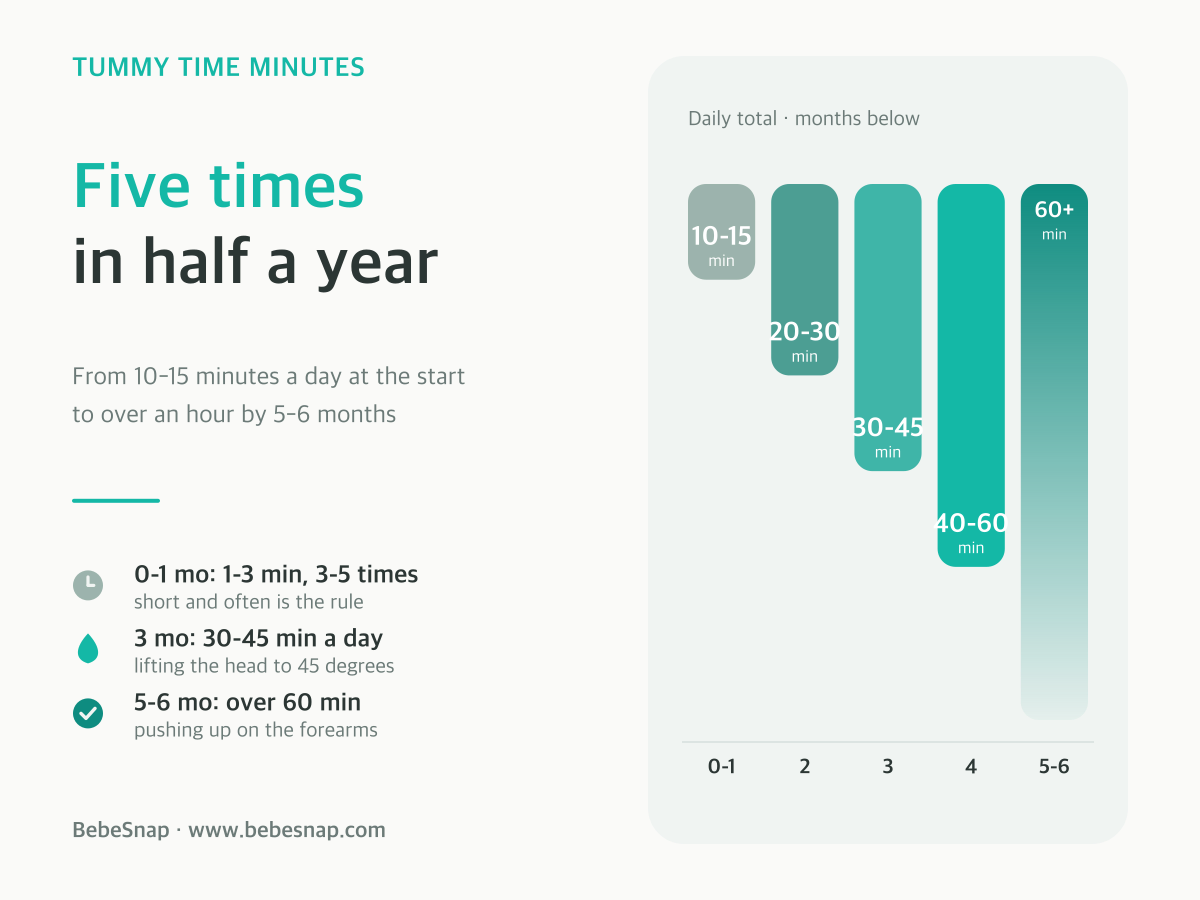
- Goal: 20-30 minutes total/day
3-4 Months
- Can do 5-10 minutes continuously
- Goal: 40-60 minutes total/day
- Starting to lift head and turn side to side
Tummy Time Guide by Age
| Age | Per Session | Sessions/Day | Daily Total | Development Goal |
|---|---|---|---|---|
| 0-1 month | 1-3 min | 3-5 | 10-15 min | Turn head |
| 2 months | 3-5 min | 4-5 | 20-30 min | Brief head lift |
| 3 months | 5-10 min | 4-5 | 30-45 min | Head at 45° |
| 4 months | 10-15 min | 3-4 | 40-60 min | Head at 90° |
| 5-6 months | 15-20 min | 3-4 | 60+ min | Push up on arms |

Proper Tummy Time Technique
Basic Position
1. Use a flat, firm surface
- Play mat, blanket, or carpet
- Avoid beds or sofas (too soft)
2. Position your baby
- Arms in front of chest
- Elbows under shoulders
- Head turned to one side
3. Parent's position
- Get at baby's eye level
- Talk and smile
- Use toys to engage
Tummy Time Variations
1. Chest-to-Chest (for newborns)
- Parent reclines at angle
- Baby lies tummy-down on chest
- Eye contact and skin-to-skin together

2. Lap Tummy Time
- Baby's tummy on parent's lap
- Gently rock or pat back
- Also helps with gas
3. Airplane Hold
- Baby face-down on your forearm
- Walk slowly around room
- Great for burping and colic
4. Exercise Ball Tummy Time
- Baby's tummy on large exercise ball
- Gently roll forward and back
- Helps with balance development
When Baby Hates Tummy Time
Many babies dislike tummy time at first. Don't give up!
Step-by-Step Adaptation
Step 1: Start on Chest
- Begin on parent's chest
- Heartbeat and warmth provide comfort
Step 2: Short and Frequent
- Even 1-2 minutes, multiple times
- Stop when crying, try again later
Step 3: Add Entertainment
- Place a mirror in front (babies love their reflection)
- High-contrast black-and-white cards
- Rattles or squeaky toys
Step 4: Join Them
- Get down on your tummy too
- Sing songs
- Make expressive faces

Timing Tips
- Right after diaper change
- Just after waking from nap (happy mood)
- At least 30 minutes after feeding (prevents reflux)
Tummy Time Safety
Never Do
- Sleep on tummy: SIDS risk!
- Leave unattended: Always supervise
- Right after feeding: Can cause spitting up
- On soft surfaces: Suffocation risk
Stop Signs
- Face buried in mat
- Appears to have trouble breathing
- Persistent crying
- Skin color changes
Development Checklist
Check if your baby is developing well:
1 Month
- [ ] Can turn head side to side
- [ ] Moves legs when on tummy
2 Months
- [ ] Can briefly lift head (few seconds)
- [ ] Tries to push up with arms
3 Months
- [ ] Holds head at 45° angle
- [ ] Starting to support on forearms
4 Months
- [ ] Holds head at 90° angle
- [ ] Pushes up to lift chest
- [ ] Reaches for toys
5-6 Months
- [ ] Attempts army crawl or rolling
- [ ] Grasps toys with both hands
- [ ] "Superman" pose (lifts arms and legs)
Creating a Tummy Time Space
Set up an environment baby will enjoy:
Recommended Items
- Play mat: Cushioned and washable
- High-contrast toys: Black-white or primary colors
- Baby-safe mirror: To see their face
- Soft books: Textured cloth books
- Tummy time pillow: C-shaped support
Environment Setup
- Lighting: Bright but not glaring
- Temperature: Comfortable for activity
- Sound: Soft music or white noise
Special Situations
Premature Babies
- Use corrected age
- Consult doctor after NICU discharge
- Start with even shorter sessions
Babies with Severe Reflux
- Wait 1 hour after feeding
- Use slightly inclined surface
- Start with lap tummy time
Torticollis (Head Tilts to One Side)
- Consult physical therapist
- Encourage looking opposite direction
- Tummy time is therapeutic
Track Tummy Time with BebeSnap
Accurate tracking helps monitor development. With BebeSnap:
- One-touch tummy time recording
- Automatic daily/weekly total calculation
- Developmental milestone check feature
- Photo documentation of growth
Frequently Asked Questions (FAQ)
Q: My baby cries every time during tummy time, should I continue?
A: Crying during tummy time is very normal at first, so don't give up. Stop the session the moment your baby cries, soothe them, then try again later for just 1 to 2 minutes at a time. Starting with chest-to-chest tummy time on your reclined chest, where your heartbeat and warmth provide comfort, makes the adaptation much easier.
Q: How much tummy time per day is effective?
A: Aim for about 10 to 15 minutes a day for newborns, gradually building to 40 to 60 minutes a day by 3 to 4 months of age. Rather than one long stretch, break it into several short sessions throughout the day, since multiple brief sessions are easier for your baby and just as effective for building strength.
Q: My baby doesn't army crawl, is that okay?
A: Not all babies army crawl, and some skip it entirely to go straight to regular crawling, so its absence alone isn't a concern. However, if your baby shows no method of moving around at all, whether army crawling, crawling, or rolling, by 7 to 10 months of age, it's worth checking in with your pediatrician.
Q: Can I use a bouncer or jumper instead of tummy time?
A: No, bouncers and jumpers can't replace tummy time, and relying on them too much may actually delay your baby's development. Tummy time is what strengthens the neck and back muscles that form the foundation for head control and rolling, so these devices should only be used as occasional, supplementary tools, not a substitute.
References
Keep Every Growth Milestone
Log height, weight, and milestones. The growth curves are drawn for you.
See what the app does firstYou Might Also Like
Apple for Babies: Stage-by-Stage Portions and When Raw Apple Is Safe
Spinach for Babies: When to Start, Why Boiling Matters, and the One Time to Skip It
Potato for Babies: When to Start, Safe Shapes, and Why Never to Blend It
Introducing Fish to Your Baby: When to Start, What Order, What to Avoid
You Might Also Like

Wonder Weeks Calculator: Your Baby's 10 Mental Leaps From the Due Date
Enter your due date and get all 10 leap dates. They land at weeks 5, 8, 12, 19, 26, 37, 46, 55, 64 and 75, each lasting 1 to 2 weeks.

Ultimate Twins Parenting Guide: Feeding, Sleep & Daily Routine Tips
Tandem feeding and synchronized sleep schedules are the keys to twin parenting. From double football hold positions to daily routine templates, here's everything you need for raising twins.

Baby Sensory Play Guide: Age-Appropriate Activities for Brain Development
A baby's brain forms over 1 million neural connections per second in the first 3 years. Discover age-appropriate sensory activities from 0-18 months plus DIY sensory toys.