How Much Milk With Solids at 7-9 Months | Stage 2 Weaning Milk Amount

Stop Trying to Remember Feed Times
Get Started FreeOnce you move solids up to two meals a day, one question almost always follows: "So how much should I cut back on formula or breast milk now?" Your baby is finally eating real food, so it feels like milk should drop off fast, and yet cutting it makes you worry she'll miss out on nutrition.
Here's the short answer up front: during stage 2 weaning (7 to 9 months), this isn't the time to "cut" milk, it's the time to "keep it steady and watch it taper on its own." Below we'll cover why that is, how much to give across the day, and common worries like "my baby won't take a bottle now that she's eating solids."
💡 The short version: at this stage breast milk and formula are still your baby's main source of nutrition. Even with two solid meals, keep milk at about 600~800ml (3 to 4 feeds) a day and let it taper off naturally rather than cutting it back on purpose.Two solid meals - so how much milk do I drop?
The middle stage usually begins a month or two after starting solids, once your baby reliably swallows one meal a day and you add a second, typically around 7 months. Your baby practices moving food around the mouth and mashing soft foods (about the firmness of tofu) with the tongue.
But two meals of solids is no reason to slash milk. At this stage most of your baby's nutrition still comes from breast milk or formula. Middle-stage solids are still "practice plus a top-up," not the main meal. So the goal isn't to "cut," it's to "hold steady and watch the natural decline." Here's the rough trend.
| Stage | Solid meals | Total daily milk | Feeds | Per feed |
|---|---|---|---|---|
| Late early stage (6 mo) | 1x | 700~900ml | 4~5 | about 140~220ml |
| Early middle (7 mo) | 2x | 600~800ml | 3~4 | about 150~260ml |
| Late middle (8~9 mo) | 2x | 500~700ml | 3~4 | about 130~230ml |
"Per feed" is simply the daily total divided by the number of feeds. If you're formula feeding, the right number tracks your baby's weight, so the weight-based daily formula calculator will be more precise.
These numbers are average targets, not a scorecard. What matters is the direction. As solids increase, milk drifting down a little is normal, because this happens as your baby fills up and naturally asks for milk less, not because you engineer it. If a parent instead cuts milk sharply because "she's eating now," total intake can fall short.
⚠️ Keep at least 500~600ml of milk a day until the first birthday. No matter how well your baby eats solids, breast milk and formula are still the key source of iron, fat, and calories at this age, so cutting them abruptly can throw nutrition off.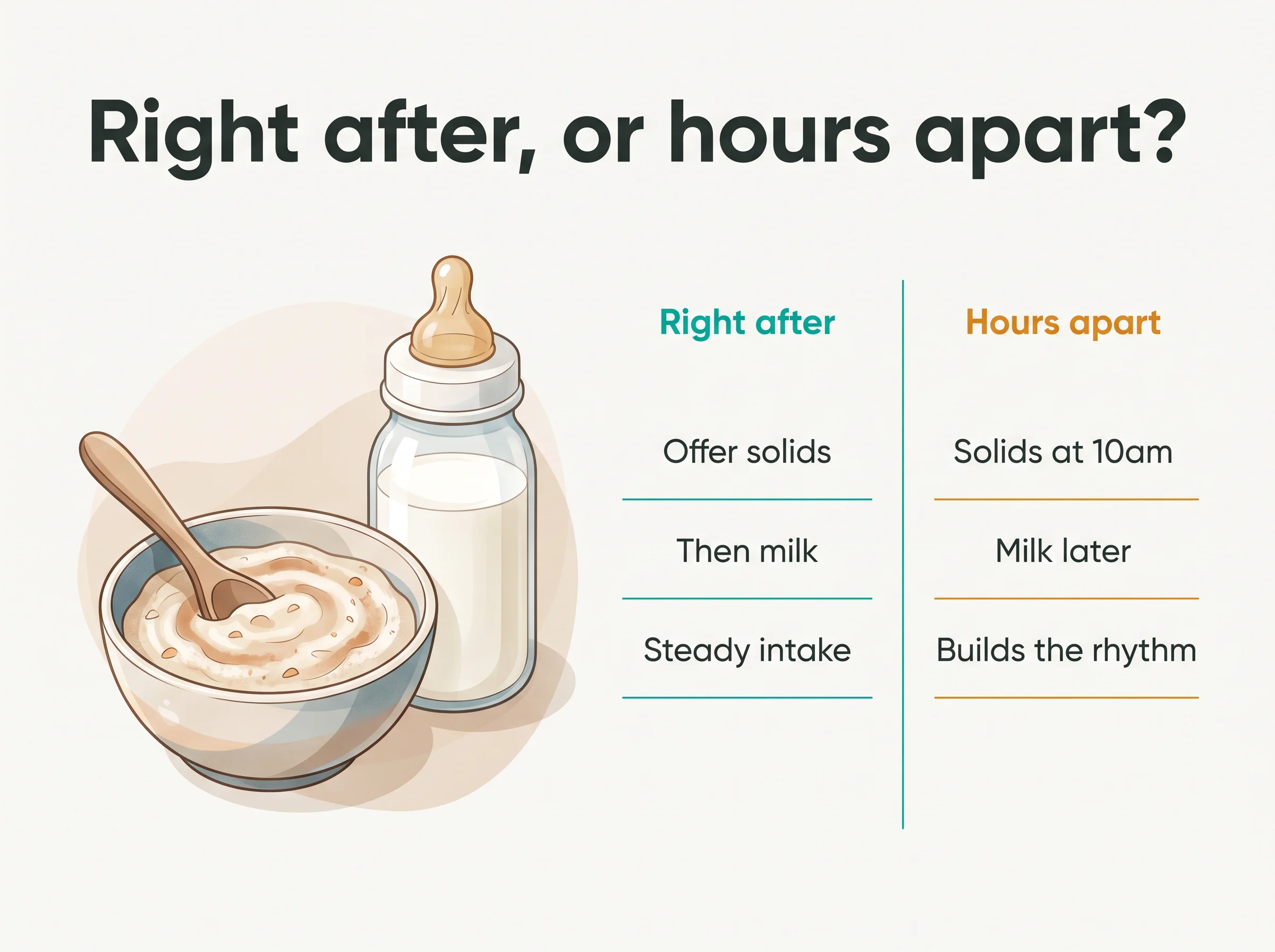
Milk right after solids, or on its own?
A common point of confusion in the middle stage is the gap between solids and milk. There are two main approaches.
Milk right after solids works well for babies who just moved up from the early stage. Solids alone don't fill them yet, so you finish the meal with breast milk or formula right afterward. When your baby only takes a few bites of solids, this keeps total intake stable.
Solids and milk spaced apart is where you naturally head once your baby eats a fuller meal of solids. For example, you offer solids mid-morning and then give a separate milk feed a couple of hours later when hunger returns. This pre-builds the "food separate, milk separate" rhythm you'll want when you move to three meals a day.
There's no single right answer. Just avoid one thing: don't give a full milk feed right before solids, or your baby will barely eat the meal. Watch your baby's response over a few days and find the spacing that fits your home.
A sample day that's easy to follow
The times are just a guide. If your baby wakes early, slide everything earlier; if a nap runs long, push it later. Protect the order and the day won't fall apart. Here's how two solid meals plus 3 to 4 milk feeds can sit in a day.
| Rough time | What to offer | Why it helps |
|---|---|---|
| ~7 AM (waking) | Breast milk or formula | The tank is empty after the night, so fill it first. |
| ~10 AM | Solids meal 1 (+ milk if wanted) | Less sleepy and in a good mood, so baby eats better. |
| ~2 PM | Breast milk or formula | Fills the gap between lunch and dinner. |
| ~6 PM | Solids meal 2 (+ milk to finish) | Comfortable as long as it isn't right before bed. |
| ~9 PM (before bed) | Breast milk or formula | The feed that closes out the day. |

Notice that even with two solid meals, milk still appears three times (waking, afternoon, bedtime). If your baby still has a night feed, that becomes four a day. This way you cover solids while naturally protecting the daily milk total.
"She eats solids and now refuses her bottle" - sound familiar?
Two worries come up constantly in the middle stage. Both are usually normal, so take a breath.
My baby ate solids and now won't take formula. This means your baby filled up on solids. Unless total intake is badly short, it's not a problem. But if she takes almost no milk right after solids, trim the solid portion slightly or widen the gap so there's room to want milk again.
Her milk intake dropped from before. As noted, milk easing down as solids grow is the natural trend. Rather than reacting to a single day, look at a 3 to 7 day average. If she's playful, makes 5 to 6 or more wet diapers a day as usual, and stays on her growth curve, she's fine.
On the other hand, if both solids and milk drop noticeably while she turns listless, wet diapers fall off sharply, or weight isn't gaining, that may be more than appetite. In that case it's safer to get checked by your pediatrician.
Don't skip water and iron
From the middle stage you can start practicing small sips of water. But water isn't a main drink here; it's a few sips at meals (roughly 30 to 60ml a day) to learn the cup. Too much water can crowd out milk or solids, so offer just a little from a cup.
And the nutrient to watch most at this age is iron. The iron stores your baby was born with run nearly empty by about 6 months. Breastfed babies especially are prone to running low, because breast milk is low in iron. That's why middle-stage solids should regularly include lean meats like beef and chicken, iron-fortified cereal, egg yolk, and legumes.
💡 Iron absorbs better when paired with vitamin C-rich vegetables and fruit. For example, serve a beef puree alongside broccoli or zucchini.Balancing milk and solids with BebeSnap
When you juggle solids and milk, "how many ml did she actually get today?" is easy to lose track of. Log both solids and feeds in BebeSnap and you can see at a glance whether the daily milk total lands in the 600~800ml target. A few days of records reveal how milk eases down as solids climb, and when the family shares one log, the running total carries over no matter who fed her. Noting reactions after new foods also helps at your next checkup.
Frequently Asked Questions (FAQ)
Q: How much milk should my baby have while doing middle-stage solids?
A: At 7 to 9 months, even with two solid meals, keep about 600~800ml of milk in 3 to 4 feeds a day. As your baby nears 8 to 9 months this may taper naturally to 500~700ml. Since breast milk or formula is still the main source of nutrition before age one, keep at least 500~600ml.
Q: Should I give milk right after solids?
A: There's no single rule. While solids alone don't fill your baby, finish the meal with milk right afterward; once portions grow, offer milk as a separate feed. Just avoid a full milk feed immediately before solids, because your baby will then barely eat the meal. Watch responses over a few days to find your spacing.
Q: My baby eats solids and now refuses the bottle. Is that okay?
A: Usually yes, because it means she filled up on solids. As long as the daily milk total doesn't drop well below 500~600ml, there's no need to worry. Trimming the solid portion slightly or widening the gap between solids and milk gives her room to want milk again.
Q: Why is iron so important in middle-stage solids?
A: The iron stores your baby was born with run nearly empty by about 6 months. Breastfed babies are especially prone to low iron, so regularly include lean meats like beef and chicken, iron-fortified cereal, egg yolk, and legumes. Serving them with vitamin C-rich vegetables improves absorption.
References
Stop Trying to Remember Feed Times
Log time, amount, and intervals. BebeSnap turns them into your baby's daily pattern.
See what the app does firstMedical Disclaimer: This article is for informational purposes only and does not replace professional medical advice. If you have concerns about your baby's health, please consult a pediatrician.
You Might Also Like
Wonder Weeks Calculator: Your Baby's 10 Mental Leaps From the Due Date
Baby Weight Gain Calculator: Grams Per Day From Two Weigh-Ins
Baby Impetigo: Golden Crusts, Antibiotic Treatment, and When Nursery Is Safe Again
Baby Mouth Sores (Stomatitis): Causes, How to Tell Them Apart, and Dehydration Signs
You Might Also Like
Tomato for Babies: When to Start, Skin and Seeds, and Why Cherry Tomatoes Are Never Served Whole
Tomato can start at 5-6 months once the skin and seeds are removed and it is cooked. Portions run 20-30g at 7-8 months and 30-40g at 9-11 months, counted together with fruit. Cherry tomatoes are the one vegetable Japan's childcare guidance names by name as something not to serve whole.

Cow's Milk Protein Allergy (CMPA) and Choosing a Hypoallergenic Formula
Blood in stool, eczema, or vomiting may signal cow's milk protein allergy (CMPA), which affects 2-3% of infants and differs from lactose intolerance. Learn how to choose between extensively hydrolyzed and amino acid formula; most outgrow it by age 5.

Baby Vitamin D Supplements: Timing, Dosage, and How to Give
Breastfed babies need 400 IU of vitamin D daily from the first days! Even formula-fed babies under 1L/day need it. Learn timing, dosage, and easy ways to give.