When Can Baby Sleep in Their Own Room? Room-Sharing, Pillows, Blankets and Moving to a Bed
See Your Baby's Sleep Pattern Emerge
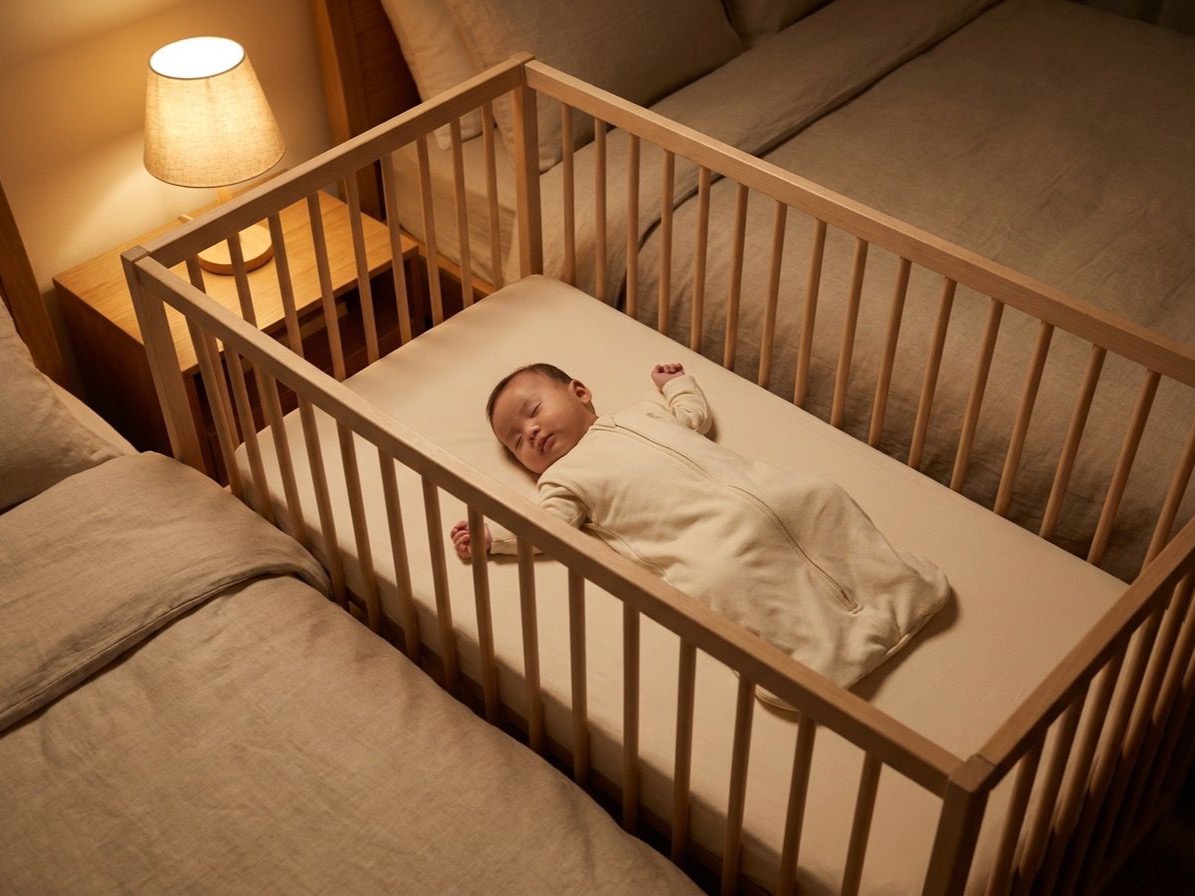
Get Started FreeWhen every grunt from the bassinet wakes you up, it's natural to wonder when your baby can move to their own room. The American Academy of Pediatrics (AAP) recommends keeping your baby in your room, on a separate sleep surface made for infants, for at least the first 6 months. After that there is no fixed date, so the move can be timed around a safe setup and what works for your family. Below is the full timeline, including when pillows and blankets become okay and when to leave the crib.
💡 Room-share for at least the first 6 months: same room, separate crib or bassinet. Sleep-related deaths are highest in those months (AAP). Keep pillows, blankets and toys out of the sleep space until 12 months, and use a wearable blanket if your baby gets cold.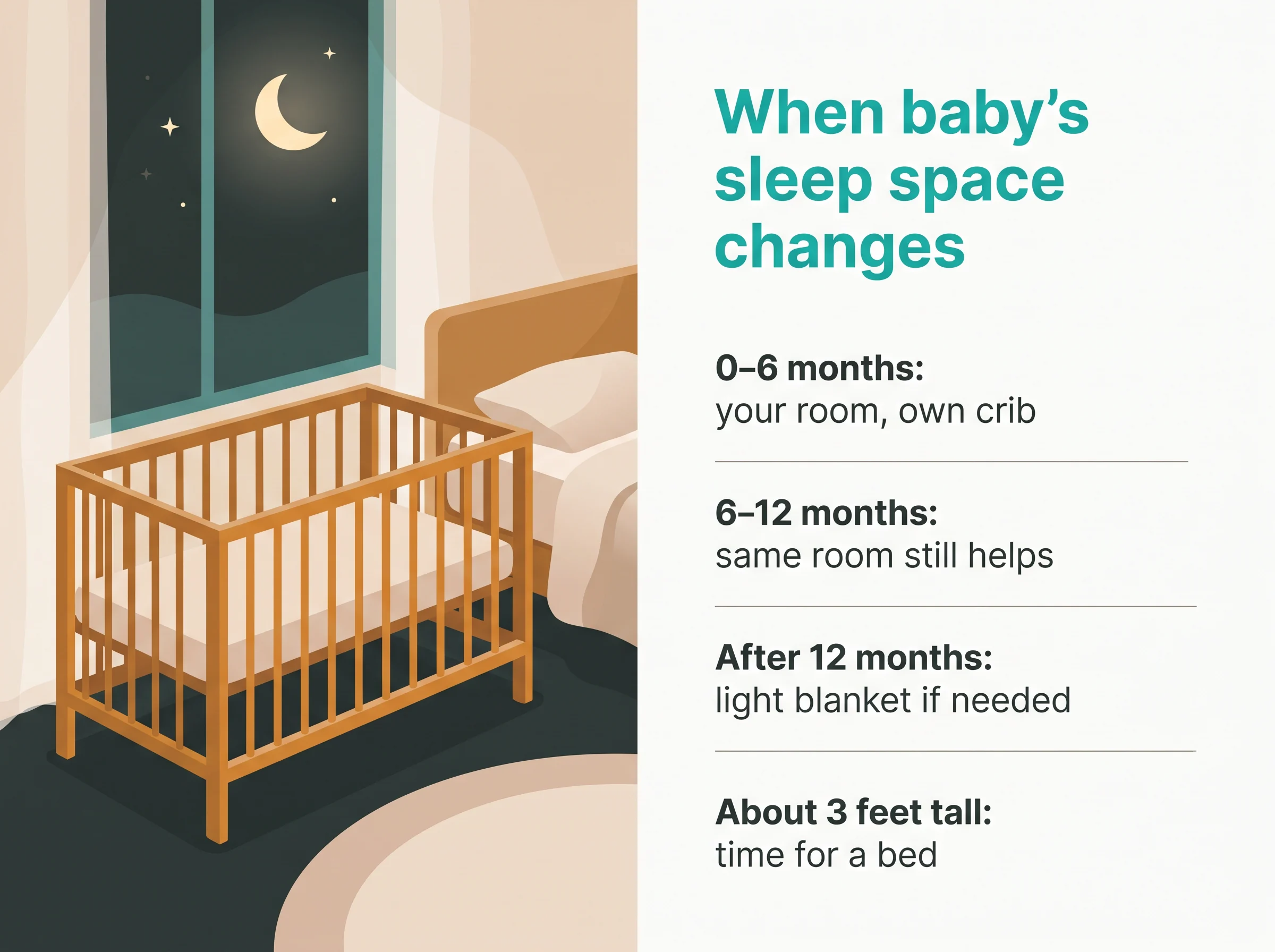
When Can Baby Move to Their Own Room?
In its 2022 safe sleep policy, the AAP recommends that babies sleep in the parents' room, close to the parents' bed, but on a separate surface designed for infants, ideally for at least the first 6 months. There is evidence that this setup lowers the risk of sudden infant death syndrome (SIDS) by as much as 50%, and it is the arrangement most likely to prevent the suffocation, strangulation and entrapment that can happen in an adult bed.
The same policy says room-sharing without bed-sharing is protective for the whole first year, and that there is no specific evidence for when it becomes safe to move a baby to a separate room before age 1. Sleep-related deaths are highest in the first 6 months, which is why room-sharing matters most during that stretch. One AAP parent page puts it as "at least 6 months, but preferably up to 1 year."
| Age | Where baby sleeps |
|---|---|
| 0 to 6 months | Your room, own crib or bassinet. The most important stretch |
| 6 to 12 months | Room-sharing still helps; preferably keep it up |
| After 12 months | Own room whenever your family is ready |
Do Babies Sleep Longer in Their Own Room?
The INSIGHT study, published in Pediatrics in 2017, compared sleep in 230 first-time mothers and their babies in Pennsylvania.
- At 4 months: total night sleep was about the same either way. Babies who had moved to their own room before 4 months had a longest sleep stretch 46 minutes longer.
- At 9 months: babies who moved before 4 months slept an average of 627 minutes a night, babies who moved between 4 and 9 months slept 601, and babies still room-sharing slept 587.
- At 12 and 30 months: there was no difference at 12 months. At 30 months, children who had their own room by 9 months slept more than 45 minutes longer at night.
Room-sharing families also had about twice the odds of having blankets, pillows or other objects in the baby's sleep space at 4 months, and about 4 times the odds of bringing the baby into the adult bed overnight at both 4 and 9 months.
Keep the limits in mind: this was a second look at families from one hospital who joined an obesity-prevention trial, sleep was reported by mothers on a questionnaire, and the study did not measure SIDS risk. The AAP's 2022 policy, published after it, still recommends at least 6 months of room-sharing. If you room-share, the study points to two things to watch: objects creeping into the sleep space and bringing your baby into your bed at night.
Before You Make the Move
- Is your baby past 6 months? The AAP prefers room-sharing up to 1 year when that works for you.
- Is the sleep space bare? A firm, flat mattress with a fitted sheet and nothing else: no pillows, quilts, blankets, bumper pads or toys.
- Will they stay warm without a blanket? Dress your baby in layers or a wearable blanket, generally one layer more than you're wearing. Skip anything weighted, including weighted blankets, sleepers and swaddles.
- What's the plan for night feeds? If you bring your baby into your bed to feed or comfort them, put them back in their own sleep space before you fall asleep.
- Don't count on a monitor for SIDS: the AAP advises against using home cardiorespiratory monitors to reduce SIDS risk. Consumer heart rate and oxygen monitors don't have to meet the requirements for medical devices, and there is no evidence they lower SIDS risk. An audio monitor can tell you your baby is awake, but it is not a safety device.
How to Make the Switch
1. Start with a separate sleep surface in your room
- If your baby still sleeps in your bed, make this change now, at any age. Put a crib or bassinet in your room.
2. Move naps to the new room first
- Keep the same pre-sleep steps you already use, such as a bath, a feed and a book. See how to build a bedtime routine.
3. Then move night sleep
- Putting your baby down drowsy but still awake gives them practice falling asleep on their own. Different approaches are compared in sleep training methods.
When Can Babies Have a Pillow or Blanket?
Not before the first birthday. The AAP asks parents to keep pillows, quilts, comforters, blankets, bumper pads and toys out of the infant sleep space, because they raise the risk of suffocation, entrapment and strangulation.
There is no research-backed date when these become 100% safe. The AAP explains that most experts agree they pose little risk to healthy babies after 12 months of age.
| Age | Pillows and blankets |
|---|---|
| Under 12 months | None. Use layers or a wearable blanket |
| After 12 months | A light blanket your child can kick off. No set age for a pillow, so there's no rush |

When to Move From the Crib to a Bed
The AAP says that once children are about 3 feet tall (about 90 cm), they should start sleeping in a bed. If you're worried about falls, you can start with the mattress on the floor.
The most common crib falls happen when a baby tries to climb out. Before your baby can sit, lower the mattress so they can't fall out by leaning on or pulling up over the side, and set it at the lowest position before they learn to stand. If your child is trying to climb out before reaching 3 feet, recheck the mattress height and consider a mattress on the floor.
When Bed-Sharing Is Especially Risky
The AAP recommends against bed-sharing under any circumstances. The risk climbs sharply in these situations:
- An adult in the bed is very tired, has been drinking, or has taken medicines or drugs that make it harder to wake: more than 10 times higher risk of sleep-related death
- Baby is younger than 4 months: 5 to 10 times higher
- Baby was born preterm or at low birth weight: 2 to 5 times higher
- Falling asleep with a baby on a couch or soft armchair: up to 67 times higher
Smoking or vaping, during pregnancy or now, also makes bed-sharing more dangerous. More safe sleep rules are in our SIDS prevention guide.
Track the Transition with BebeSnap
Once your baby moves rooms, you'll want to know whether night wakings go up or bedtime slips later. In the BebeSnap app you can log when your baby falls asleep and wakes, and see total daily sleep and night wakings change over time.
- Sleep log: record sleep and wake times as they happen
- Sleep stats: total daily sleep and how often your baby wakes at night
- Family sharing: everyone who cares for your baby sees the same record
👉 Learn more about BebeSnap sleep tracking
Frequently Asked Questions (FAQ)
Q: When can my baby sleep in their own room?
A: The AAP recommends room-sharing on a separate infant sleep surface for at least the first 6 months, because sleep-related deaths are highest then and room-sharing can cut SIDS risk by up to 50%. Room-sharing stays protective through the first year, and there is no evidence for when a separate room becomes safe before age 1.
Q: Will my baby sleep longer in their own room?
A: In the INSIGHT study of 230 families, total night sleep was similar at 4 months. At 9 months, babies who moved before 4 months slept 40 minutes more per night than room-sharers, and there was no difference at 12 months. Sleep was reported by mothers, and the study did not measure SIDS risk.
Q: When can my baby sleep with a pillow or blanket?
A: Keep pillows, blankets, bumpers and toys out of the sleep space until 12 months, and use layers or a wearable blanket instead. The AAP says no study shows when these become completely safe, but most experts agree they pose little risk to healthy babies after 12 months. There's no set age for a pillow.
Q: When should my toddler move from a crib to a bed?
A: The AAP says children should start sleeping in a bed once they are about 3 feet (90 cm) tall, and you can begin with the mattress on the floor if you're worried about falls. Most crib falls happen during climbing, so lower the mattress to its lowest position before your baby learns to stand.
References
- American Academy of Pediatrics - Sleep-Related Infant Deaths: Updated 2022 Recommendations
- AAP HealthyChildren - How to Keep Your Sleeping Baby Safe: AAP Policy Explained
- AAP HealthyChildren - Safe Sleep: 9 Ways to Reduce a Baby's Risk of SIDS and Suffocation
- AAP HealthyChildren - Choosing a Crib
- AAP HealthyChildren - Make Baby's Room Safe: Parent Checklist
- Paul et al., Pediatrics 2017 - Mother-Infant Room-Sharing and Sleep Outcomes in the INSIGHT Study
See Your Baby's Sleep Pattern Emerge
Track sleep and watch wake windows and night stretches appear as clear graphs.
See what the app does firstMedical Disclaimer: This article is for informational purposes only and does not replace professional medical advice. If you have concerns about your baby's health, please consult a pediatrician.
You Might Also Like
Kaup Index (Baby BMI): How to Calculate It and What's Normal by Age
Wonder Weeks Calculator: Your Baby's 10 Mental Leaps From the Due Date
Baby Weight Gain Calculator: Grams Per Day From Two Weigh-Ins
Baby Impetigo: Golden Crusts, Antibiotic Treatment, and When Nursery Is Safe Again
You Might Also Like
Baby Sleep While Traveling: Settling Them in a New Place and Resetting After
Worried a trip will wreck your baby's sleep? The first night is the hardest, and most babies reset within 3-7 days at home. What to pack, naps on the move, and safe sleep away.

Baby Separation Anxiety | Stranger Anxiety Signs & Daycare Transition Tips
Crying when anyone but mom holds them is normal separation and stranger anxiety. Learn when it appears, its signs, and effective coping: including daycare adjustment.

Baby Waking at 5 AM: What to Do and What Not to Do
Is your baby up at 5 AM? It's usually bedtime timing, room light, or the last wake window. Waking after 6 AM is normal. Here's what to do and what to avoid.