Baby Eye Contact, Vision Milestones & Strabismus Check: Pseudostrabismus vs Real Strabismus
Keep Every Growth Milestone
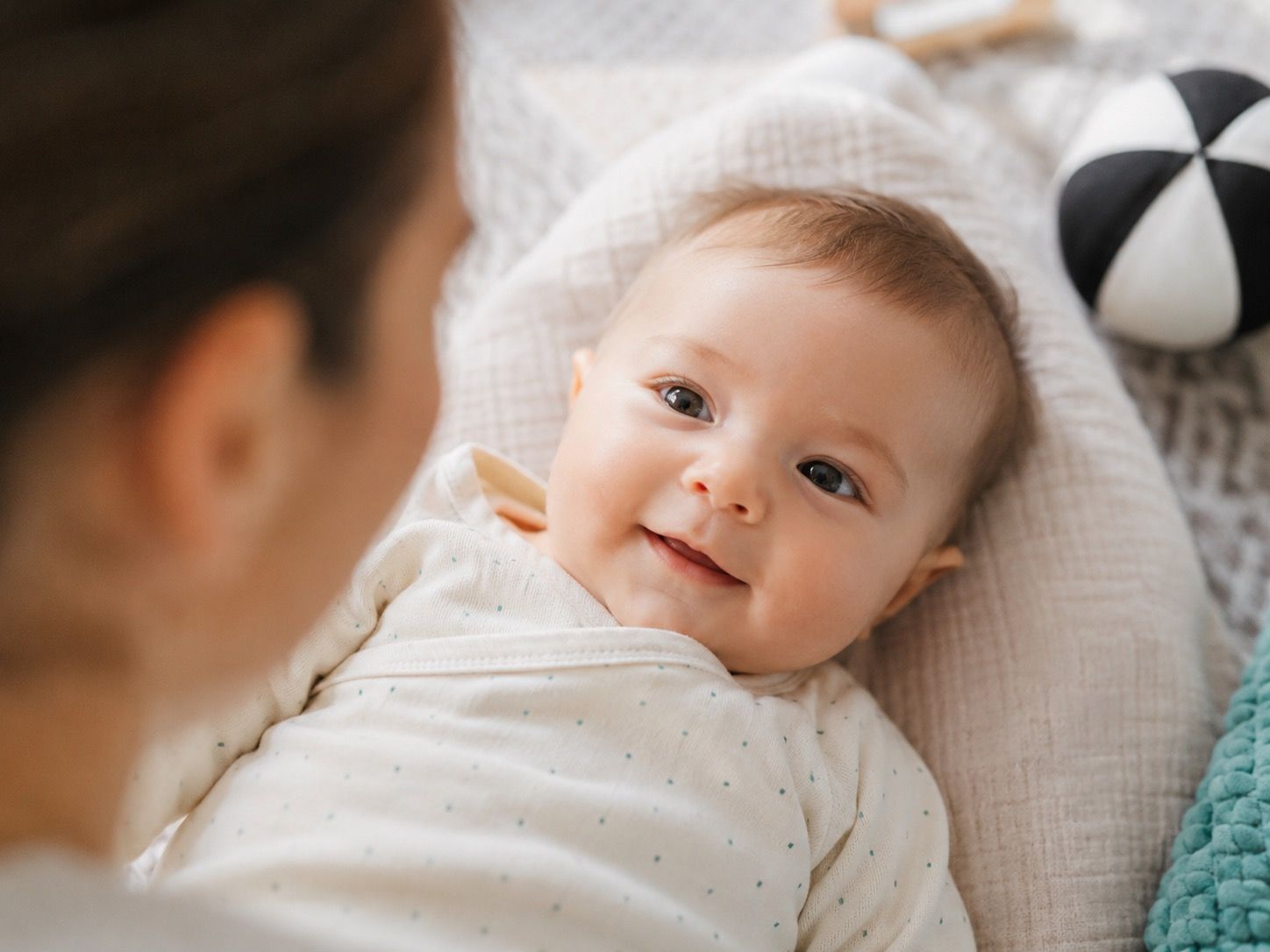
Get Started FreeHolding your newborn, you've probably wondered, "Is my baby actually looking at me?" or "Their eyes keep drifting inward: could that be a squint?" Here's the reassuring truth: most babies don't start making real eye contact until around 6 to 8 weeks, because before that their focus is still too blurry. And because newborns have a low nasal bridge and wide-set eyes, a great many of them look cross-eyed when their eyes are perfectly straight: a harmless condition called pseudostrabismus.
That said, it's worth knowing the difference. True strabismus (a real eye misalignment) shows up as eyes that keep turning even after 4 months, and left untreated it can lead to amblyopia (lazy eye). The good news is there's a simple check you can do at home with nothing but a flashlight. Let's walk through the eye-contact and vision milestones month by month, then the light-reflex test that helps tell a fake squint from a real one.
When Does Your Baby Start Making Eye Contact?
Eye contact is more than a "my eyes work" signal; it's your baby's very first sign of social connection. Vision sharpening and eye contact grow hand in hand.
| Age | Eye Contact & Vision Milestone | What You'll Notice |
|---|---|---|
| Birth–4 weeks | Perceives brightness and large shapes only | Briefly gazes at faces 8–12 inches away; eye contact still rare |
| 6–8 weeks | First real eye contact begins | Locks onto your eyes, soon followed by the social smile |
| 2–3 months | Sustained eye contact and tracking develop | Follows a moving face or toy side to side |
| 3–4 months | Color vision starts; eyes align steadily | After this point, a turning eye is a reason to check (possible strabismus) |
| 5–6 months | Binocular (depth) vision and color fully established | Reaches for distant objects; eye-hand coordination |
| 7–12 months | Depth and distance perception refine | Accurately grabs faraway toys; responds to peek-a-boo |
Why Newborns Look Cross-Eyed
Eyes that seem to drift inward in the early months are extremely common. There are two main reasons.
1. facial structure. A newborn's nasal bridge is still low and flat, and many babies have epicanthal folds (skin folds at the inner corner of the eye) that hide the white of the eye on the nasal side. This makes perfectly straight eyes look like they're turning inward. This is pseudostrabismus.
2. immature muscle control. Through about 3 to 4 months, a baby hasn't yet mastered aiming both eyes together, so the eyes may briefly cross or drift when they're tired or sleepy. This usually settles on its own with time.
Pseudostrabismus typically disappears on its own by age 2 or 3 as the nasal bridge grows. The catch is that you can't reliably tell this harmless "fake squint" from a real strabismus that needs treatment just by looking.
Pseudostrabismus vs. Real Strabismus: How to Tell
Here are the key differences at a glance.
| Feature | Pseudostrabismus | True Strabismus (esotropia) |
|---|---|---|
| Cause | Low nasal bridge, epicanthal folds: facial structure | Genuine misalignment of eye muscles or nerves |
| Light reflex position | Same spot in both eyes (symmetric) | Off-center in one eye (asymmetric) |
| On straight gaze | Looks crossed, but truly aligned | One eye actually turns in or out |
| Course | Usually gone by age 2–3 | Does not resolve alone; needs treatment |
| Amblyopia risk | None | Can progress to amblyopia if untreated |

Real strabismus may keep the eye turned all the time, or it may come and go, showing up only when your baby is tired. In particular, infantile esotropia: a large inward turn appearing before 6 months: often needs early surgery, so it warrants a prompt visit to a pediatric ophthalmologist.
💡 Left untreated, strabismus causes the brain to ignore the blurry image from the turned eye, so that eye's vision fails to develop; this is amblyopia. Strabismus isn't a cosmetic issue; it's a vision issue.The At-Home Light-Reflex Check
You can loosely mimic the corneal light-reflex test (the Hirschberg test) doctors use, right at home. It's no substitute for a real eye exam, but it helps you decide whether it's time to book one.
1. Get ready
- Grab a small flashlight or your phone's flash
- Dim the room a little so the reflection shows up clearly
2. Shine the light
- From directly in front, about 12 inches from your baby's face, aim the light between their eyes
- Let your baby glance at the light for a moment
3. Check the reflection
- Compare where the little white dot lands on each cornea (the dark center of the eye)
- Normal: the dots sit in the same spot in both eyes (usually just slightly toward the nose), symmetric
- Possible strabismus: one dot is off-center compared with the other (e.g., centered in one eye, near the edge in the other)
4. Use a photo
- Take a flash photo while your baby looks at the camera, then zoom in to compare the reflection spots; this is often easier to judge
When to See an Eye Doctor
Even with likely pseudostrabismus, a check is reasonable if you're worried. But don't wait if you notice any of these, see a pediatric ophthalmologist.
Alignment concerns
- One eye keeps turning in or out after 4 months
- The light reflex sits clearly in different spots in each eye
- The eyes look vertically misaligned
Behavioral signs
- Tilting the head to one side to look at things
- Frequently closing or covering one eye to see
- Still no eye contact or face-looking after 3 months
Treat as urgent
- The pupil glows white or yellow instead of red in photos (leukocoria, a possible sign of congenital cataract or retinoblastoma)
- Severe trouble opening the eyes even under normal indoor light
Vision screening is part of routine well-child checkups, and the American Academy of Pediatrics (AAP) recommends screenings at 6 months, 3 years, and 5 years. The 3-year exam matters most because that's when vision can first be measured properly: catching strabismus and amblyopia at that age gives the best chance of recovery.
Is Screen Time Really Bad for Baby's Eyes?
It's one of the most common questions parents ask. The short answer: too-early screen exposure does nothing good for eye development. The AAP recommends no screens (other than video chatting) for babies under 18 months.
There are two reasons. First, viewing a screen up close for long stretches raises the risk of developing and worsening myopia (nearsightedness). Second, every minute on a screen is a minute not spent looking at faces and making eye contact: so babies can miss out on eye-contact and social development.
Do this instead.
Supporting eye development at 0–12 months
- Make frequent eye contact and smile from 8–12 inches away
- Show high-contrast black-and-white books and mobiles (color is still hard to see)
- Slowly move bright, colorful toys side to side for tracking practice
- Let your baby crawl in a safe space to build depth perception
Managing Eye Contact & Vision Milestones with BebeSnap
If you want to log when eye contact started, tracking progress, and even your light-reflex check results, try the BebeSnap app:
- Milestone tracking: Record first eye contact, first tracking, and other visual milestones month by month, with dates
- AI photo analysis & chatbot: Noticed something odd about eye alignment or the light reflex? Ask the AI with a photo, anytime
- Health checkup reminders: Get reminders for easy-to-miss eye screenings at 6 months, 3 years, and beyond
Frequently Asked Questions (FAQ)
Q: When does a baby start making eye contact?
A: Most babies make their first real eye contact around 6 to 8 weeks, soon followed by the social smile. By 2 to 3 months, eye contact becomes clearer and more sustained. If your baby still won't look at faces or lock eyes after 3 months, it's worth checking their vision and overall development.
Q: My newborn's eyes look crossed. Is that okay?
A: Newborns often look cross-eyed because of a low nasal bridge and epicanthal folds; this is pseudostrabismus, and it usually disappears by age 2 or 3. But if the eyes keep turning after 4 months, or the light reflex is asymmetric, it could be real strabismus, so see an eye doctor.
Q: How can I check for strabismus at home?
A: Shine a flashlight between your baby's eyes from about 12 inches away and compare where the white reflection dot lands on each cornea. Symmetric dots are normal; a dot that's off-center in only one eye suggests strabismus. This home check is just a guide, see an eye doctor if you're unsure.
Q: When can I let my baby use a smartphone?
A: The AAP recommends no screen exposure other than video chatting for babies under 18 months. Early screen time raises myopia risk and reduces chances for eye contact and social development. Instead, offer face-to-face time, outdoor play, and black-and-white or colorful toys for visual stimulation.
References
Keep Every Growth Milestone
Log height, weight, and milestones. The growth curves are drawn for you.
See what the app does firstYou Might Also Like
Tomato for Babies: When to Start, Skin and Seeds, and Why Cherry Tomatoes Are Never Served Whole
Apple for Babies: Stage-by-Stage Portions and When Raw Apple Is Safe
Spinach for Babies: When to Start, Why Boiling Matters, and the One Time to Skip It
Potato for Babies: When to Start, Safe Shapes, and Why Never to Blend It
You Might Also Like
Wonder Weeks Calculator: Your Baby's 10 Mental Leaps From the Due Date
Enter your due date and get all 10 leap dates. They land at weeks 5, 8, 12, 19, 26, 37, 46, 55, 64 and 75, each lasting 1 to 2 weeks.
Baby Vitamin D Supplements: Timing, Dosage, and How to Give
Breastfed babies need 400 IU of vitamin D daily from the first days! Even formula-fed babies under 1L/day need it. Learn timing, dosage, and easy ways to give.
Baby Vision Development Milestones: From Newborn Eyesight to Amblyopia Early Detection
Newborns see only 20/400, but vision reaches 20/20 by age 6, amblyopia affects 3% of kids and must be treated before age 7.