Baby Sunscreen & Sun Protection Guide: When to Start and How to Use SPF Safely
Check Your Baby's Health from One Photo
Get Started FreeThe weather warms up and you can't wait to get the baby outside, but then you reach for the sunscreen and pause: "Can I even put this on such a little one? When am I supposed to start?" I had the same hesitation. Here's the short answer: for a baby under 6 months, shade and clothing come before sunscreen. Once they hit 6 months, that's when you start applying SPF 30+ about 15-30 minutes before heading out. Below, mom to mom, let's go through why baby skin burns so easily, how to protect them at each age, and exactly how to use sunscreen the right way.
Baby Skin Burns More Easily Than You'd Think
A baby's skin is much thinner than ours, with far less of the melanin that shields against the sun. So no matter how light or dark your baby's skin is, every baby burns more easily than an adult. UV rays reach deep into the skin cells, and one bad burn early in life can set the stage for skin problems down the road: which is exactly why it's worth getting ahead of it.
There are really two kinds of UV to know about. One sinks deep into the skin and causes aging and dark spots; the other works on the surface and is what gives you a burn. When you're picking a sunscreen, look for the words "broad-spectrum" on the label; that just means it handles both kinds at once, so it's an easy shortcut.
💡 A deeper skin tone doesn't make your baby sun-proof. Even with more melanin, UV still damages skin, so sun protection is a must for every baby!How Old Is Your Baby? Here's the Plan
Not Yet 6 Months
At this age, the move isn't to slather on sunscreen; it's to keep the sun off them in the first place.
1. Skip the midday sun
- The rays are strongest from 10 a.m. to 4 p.m., so try to plan outings around that window
- When you do go out, stick to the shade
2. Clothes and a hat do the most
- Pop on a wide-brimmed hat that shades the face and neck
- Cover skin with light, breathable long sleeves and pants
- Pull down the stroller canopy to block the direct sun
3. Sunscreen only when you have to, and just a little
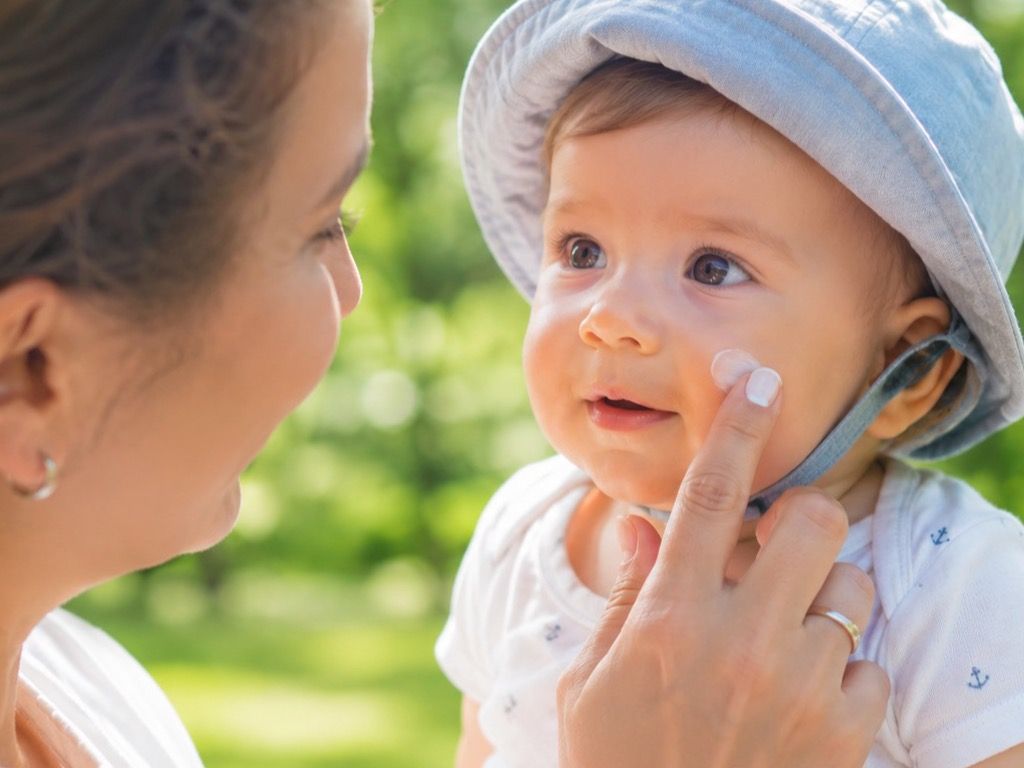
- If you truly can't find shade, a dab of SPF 30+ mineral sunscreen on small spots like the face and backs of the hands is okay
6 Months and Older
Now you can apply sunscreen to all the skin that's exposed. Here's a quick cheat sheet for choosing one.
| Item | What to look for |
|---|---|
| SPF Level | SPF 30 or higher |
| Coverage | Broad-spectrum UVA + UVB |
| Formula | Mineral (non-chemical): zinc oxide or titanium dioxide |
| When to apply | 15-30 minutes before going out |
| Reapply | Every 90 minutes to 2 hours |
| After swim or sweat | Reapply right away |
Mineral or Chemical? This One's Better for Babies
If you look at the ingredients, sunscreens fall into two camps, and for babies, the mineral (non-chemical) kind is the one to reach for. Here's how they differ.
| Feature | Mineral (Zinc Oxide / Titanium Dioxide) | Chemical (Oxybenzone, etc.) |
|---|---|---|
| How it works | Bounces UV rays off like a mirror | Soaks up UV rays and turns them to heat |
| Skin absorption | Barely any; non-nano particles don't pass through healthy skin | Absorbed into the skin |
| FDA view | Recognized as safe and effective | Still under further review |
| When it works | Protects the moment you apply it | Needs 15-30 minutes to kick in |
| On sensitive skin | Gentle enough for delicate skin | Can trigger allergic reactions |
| White cast | Can look a little white (nano formulas less so) | No white cast |

The U.S. FDA recognizes zinc oxide and titanium dioxide as safe and effective ingredients. Because these non-nano particles don't soak into healthy skin, they're one you can use on your baby with more peace of mind than the chemical kind.
💡 Skip spray sunscreens for babies; they can breathe in the mist. Reach for a cream, lotion, or stick-type mineral sunscreen instead!How to Apply It So It Actually Works
1. Before you apply
- Put it on 15-30 minutes before heading out, so it has time to settle into the skin
- Apply to dry, clean skin so it goes on evenly
2. Where to put it
- Every bit of exposed skin, and don't be stingy
- Face, behind the ears, neck, backs of hands and feet
- Go gently around the eyes (skip the eyelids)
- Use a separate SPF lip balm on the lips
3. When to reapply
- Every 90 minutes to 2 hours, no skipping
- Right away after swimming or a big sweat
- Toweling off wipes the protection off with it
4. Once you're home
- Wash it all off with a gentle cleanser
- Leftover sunscreen sitting on the skin can cause a breakout
Honestly, Clothing and Shade Come First
The World Health Organization (WHO) names three ways to protect skin, shade, clothing, and SPF 30+ sunscreen: and the order matters. Shade and clothing come before sunscreen. Think of sunscreen as the finishing touch that fills in the gaps.
Protecting with clothes and shade:
- Wide-brimmed hat: a brim over 2 inches that shades the face, ears, and neck
- Covering clothes: UPF 50+ swimwear or a rash guard, plus light long sleeves
- Stroller canopy: pull down the hood to block the direct sun
- Dodge peak hours: stay indoors or in the shade from 10 a.m. to 4 p.m.
If Your Baby Does Get Sunburned
If your baby's skin has gone red and burned, cooling it down quickly is what matters.
Do this right away:
- Bring them into a cool room
- Cool the skin gently with lukewarm water (not cold water or ice)
- Offer plenty of breast milk or formula to keep them hydrated
- Dab on fragrance-free aloe gel or a gentle moisturizer
See a doctor if:
- Blisters form on the skin
- The face or a large area is burned
- They run a fever or are crying inconsolably
- They're vomiting or showing signs of dehydration
Frequently Asked Questions (FAQ)
Q: Is sunscreen needed on cloudy days?
A: Yes, absolutely. Up to 80% of UV rays pass through clouds, so sunscreen is necessary even on overcast days when going outside. Apply an SPF 30+ broad-spectrum mineral formula 15-30 minutes before heading out, and remember that shade and clothing like a wide-brimmed hat are your first line of protection.
Q: Can babies be exposed to UV rays indoors near a window?
A: UVA rays (the kind that sink deep into the skin and cause aging and dark spots) do pass through glass. Prolonged exposure near car or home windows can still cause UV damage over time, so for a baby seated by a sunny window, pull down a stroller canopy or use light covering clothes.
Q: How long does sunscreen stay effective in the bottle?
A: Use sunscreen within one year of opening, or follow the expiration date on the packaging. Storing it in high heat or direct sunlight degrades its effectiveness faster, so keep it cool. An effective bottle still needs proper use: apply 15-30 minutes before going out and reapply every 90 minutes to 2 hours.
Q: Is SPF 50+ better than SPF 30 for babies?
A: The difference in UV protection between SPF 30 and SPF 50 is only about 3-4%, so an SPF 30+ broad-spectrum mineral sunscreen is sufficient for babies. What matters most is consistent reapplication, every 90 minutes to 2 hours, and right away after swimming or heavy sweating, since toweling off removes the protection.
Managing with BebeSnap
Keeping track of your baby's outdoor time and sun exposure helps you build safer habits. Use the BebeSnap app to stay on top of it all:
- Log outdoor schedules and time of day to monitor UV exposure windows
- Get instant AI chatbot advice if your baby shows signs of sunburn or skin irritation 👉 Learn about BebeSnap's AI Chatbot
- Track your baby's skin condition changes over time with the skin analysis feature
References
Check Your Baby's Health from One Photo
AI stool analysis reads color and texture, and keeps every health record in one place.
See what the app does firstMedical Disclaimer: This article is for informational purposes only and does not replace professional medical advice. If you have concerns about your baby's health, please consult a pediatrician.
You Might Also Like
Tomato for Babies: When to Start, Skin and Seeds, and Why Cherry Tomatoes Are Never Served Whole
Apple for Babies: Stage-by-Stage Portions and When Raw Apple Is Safe
Spinach for Babies: When to Start, Why Boiling Matters, and When to Skip It
Potato for Babies: When to Start, Safe Shapes, and Why Never to Blend It
You Might Also Like
Baby Impetigo: Golden Crusts, Antibiotic Treatment, and When Nursery Is Safe Again
Golden-brown crusts spreading across your baby's skin? Impetigo is a common, highly contagious bacterial skin infection in young children. It stops being contagious 48 hours after treatment starts. Here is how to recognise it and when nursery is safe again.
When Can Babies Start Swimming? Safe Ages and Baby Swim Guide
When can babies start swimming? AAP recommends swim lessons from age 1, with parent-baby water play classes safe from 6 months old.
Baby Snoring & Infant Sleep Apnea: Causes, Symptoms, and When to Seek Help
About 3.2% of babies snore regularly at 3 months. Learn when snoring is normal and when a 20-second breathing pause means calling 911 right away.