Ultimate Twins Parenting Guide: Feeding, Sleep & Daily Routine Tips

All Your Baby Records in One App
Get Started FreeCongratulations on your twins, and double the joy really does come with double the worry, doesn't it? "How do I feed two babies at once?" "Will I ever sleep again?" "Can I honestly pull this off?" If those questions are keeping you up at night, you are in exactly the right place. This guide is packed with real, down-to-earth strategies to make twin life a little more manageable, from tandem feeding to syncing up sleep.
Twins Are More Common Than You Might Feel
If you've ever thought "why is it just us?", take heart: twin families are more common than they feel. Around the world, twins make up about 2-4% of all deliveries, and the rate has been climbing since the 1980s. The worldwide twinning rate has risen by over 30%, from about 9 twin deliveries per 1,000 births in 1980-1985 to roughly 12 per 1,000 in 2010-2015. In the United States, the twin birth rate sits at about 30.7 per 1,000 live births. So your family is far from unusual.
There are two kinds of twins, by the way.
- Identical twins (monozygotic): one fertilized egg splits into two. Same sex, similar looks, and about 30% of all twins.
- Fraternal twins (dizygotic): two separate eggs fertilized by two sperm. They may be different sexes, are as genetically alike as ordinary siblings, and make up about 70% of all twins.
Feeding Two at Once Is Your Lifeline
The biggest time-saver in twin feeding is learning to feed both babies at the same time. Without it, you can genuinely spend the whole day nursing or bottle-feeding one baby after the other. It feels tricky at first, but once you find your position, it gets so much easier.
Here are the main ways to nurse both at once.
Double football hold (double rugby hold)
- Tuck one baby under each arm, legs extending behind you
- Best for C-section recovery since the babies stay off your belly
- A twin nursing pillow gives you hands-free support
Double cradle hold
- Both babies lie across your lap in an X-pattern
- Works best once they have a bit of head control
Combination hold (football + cradle)
- One baby in the football position, the other in a cradle hold
- Handy when your babies prefer different positions
Combination or Formula Feeding Is Okay Too
If breastfeeding both babies feels like too much, please know there's no shame at all in topping up with formula or switching to it entirely. Plenty of twin parents go with combination feeding, because exclusively nursing two babies is genuinely hard.
- Combination feeding tip: alternate which baby gets breast milk and which gets formula at each session
- Bottle-feeding tip: place the babies in bouncers at a slight incline and hold one bottle in each hand. If they doze off, move them to their cribs on their backs rather than letting them sleep in the bouncers. Never prop the bottles or leave a baby to feed alone, since that brings choking and ear infection risks.
- Prep ahead: pre-measure formula into bottles before bed to speed up the night feeds
Getting the Feeding Schedule to Line Up
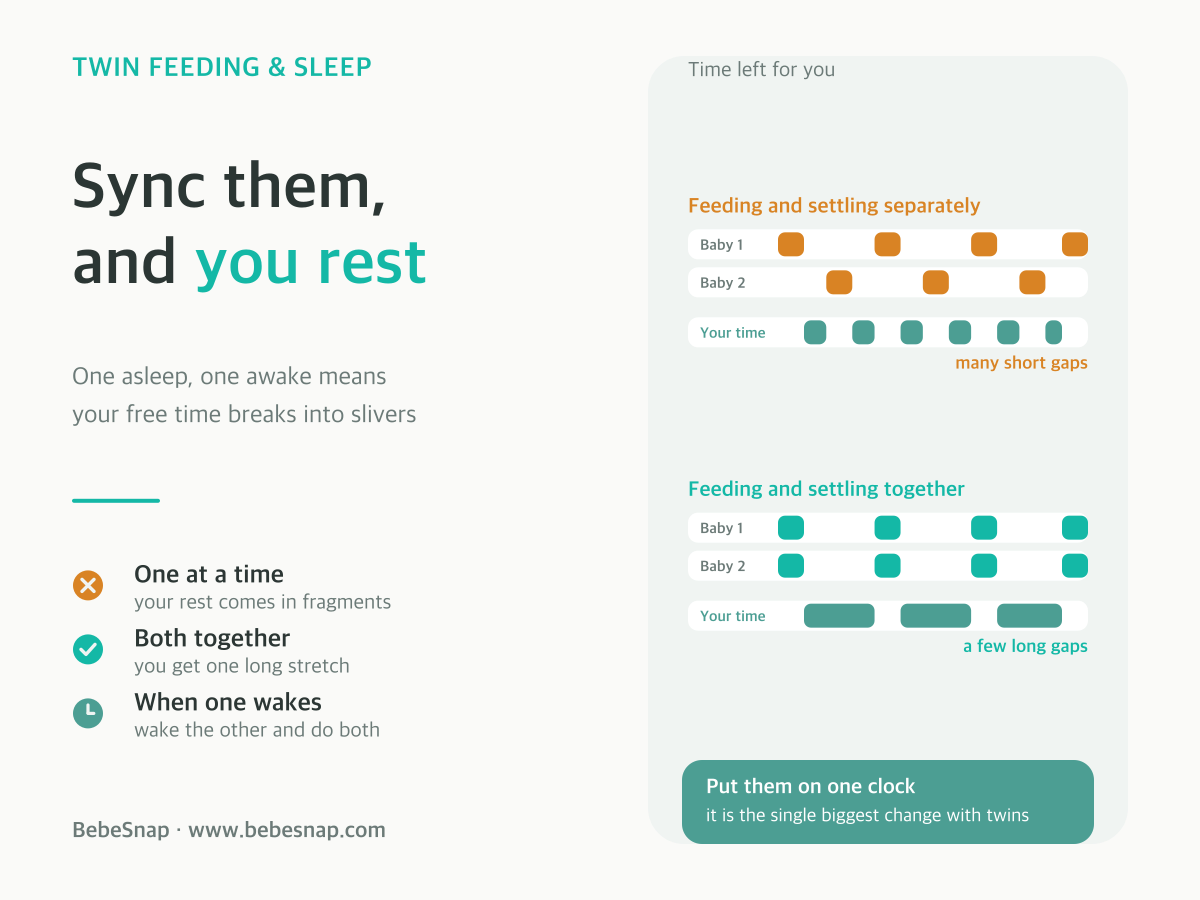
The golden rule of twin feeding schedules is simple: when one baby wakes to eat, wake the other one too.
| Age | Feeding Interval | Daily Feeds | Key Tip |
|---|---|---|---|
| Newborn to 1 month | Every 2-3 hours | 8-12 | Wake sleeping twin when the other feeds |
| 1-3 months | Every 3-4 hours | 6-8 | Establish tandem feeding routine |
| 3-6 months | Every 4 hours | 5-6 | Begin reducing nighttime feeds |
| 6 months and older | Every 4-5 hours | 4-5 + solids | Introduce solids to each baby individually |
Syncing Sleep Is Truly a Survival Skill
The number one rule of twin sleep is to get both babies on the same schedule. If one sleeps while the other is awake around the clock, you'll never catch a break. It won't line up perfectly at first, and that's okay; just nudge them toward the same rhythm.
Same Room, Separate Cribs
The American Academy of Pediatrics recommends room-sharing for at least the first 6 months to reduce SIDS risk. Twins should sleep in the same room, each in their own safe sleep space.
- Never bed-share with twins: each baby needs their own crib or bassinet
- Twins adapt to each other's sounds: most twins surprisingly quickly learn to sleep through a sibling's crying
- Don't rush to separate rooms: if one twin's crying rarely wakes the other, keeping them together works well
How to Get Their Sleep in Sync
Wake together, sleep together Set consistent nap times and bedtimes, and when one wakes, feed both, then put both back down.
Keep the bedtime routine consistent Go bath, massage, feeding, lullaby in the same order every night, and use the identical routine for both babies.
Set up the sleep environment A white noise machine helps both babies settle (keep it as far from their heads as possible and use it only for short periods), keep the room at 68-72°F (20-22°C), and keep it dark and quiet at night.
💡 Sleep training can begin around 4-6 months. Start both babies at the same time, but adjust the pace if one struggles more than the other.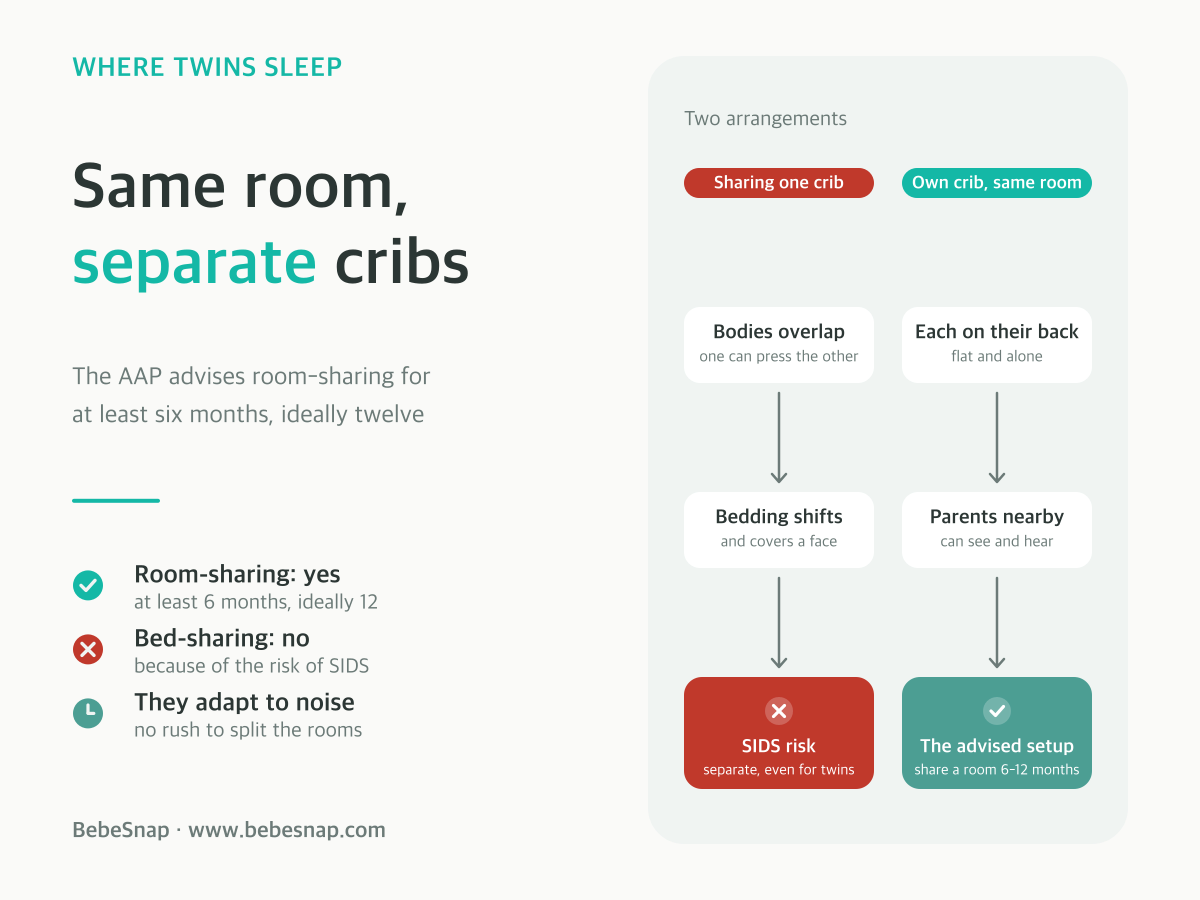
Twin Parenting Is Honestly a Gear Game
It's no exaggeration to say twin parenting is a gear game. Having the right things ready ahead of time makes the chaos so much smoother, so here are the true must-haves.
Feeding gear
- A twin nursing pillow (such as My Brest Friend Twin or TwinGo)
- At least 8 bottles, because constant washing is rough
- A double electric breast pump for pumping both sides at once
Sleep gear
- Two cribs or bassinets (in the same room)
- Swaddles or sleep sacks (4-6 per baby)
- A white noise machine (placed far from the babies' heads, used for short periods)
On-the-go gear
- A double stroller (side-by-side or tandem style)
- Two baby carriers or a twin-specific carrier
- Two car seats
Diapering
- Expect roughly 20-24 diaper changes a day combined (10-12 per baby as newborns)
- Buy in bulk, always
What a Twin Day Actually Looks Like (0-3 Months)
Here's a realistic daily template for newborn twins. Don't stress about following it to the letter; a general rhythm is all you're after.
| Time | Activity | Tip |
|---|---|---|
| 6:00 AM | Wake up, tandem feed | Wake both babies even if only one stirs |
| 7:00 AM | Diaper changes, tummy time | Alternate which baby gets tummy time first |
| 8:00 AM | Nap 1 | Put both down at the same time |
| 9:00 AM | Tandem feed | Parents take turns burping |
| 10:00 AM | Play time | Floor play, sensory stimulation |
| 10:30 AM | Nap 2 | Rest while babies sleep! |
| 12:00 PM | Tandem feed | Alternate breast/formula if combo feeding |
| 1:00 PM | Play time or outing | Stroller walk for fresh air |
| 2:00 PM | Nap 3 | Both babies down together |
| 3:00 PM | Tandem feed | Parents swap caregiving duties |
| 4:30 PM | Short catnap | 30-60 minutes maximum |
| 6:00 PM | Feed, bath time | Bathe one baby at a time |
| 7:00 PM | Bedtime routine, lights out | Consistent routine is key |
| 10:00 PM | Dream feed | Feed both babies simultaneously |
| 2:00-4:00 AM | Night feed | Use the parent shift system |

Please Don't Try to Do It All Alone
The most important piece of twin parenting advice you'll ever get is this: ask for help, and let yourself accept it. Trying to do everything yourself burns you out fast, and there's nothing weak about leaning on others.
Family support
- Plan for at least a month of help after the birth
- Be specific rather than vague (e.g., "Could you come Tuesday morning and do the laundry?")
- Encourage your partner to take parental leave if they can
Professional support
- Postpartum doulas experienced with multiples
- Lactation consultants who specialize in tandem feeding
- Regular pediatrician visits to track each baby's growth
Twin parent communities
- Join local or online twin parent groups (Twiniversity, Twins Trust)
- Connect with other parents of multiples nearby
- Sharing with people who truly get it is worth so much
Double the Costs, Lighter with a Plan
Raising twins honestly does roughly double many of the costs. The good news is that a little planning ahead takes a lot of the pressure off.
Cost-saving strategies
- Buy diapers and formula in bulk for the best discounts
- Make good use of secondhand markets for gear like strollers, but skip a used car seat unless you know its full history (no crashes, not too old or recalled, and with its labels and instructions)
- Look for twin discounts from baby brands and subscription services
- Research government benefits and tax credits for multiple births
What to budget for
- Double the diapers, clothing, and formula
- Two car seats, two cribs, and a double stroller
- Higher childcare costs if you use daycare
- Possible extra medical costs from premature birth, since twins are more likely to arrive early
Track Each Baby Separately, and Don't Compare
Even identical twins can develop at different rates. It's only human to compare them, but try not to; instead, keep careful track of each one's milestones so you can catch any concerns early.
- Weight and height: follow each baby's growth curve at regular checkups
- Milestones: head control, rolling, sitting can come at different times for each
- Feeding and sleep patterns: one twin may eat more or sleep longer than the other
- Health records: keep separate vaccination and illness records
Look After Your Own Heart Too
Twin parenting is exhausting, body and mind. Taking care of yourself matters just as much as caring for the babies.
- Let go of perfectionism: a messy house is a perfectly normal house with twins
- Rest whenever you can: when both babies nap at once, sleep; the dishes can wait
- Watch for postpartum depression: parents of multiples face a higher risk of it, so reach out for professional support if you feel persistently overwhelmed or disconnected
- Talk often with your partner: share what's hard and tell each other thank you
- Remind yourself: you're doing an extraordinary job, because raising two babies at once is remarkable
Managing Twins with BebeSnap
With twins, there's twice as much to record, and it's so hard to keep it all in your head. BebeSnap lets you register each baby individually and track them separately, which makes it especially handy for twin parents.
- Individual tracking: log feedings, sleep, and diaper changes separately for each baby
- Pattern comparison: compare feeding amounts and sleep durations between your twins to spot differences
- AI stool analysis: snap a photo of each baby's diaper and let AI assess their digestive health
- Growth tracking: view each baby's growth curve on its own to monitor development
- AI parenting assistant: ask the AI chatbot any twin-specific parenting question
Frequently Asked Questions (FAQ)
Q: How do I feed twins at the same time?
A: There are three tandem positions: the double football hold (one baby under each arm), the double cradle hold (both babies in an X-pattern across your lap), and a combination of the two. The football hold is best during C-section recovery since babies stay away from your abdomen. Master individual feeding with each baby before attempting tandem feeding.
Q: How do I synchronize my twins' sleep schedules?
A: The key is to wake one baby when the other wakes, feed both, then put both back down. Set consistent nap and bedtimes, and apply the same routine (bath, massage, feeding, lullaby) to both babies. White noise and a room temperature of 68-72°F (20-22°C) also help them settle.
Q: Can twins sleep in the same crib?
A: No. Because of SIDS risk, each twin needs their own crib or bassinet. However, the AAP recommends room-sharing with parents for at least the first 6 months, so the safest setup is the same room with separate, safe sleep spaces for each baby.
Q: How can parents of twins actually get sleep?
A: The parent shift system is essential. For example, one parent sleeps from 7 PM to 1 AM while the other handles feeds, then you swap: guaranteeing each parent about 6 hours of uninterrupted sleep. Accept help from family or postpartum doulas, and don't try to do it all alone.
References
All Your Baby Records in One App
Feeding, sleep, diapers, growth: every daily record in one place.
See what the app does firstYou Might Also Like
Tomato for Babies: When to Start, Skin and Seeds, and Why Cherry Tomatoes Are Never Served Whole
Apple for Babies: Stage-by-Stage Portions and When Raw Apple Is Safe
Spinach for Babies: When to Start, Why Boiling Matters, and When to Skip It
Potato for Babies: When to Start, Safe Shapes, and Why Never to Blend It
You Might Also Like

Decoding Baby Cries: Reading Hunger, Sleepy, Discomfort, and Pain by Sound and Body Cues
Baby cries can be read through sound patterns and body cues. Here's how to tell hunger, sleepy, discomfort, and pain apart, the pre-cry signals, why crying peaks around 6 weeks, and 5 soothing moves.

Complete Weaning Guide: When and How to Stop Breastfeeding
Feeling overwhelmed about weaning? Learn the right timing, step-by-step methods, how to prevent engorgement, and night feeding tips.

Newborn First Week Survival Guide: Everything You Need After Hospital Discharge
Bringing your newborn home? A complete day-by-day guide covering 8-12 daily feedings, 16-17 hours of sleep, 5-10% physiological weight loss, jaundice checks, and warning signs for the critical first 7 days.