Cradle Cap (Infant Seborrheic Dermatitis): How to Remove It Safely and When to See a Doctor
Check Your Baby's Health from One Photo
Get Started FreeYou're stroking your baby's head one morning and notice thick, yellowish, greasy flakes crusted across the scalp: maybe creeping onto the eyebrows, the outer ears, or the creases beside the nose. Your first thought is usually, "Can I peel this off? Is it a disease?" Here's the short answer: this is cradle cap (infant seborrheic dermatitis), and it is almost never painful or itchy, and it is not contagious. For most babies it clears up on its own within a few months. The one rule that matters most: don't pick it off: soften it first, then lift it gently. Below we'll walk through why it happens, a safe 4-step removal routine, and the signs that mean it's time to call the doctor.
💡 The short answer: those yellow, greasy crusts are seborrheic dermatitis. It's not an infection and not a hygiene problem. It commonly appears from 2-3 weeks of age and clears on its own by around the first birthday (8-12 months). Never scrape it with your nails, soften it with oil for at least 15 minutes, then lift it gently.Why Do These Yellow Crusts Appear?
Cradle cap is an oily, scaly rash that shows up where oil glands are plentiful, and no one knows exactly what causes it. One theory is that maternal hormones that crossed the placenta keep stimulating the baby's oil glands for a while after birth; another is that the skin reacts to a common yeast that lives on everyone's skin. Extra oil mixes with shedding skin cells and hardens into those yellow, greasy scales.
Here's the reassuring part every parent should know: this is not a bacterial or fungal infection. It is not caused by not washing your baby enough, and it has nothing to do with poor hygiene. Because of that, it cannot spread to other babies or siblings. You have absolutely no reason to blame yourself for having "missed a spot."
💡 Cradle cap is not contagious and is not a sign of neglect. The exact cause isn't known, and it usually settles down on its own as your baby grows.Where Else Does It Show Up Besides the Scalp?
Although it's famous as a "scalp" problem, cradle cap can appear anywhere oil glands cluster. Each spot looks slightly different, so knowing them in advance keeps you from panicking.
- Scalp: the most common spot. Yellow or white greasy scales and crusts spread across the crown
- Eyebrows: yellow flakes settle between the brow hairs and look like dandruff
- Outer ears and behind the ears: layers of scale build up in the ear folds and behind the ear
- Forehead and hairline: crusting follows the edge of the hairline
- Beside the nose and under the brows: reddish, flaky patches form along the nose creases
- Neck, armpit, and diaper-area folds: it can spread wherever skin overlaps
In most babies it stays limited to the scalp and doesn't bother them at all. However, if it turns red and spreads widely into the neck, armpits, or trunk, it may need to be told apart from eczema (more on that below).
How Do I Tell It From Acne, Heat Rash, or Eczema?
Baby rashes come in many forms, so it's easy to mix them up. The two clues that point to cradle cap are "yellow, greasy crusts or scales" and "barely any itch." Newborn acne shows up as red pimples, heat rash as blisters in skin folds, and eczema as a dry, intensely itchy rash. Use the table below for a quick side-by-side.
| Feature | Cradle Cap | Newborn Acne | Heat Rash | Eczema |
|---|---|---|---|---|
| Main Location | Scalp, brows, outer ears, beside nose | Cheeks, nose, forehead | Neck, armpits, back folds | Starts on scalp, cheeks, and forehead, then trunk and limbs (limb folds in older children) |
| Appearance | Yellow, greasy crusts and scales | Red bumps, white pustules | Clear-to-red tiny blisters | Dry, rough red patches, weeping |
| Itch | Little to none | None | Mild prickling | Severe (worse at night) |
| Course | Clears over months, by first birthday | Gone within 3-4 months | Days once cooled | Chronic, recurring |

The easiest single clue is itch. If your baby is trying to scratch or is very fussy at night, eczema is more likely than cradle cap. On the flip side, if the crusts are there but your baby is comfortable and sleeping fine, cradle cap is the strong favorite.
A Safe 4-Step Way to Remove It at Home
There's really just one principle for managing cradle cap: never scrape dry crusts, soak them thoroughly with oil first, then lift them gently. Follow this sequence and you can handle it safely at home.
Step 1. Soften the crusts with oil
- Apply a thin layer of baby oil, mineral oil, or petroleum jelly over the crusts
- Leave it on for at least 15 minutes (overnight if the crusts are thick) so they soften fully
- The oil loosens the crusts so they separate from the skin easily
Step 2. Massage and brush gently
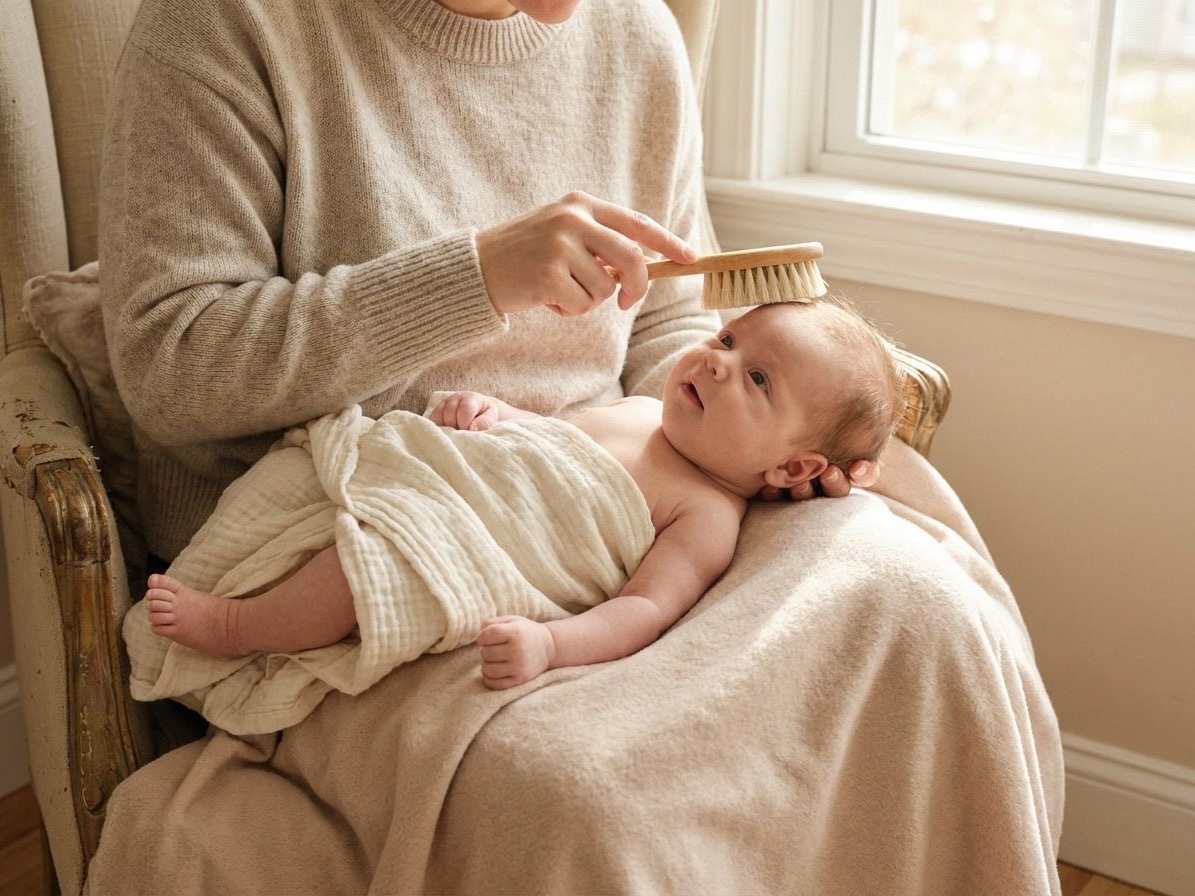
- Use your fingertips or a soft baby brush or comb in small circular motions
- A soft toothbrush works well too, the softened crusts start to lift on their own
- Don't try to remove everything at once; take off only what comes away naturally
Step 3. Wash with a mild baby shampoo
- Cleanse the scalp with a gentle, fragrance-free baby shampoo to rinse out the leftover oil and flakes
- Always wash the oil out thoroughly: if oil is left behind, scale actually builds up faster
- Pat the scalp dry with a soft towel afterward
Step 4. Repeat on a schedule
- For routine care, repeating this 2-3 times a week is enough
- During a bad flare, a gentle shampoo daily to every other day is fine
- Ease off as it improves. The goal is a gradual reduction over several days, not stripping it all in one go
The Things You Should Never Do
Some well-meaning moves can actually damage the skin. Please avoid these.
- Picking it off with your nails or fingers: prying dry crusts tears the skin, causes bleeding, and lets bacteria in for a secondary infection
- Scraping while dry: only lift crusts after they've been softened with oil
- Using adult anti-dandruff or antifungal shampoos on your own: they can be too harsh for baby skin; ask a doctor first if one is truly needed
- Applying steroid creams on your own: don't use them on a hunch; use only what a doctor prescribes after examining your baby
- Scrubbing too often or too hard: vigorous rubbing several times a day leaves the scalp raw
Can I Peel It? Will Hair Fall Out? When Will It Go Away?
Here are direct answers to the three questions parents ask most.
Can I peel it off? Yes, softening it with oil and lifting it gently, as in the 4 steps above, is fine. But you don't actually have to remove it. The crusts themselves don't hurt your baby, so if the look bothers you, gentle management is more than enough. There's no need to fight to strip every last flake.
Some hair comes off with it, is that okay? A few strands of hair may lift away along with the crusts. This isn't damaged hair roots; it's just hair that was tangled in the crust coming loose. It grows back over time, so there's nothing to worry about.
When will it disappear? For most babies it improves over several months without any special treatment and fades on its own by 8-12 months of age, around the first birthday. A few babies keep it a little longer, but it's usually nothing to be concerned about.
When You Should See a Doctor
Cradle cap is almost always manageable at home, but see a pediatrician or pediatric dermatologist if you notice any of these.
- The area becomes red, swollen, or warm, or has weeping or pus (possible secondary infection)
- Your baby has a fever (for a baby under 3 months, a temperature of 100.4°F (38.0°C) or higher means calling the doctor right away, even at night)
- The crusts bleed or give off a foul odor
- The rash spreads well beyond the scalp into the neck, armpits, and trunk
- Your baby is intensely itchy, scratching, fussy, and unable to sleep (needs to be told apart from eczema)
- It doesn't improve after 2-3 weeks of home care, or keeps getting thicker
Track Your Baby's Skin Changes With BebeSnap
Looking at it every day, it's hard to tell whether the crusts are healing or spreading. Keeping a photo record makes that call much easier.
- AI Skin Analysis: snap a photo of the scalp or face and our AI reviews the condition and suggests a care direction
- Photo Timeline: shoot the same spot every few days so you can see improvement or worsening at a glance, which really helps at the doctor's office
- AI Parenting Chatbot: ask questions like "Should I take this crusting to the doctor?" any time, even at night
Frequently Asked Questions (FAQ)
Q: When do the yellow crusts on a newborn's scalp go away?
A: Cradle cap usually improves over several months without special treatment and fades on its own by 8-12 months, around the first birthday. It typically appears from 2-3 weeks of age and is most common within the first 3 months. Managing it with oil massage and a mild shampoo 2-3 times a week helps it settle faster.
Q: Can I peel the scalp crusts off with my hand?
A: No, prying dry crusts off with your nails can cause bleeding, secondary infection, and hair loss in that spot. Instead, apply baby oil or mineral oil for at least 15 minutes to soften them, lift gently with a soft brush or comb, then rinse with a mild shampoo. Always wash the leftover oil out so scale doesn't build up.
Q: Is cradle cap contagious or a sign of poor washing?
A: Neither. It's not an infection, so it can't spread to other babies or siblings. Nobody knows the exact cause; one theory points to maternal hormones stimulating the baby's oil glands, another to a reaction to a common skin yeast. It's also not caused by poor hygiene, so there's no reason for parents to blame themselves.
Q: How do I tell cradle cap apart from eczema?
A: The biggest difference is itch. Cradle cap produces yellow, greasy crusts on the scalp, brows, and outer ears and is barely itchy. Eczema, by contrast, is a dry, rough red rash that usually starts on the cheeks, forehead, and scalp, can spread to the trunk and limbs, and is intensely itchy, making babies fussy at night. See a doctor if your baby scratches hard or it spreads to the trunk.
References
Check Your Baby's Health from One Photo
AI stool analysis reads color and texture, and keeps every health record in one place.
See what the app does firstMedical Disclaimer: This article is for informational purposes only and does not replace professional medical advice. If you have concerns about your baby's health, please consult a pediatrician.
You Might Also Like
Tomato for Babies: When to Start, Skin and Seeds, and Why Cherry Tomatoes Are Never Served Whole
Apple for Babies: Stage-by-Stage Portions and When Raw Apple Is Safe
Spinach for Babies: When to Start, Why Boiling Matters, and the One Time to Skip It
Potato for Babies: When to Start, Safe Shapes, and Why Never to Blend It
You Might Also Like
Baby Impetigo: Golden Crusts, Antibiotic Treatment, and When Nursery Is Safe Again
Golden-brown crusts spreading across your baby's skin? Impetigo is a common, highly contagious bacterial skin infection in young children. It stops being contagious 48 hours after treatment starts. Here is how to recognise it and when nursery is safe again.

Fixing Newborn Day-Night Confusion: How to Reset Your Baby's Circadian Rhythm
Sleeping all day, awake all night! Newborn day-night confusion naturally improves by 6-8 weeks. Learn how to speed up the process.

Roseola in Babies | High Fever Then Rash, Febrile Seizures & When to Worry
If a pink rash appears just as a 3–4 day high fever breaks, it's likely roseola, common between 6 months and 2 years and usually self-limiting. Timeline, febrile-seizure care, and red flags inside.