How to Read Baby Growth Charts: Complete WHO Guide

Keep Every Growth Milestone
Get Started FreeIs your baby growing normally? Learn how to read WHO growth charts, understand percentiles, and know when to be concerned about your baby's growth.
What is a Growth Chart?
A growth chart is a graph showing where your baby's weight, length, and head circumference fall compared to other children of the same age. The WHO (World Health Organization) international standards are most widely used.
Note: WHO growth standards were created based on 8,500 healthy breastfed babies from 6 countries (Brazil, Ghana, India, Norway, Oman, USA).
Understanding Percentiles
A percentile shows where your child ranks compared to 100 children of the same age.
What Percentiles Mean
| Percentile | Meaning |
|---|---|
| 50th | Middle of the pack |
| 25th | 25 out of 100 are smaller |
| 75th | 75 out of 100 are smaller |
| 3rd | Smaller than 97% |
| 97th | Larger than 97% |

Key Point
- The trend matters more than the number itself
- 3rd to 97th percentile is all normal range
- Following their own curve consistently = healthy growth
How to Read Growth Charts
Step 1: Choose the Right Chart
- Gender: Boys and girls have different charts
- Age: 0-2 years vs 2-5 years
- Measurement: Weight, length, head circumference
Step 2: Plot the Measurement
- Find baby's age on X-axis
- Find measurement on Y-axis
- Mark where they meet
- Check nearest percentile line
Step 3: Analyze the Trend
- Connect points over time
- Check if following the curve
- Watch for sudden changes
When to Worry
See Your Doctor If:
- Weight drops across 2+ percentile lines
- No weight gain for 3+ months
- Head growth suddenly changes
- Development delays observed
Track with BebeSnap
Record your baby's growth systematically. BebeSnap helps you:
- Log weight, height, head circumference
- View growth trend graphs
- Set measurement reminders
- Share records with your doctor
FAQ
Q: My baby is at the 10th percentile. Is that okay?
A: Yes. Any percentile between the 3rd and 97th is considered normal. What matters most is not the exact number but whether your baby steadily follows their own curve over time rather than dropping or jumping across multiple percentile lines.
Q: My baby is heavy but short. Is that a problem?
A: A temporary imbalance between weight and height can be perfectly normal, since babies often grow in spurts. However, if the imbalance persists over several check-ups, it's a good idea to consult your pediatrician to rule out any underlying issue.
Q: How often should I check the growth chart?
A: Checking at regular well-baby visits, such as 1, 2, 4, 6, 9, and 12 months, is enough. Measuring too frequently at home can introduce large errors, so frequent self-checks usually create more worry than useful information.
Q: My home measurements differ from the clinic's. Why?
A: Differences are common and usually come from the measurement method, such as how the baby is positioned or the equipment used. The key is to measure consistently with the same method and tools so you can compare results meaningfully over time.
References
Keep Every Growth Milestone
Log height, weight, and milestones. The growth curves are drawn for you.
See what the app does firstYou Might Also Like
Apple for Babies: Stage-by-Stage Portions and When Raw Apple Is Safe
Spinach for Babies: When to Start, Why Boiling Matters, and the One Time to Skip It
Potato for Babies: When to Start, Safe Shapes, and Why Never to Blend It
Introducing Fish to Your Baby: When to Start, What Order, What to Avoid
You Might Also Like
Wonder Weeks Calculator: Your Baby's 10 Mental Leaps From the Due Date
Enter your due date and get all 10 leap dates. They land at weeks 5, 8, 12, 19, 26, 37, 46, 55, 64 and 75, each lasting 1 to 2 weeks.
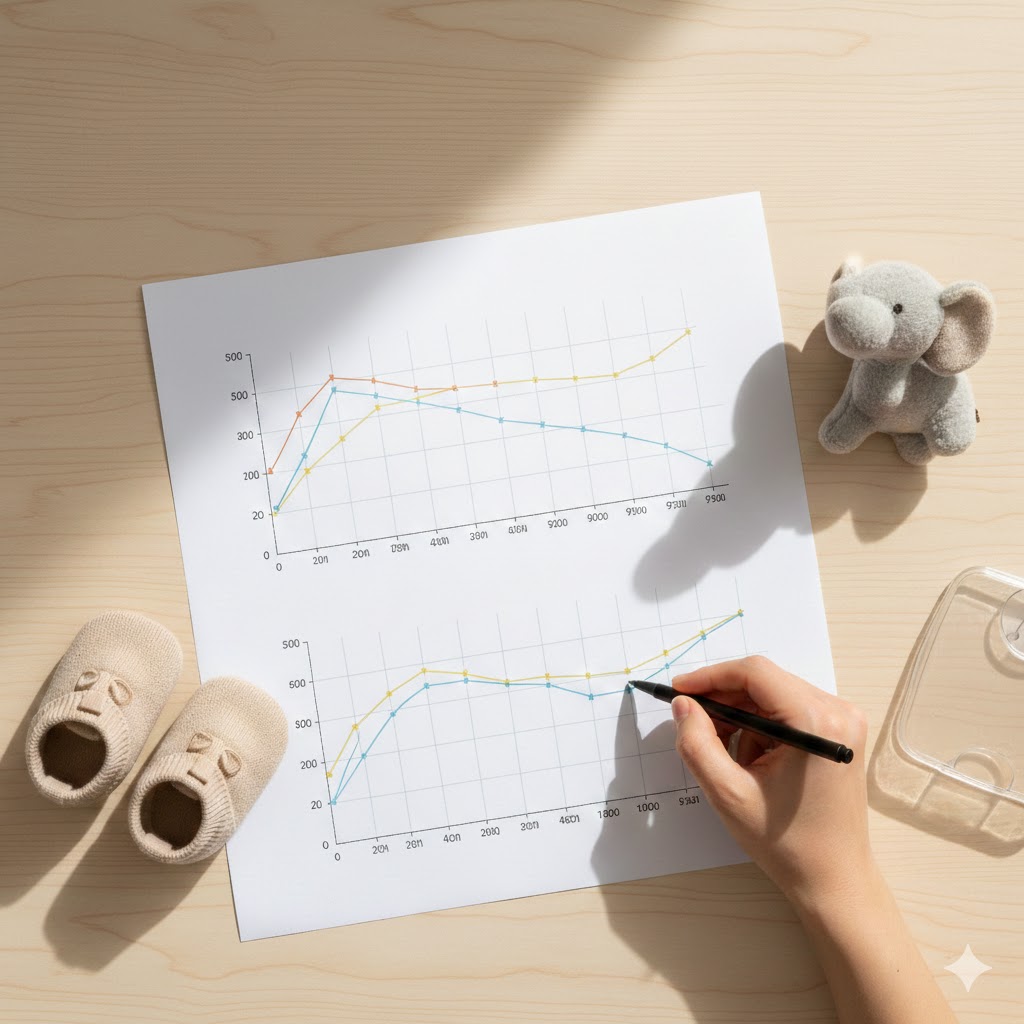
How to Read Baby Growth Charts | Percentiles Explained, Weight & Height by Age
Growth chart percentiles rank your baby among 100 infants of the same age. The 3rd-97th percentile covers the normal range (94%), and growth trends matter more than a single measurement.

9-Month Baby Development: Crawling, First Words, Separation Anxiety
At 9 months, babies crawl and start saying first words like 'mama' and 'dada'. Learn about development and safety tips.