Gassy Baby Relief: Causes, Massage Techniques & Home Remedies Guide

Check Your Baby's Health from One Photo
Get Started FreeIs your baby squirming, turning red, pulling their legs toward their tummy, and crying inconsolably? You are not alone -- most newborns and infants experience gas-related discomfort. Because your baby's digestive system is still developing, gas is an extremely common and usually harmless issue. In this comprehensive guide, we will walk you through the causes, symptoms, proven massage techniques, exercises, and prevention tips to help your gassy baby feel comfortable again.
5 Common Causes of Gas in Babies
1. Swallowing Air During Feeding
- Babies swallow air along with breast milk or formula during every feeding session
- A bottle nipple with an incorrect flow rate (too fast or too slow) increases air intake
- A shallow latch during breastfeeding can also lead to excessive air swallowing
2. Immature Digestive System
- A newborn's intestines are still developing and cannot fully break down all food components
- Undigested lactose gets fermented by gut bacteria, producing gas
- Weak abdominal muscles make it hard for babies to expel gas on their own
3. Air Intake from Crying
- Babies swallow large amounts of air when they cry
- This creates a vicious cycle: gas causes crying, and crying causes more gas
4. Mother's Diet (for breastfed babies)
- Scientific evidence is limited, but some foods have been anecdotally reported to contribute to infant gas
- Gas-producing foods like cabbage, broccoli, and legumes
- Dairy sensitivity passed through breast milk
- Caffeinated beverages
5. Formula-Related Factors
- Difficulty digesting certain formula ingredients
- Air bubbles created when shaking formula
- Bottle type or nipple flow rate mismatch
Signs Your Baby Has Gas
If your baby shows any of the following symptoms, trapped gas may be the culprit:
- Bloated, firm belly: The tummy feels tight and distended to the touch
- Pulling legs toward the chest: Drawing knees up to the belly repeatedly
- Straining with a red face: Pushing hard to try to pass gas
- Fussiness during or after feeding: Particularly cranky around mealtimes
- Frequent flatulence: Passing gas often, sometimes with an odor
- Refusing to eat: Too uncomfortable to continue feeding
- Waking suddenly from sleep: Gas pain interrupts naps and nighttime sleep
- Arching the back or squirming: Body language expressing discomfort
The I Love U Massage for Gas Relief
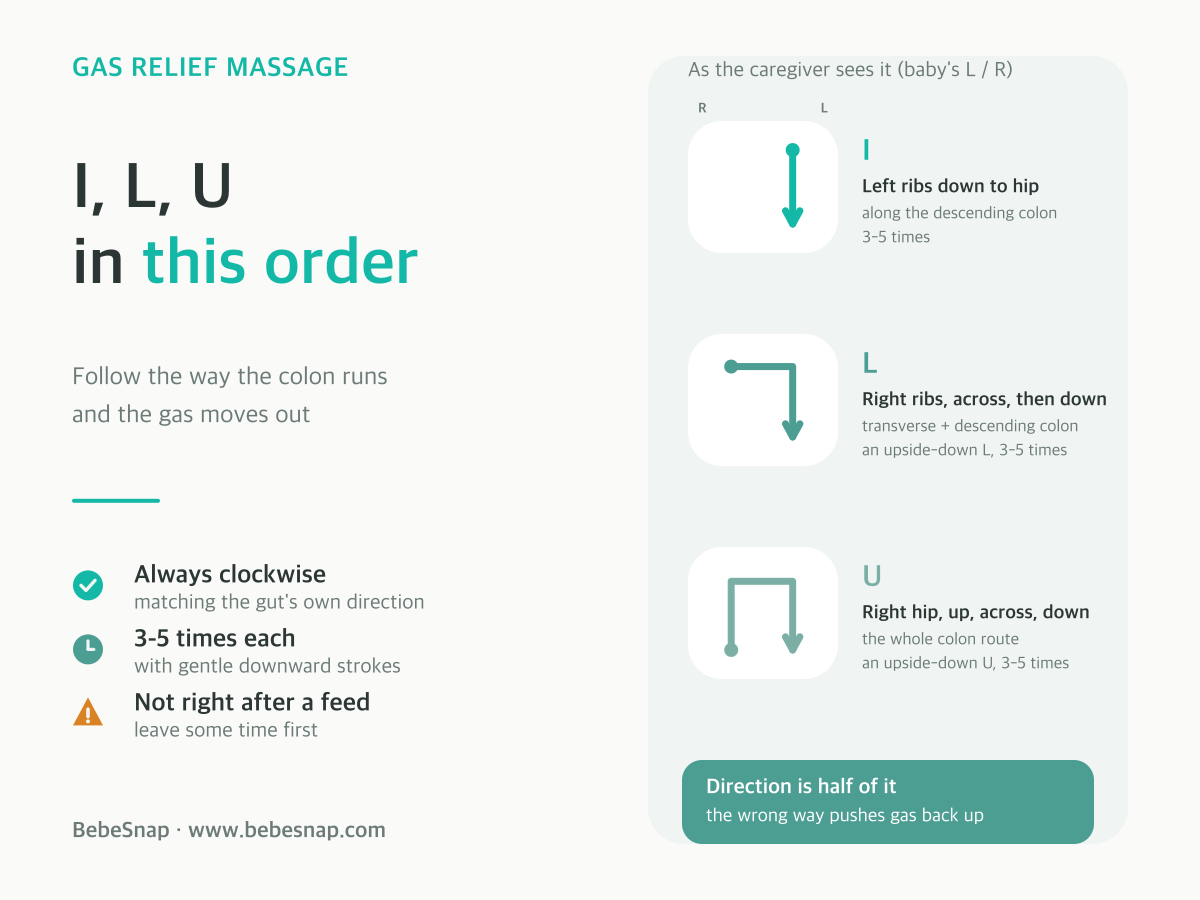
The I Love U massage is recommended by pediatricians worldwide as one of the most effective techniques for relieving infant gas. Wait at least 30-45 minutes after feeding before starting.
Preparation
- Place your baby on their back in a warm room
- Apply a small amount of baby oil or lotion to your hands
- Make sure your baby is calm and alert
Massage Steps
The "I" Stroke (stimulates the descending colon)
- Start at the left side, just below your baby's rib cage
- Gently stroke downward toward the left hip
- Repeat 3-5 times
The "L" Stroke (stimulates the transverse and descending colon)
- Start at the right side, just below the rib cage
- Stroke horizontally to the left, then downward
- This creates an inverted "L" shape; repeat 3-5 times
The "U" Stroke (follows the entire colon pathway)
- Start near the right hip
- Stroke upward to the right rib cage, across to the left rib cage, then down to the left hip
- This creates an inverted "U" shape; repeat 3-5 times
Additional Massage Techniques
Circular Motion Around the Navel
- Using your fingertips, gently trace circles around the belly button in a clockwise direction
- Apply light pressure and move slowly
- Continue for 2-3 minutes
Warm Palm Hold
- Rub your palms together to warm them
- Place your warm hands gently on your baby's belly for 10-15 seconds
- The warmth helps relax abdominal muscles and encourages gas release
Bicycle Legs Exercise
The bicycle legs exercise is one of the simplest and most effective ways to help your baby pass gas.
Basic Bicycle Legs
Step 1: Lay your baby comfortably on their back on a flat surface
Step 2: Gently hold both ankles or calves
Step 3: Slowly bend one leg, pushing the knee toward the tummy
Step 4: As you straighten that leg, bend the opposite knee toward the tummy
Step 5: Alternate legs in a pedaling motion, repeating 10-15 times

Variations
Double Knee Press
- Gently push both knees toward the belly at the same time
- Hold for 3-5 seconds, then release slowly
- Repeat 5-10 times; you may hear gas being released
Hip Lift
- With both knees bent toward the tummy, gently lift the hips slightly off the surface
- This applies gentle pressure to the abdomen and encourages gas to pass

Preventing Gas During Feeding
Prevention is always better than treatment. Here are practical tips to minimize gas during and after feedings.
Proper Feeding Positions
Breastfeeding
- Ensure a deep latch where the baby takes in the nipple and areola
- Keep your baby's head higher than their stomach
- A good latch is quiet -- no clicking or smacking sounds
Bottle-Feeding
- Tilt the bottle at a 45-degree angle to keep the nipple filled with formula
- Feed your baby in an upright or semi-upright position to reduce air intake
- Consider using anti-colic bottles with built-in venting systems
Burping Effectively
Burping during and after feeds is essential for gas prevention.
- Breastfeeding: Burp when switching breasts
- Bottle-feeding: Burp every 60-90 ml (2-3 oz)
- Hold your baby upright for 5-10 minutes after feeding and gently pat or rub their back
- If no burp comes after 10 minutes, it is okay to stop trying
For a detailed guide on burping techniques, check out our Complete Guide to Burping Your Baby!
Formula Preparation Tips
- Stir formula gently with a spoon instead of shaking vigorously to reduce bubbles
- Let prepared formula sit for a few minutes to allow air bubbles to settle
- Serve formula at body temperature, around 36-37°C (97-99°F)
Gas vs. Colic: How to Tell the Difference
When your baby cries a lot, you may wonder whether it is gas or colic. While the symptoms overlap, there are key differences.
| Feature | Gas | Colic |
|---|---|---|
| Crying Duration | Short bursts (minutes to 30 min) | 3+ hours per day |
| Frequency | Irregular, around feedings | 3+ days per week, 3+ weeks |
| Relief | Calms after passing gas or burping | Hard to soothe even with comforting |
| Timing | Any time of day | Mostly late afternoon/evening |
| Onset | From birth | Around 2-4 weeks old |
| Resolution | Gradually improves by 4-6 months | Usually resolves by 3-4 months |

Want to learn more about colic? Read our Infant Colic Guide for comprehensive information.
Gas Drops and Gripe Water: What You Need to Know
Simethicone Gas Drops
- How they work: Break up small gas bubbles into larger ones that are easier to pass
- Safety: Safety has been established, but scientific evidence for its effectiveness has not been conclusively proven
- Effectiveness: Results vary from baby to baby
- Usage: Administer a small dose before or after feedings (follow product instructions)
Gripe Water
- Ingredients: Herbal extracts (ginger, fennel, etc.) and sometimes sodium bicarbonate
- Caution: There is no scientific evidence proving its effectiveness
- Risk: Some products have been recalled due to bacterial contamination and choking hazards
- Recommendation: Always consult your pediatrician before use
Other Helpful Techniques
- Tummy time: Place your baby on their stomach for 3-5 minutes several times a day; gentle abdominal pressure helps release gas
- Warm compress: Place a lukewarm (not hot!) towel on the belly to relax the muscles
- Gentle rocking: Hold your baby and rock gently to stimulate intestinal movement
- White noise: Shushing sounds or a hair dryer on low can help calm a fussy, gassy baby
When to See a Doctor: Warning Signs
Most gas issues can be managed at home, but seek medical attention immediately if you notice:
- Fever above 38°C(100.4°F): May indicate an infection. For babies under 3 months old, go to the emergency room immediately
- Blood in the stool: A sign of a potential intestinal issue
- Persistent vomiting: Projectile vomiting (not just spit-up)
- Poor weight gain: Significant decrease in feeding or failure to gain weight
- No bowel movement for 3+ days: In newborns (especially formula-fed babies), no bowel movement for 3 or more days warrants a pediatrician visit. Breastfed babies may have longer intervals between bowel movements after 6 weeks of age
- Increasingly distended abdomen: Could indicate bowel obstruction
- Yellow or green vomit: Bile-stained vomit is a medical emergency
- Lethargy or unresponsiveness: Call 911 right away
Track Gas and Feeding Patterns with BebeSnap
Managing your baby's gas effectively starts with understanding the patterns. BebeSnap makes it easy to track, record, and analyze your baby's health data.
- Feeding log: Record feeding times, amounts, and types to identify patterns that may be causing gas
- Diaper log: Track flatulence, bowel movements, and stool consistency to spot gas-related trends
- AI stool analysis: Take a photo of your baby's diaper and let AI analyze stool color and texture for health insights
- AI parenting consultant: Ask the AI chatbot any questions about gas, digestion, or infant care anytime
- Growth tracking: Monitor whether gas issues are affecting your baby's weight gain
Frequently Asked Questions (FAQ)
Q: When will my baby's gas get better?
A: Most gas issues naturally decrease by 4-6 months as your baby's digestive system matures. It is common because a newborn's intestines are still developing and cannot fully break down lactose, and weak abdominal muscles make it hard for babies to expel gas on their own.
Q: Which direction should I do the gas-relief massage?
A: Always massage in a clockwise direction, which follows the natural path of the intestines and helps move gas through effectively. Do the pediatrician-recommended I Love U massage (I, L, and U strokes) at least 30-45 minutes after feeding. Bicycle legs, pedaling 10-15 times, usually brings relief within 1-2 minutes.
Q: How do I tell gas apart from colic?
A: Gas crying lasts minutes to 30 minutes, calms quickly after passing gas or burping, and is present from birth. Colic, by contrast, lasts 3+ hours a day, 3+ days a week, for 3+ weeks, is hard to soothe, and begins around 2-4 weeks of age. If you suspect colic, consult your pediatrician.
Q: Can I give gas drops or gripe water?
A: Simethicone gas drops are considered safe, but their effectiveness has not been conclusively proven. Gripe water has no proven effectiveness and some products have been recalled for bacterial contamination. Always consult your pediatrician before giving any over-the-counter remedy.
References
Check Your Baby's Health from One Photo
AI stool analysis reads color and texture, and keeps every health record in one place.
See what the app does firstMedical Disclaimer: This article is for informational purposes only and does not replace professional medical advice. If you have concerns about your baby's health, please consult a pediatrician.
You Might Also Like
Tomato for Babies: When to Start, Skin and Seeds, and Why Cherry Tomatoes Are Never Served Whole
Apple for Babies: Stage-by-Stage Portions and When Raw Apple Is Safe
Spinach for Babies: When to Start, Why Boiling Matters, and the One Time to Skip It
Potato for Babies: When to Start, Safe Shapes, and Why Never to Blend It
You Might Also Like
Baby Impetigo: Golden Crusts, Antibiotic Treatment, and When Nursery Is Safe Again
Golden-brown crusts spreading across your baby's skin? Impetigo is a common, highly contagious bacterial skin infection in young children. It stops being contagious 48 hours after treatment starts. Here is how to recognise it and when nursery is safe again.

Baby Green Poop: 7 Causes and What to Do
Found green poop in your baby's diaper? Learn about 7 causes of green stool and when to see a doctor.

Baby Heat Rash (Miliaria) Guide: Types, Treatment & How to Tell It From Eczema
Tiny bumps on your baby's neck, back, or armpits? Learn the 3 types of heat rash, how to distinguish it from eczema, and home care tips including keeping rooms at 72-78°F.