When to Start Brushing Baby's Teeth: Complete Infant Oral Care Guide

Check Your Baby's Health from One Photo
Get Started FreeWhen your baby's first tiny tooth breaks through the gum, it is a milestone worth celebrating, and a signal that oral care has officially begun. You might wonder, "Baby teeth fall out anyway, so does it really matter?" The answer is a definite yes. Baby teeth hold space for permanent teeth, support proper chewing and speech development, and cavities in baby teeth can affect the permanent teeth growing beneath them. Both the American Academy of Pediatric Dentistry (AAPD) and the American Dental Association (ADA) recommend starting fluoride toothpaste brushing as soon as the first tooth erupts. This guide covers everything from pre-tooth gum care to choosing a toothbrush and toothpaste, proper brushing technique, handling a baby who hates brushing, and scheduling the first dental visit.
Before Teeth: Gum Care (Birth to First Tooth)
Oral care starts before the first tooth even appears. Cleaning your baby's gums from birth helps maintain a clean oral environment and gets your baby used to having their mouth touched.
How to clean baby gums
- Dampen a clean gauze pad or soft washcloth with lukewarm water
- Wrap it around your index finger
- Gently wipe your baby's upper and lower gums, inner cheeks, and tongue
- Do this after feedings, especially before bedtime
Benefits of early gum care
- Removes bacteria and milk residue from the mouth
- Provides a gentle gum massage that can soothe teething discomfort
- Gets baby accustomed to having something in their mouth, making the transition to a toothbrush much easier
Starting Brushing: As Soon as the First Tooth Appears
When to start?
Begin brushing with fluoride toothpaste the moment the first tooth erupts. For most babies, this happens between 6 and 10 months when the lower front teeth come in first. Both the ADA and the AAP recommend using fluoride toothpaste from the very first tooth.
Why baby teeth matter
- They hold space for permanent teeth to come in properly (space maintainers)
- They are essential for proper chewing and speech development
- Cavities in baby teeth can damage the developing permanent teeth underneath
- Baby teeth do not start falling out until around age 6, so they need years of care
Choosing the Right Baby Toothbrush
Selecting an age-appropriate toothbrush makes a real difference.
| Stage | Recommended brush | Features |
|---|---|---|
| 0-6 months (pre-teeth) | Gauze / silicone finger brush | Fits over parent's finger for gum massage and cleaning |
| 6-12 months (first teeth) | Infant toothbrush (extra-small head) | Soft bristles, short head, wide handle for parent grip |
| 12-24 months | Toddler toothbrush | Small head, soft bristles, non-slip handle |
| 2-6 years | Child toothbrush | Age-appropriate size, soft bristles, fun designs |
What makes a good baby toothbrush
- The brush head should be small (about 2-3 baby teeth wide)
- Bristles should be very soft (labeled "soft" or "extra-soft")
- The handle should be wide and non-slip (easy for parents to grip)
- Replace every 3 months or when bristles start to fray
Fluoride Toothpaste: When and How Much
Fluoride toothpaste use is the most common question parents have about baby oral care.
| Age | Amount of fluoride toothpaste | Description |
|---|---|---|
| First tooth to age 3 | Rice grain size (smear) | About 0.1g, a thin smear across the bristles |
| Age 3 to 6 | Pea size | About 0.25g, child can spit (but still supervised) |
| Age 6 and older | Regular amount (1cm strip) | Child can brush and spit independently |

Why fluoride toothpaste matters
- Fluoride is the single most effective ingredient for strengthening tooth enamel and preventing cavities
- Both the ADA and AAP recommend fluoride toothpaste from the first tooth
- In the recommended amounts, it is safe even if swallowed
How to Brush Baby's Teeth: Proper Technique
Brushing your baby's teeth is the parent's job. Children need a parent to do "finishing brushing" until about age 6-7.
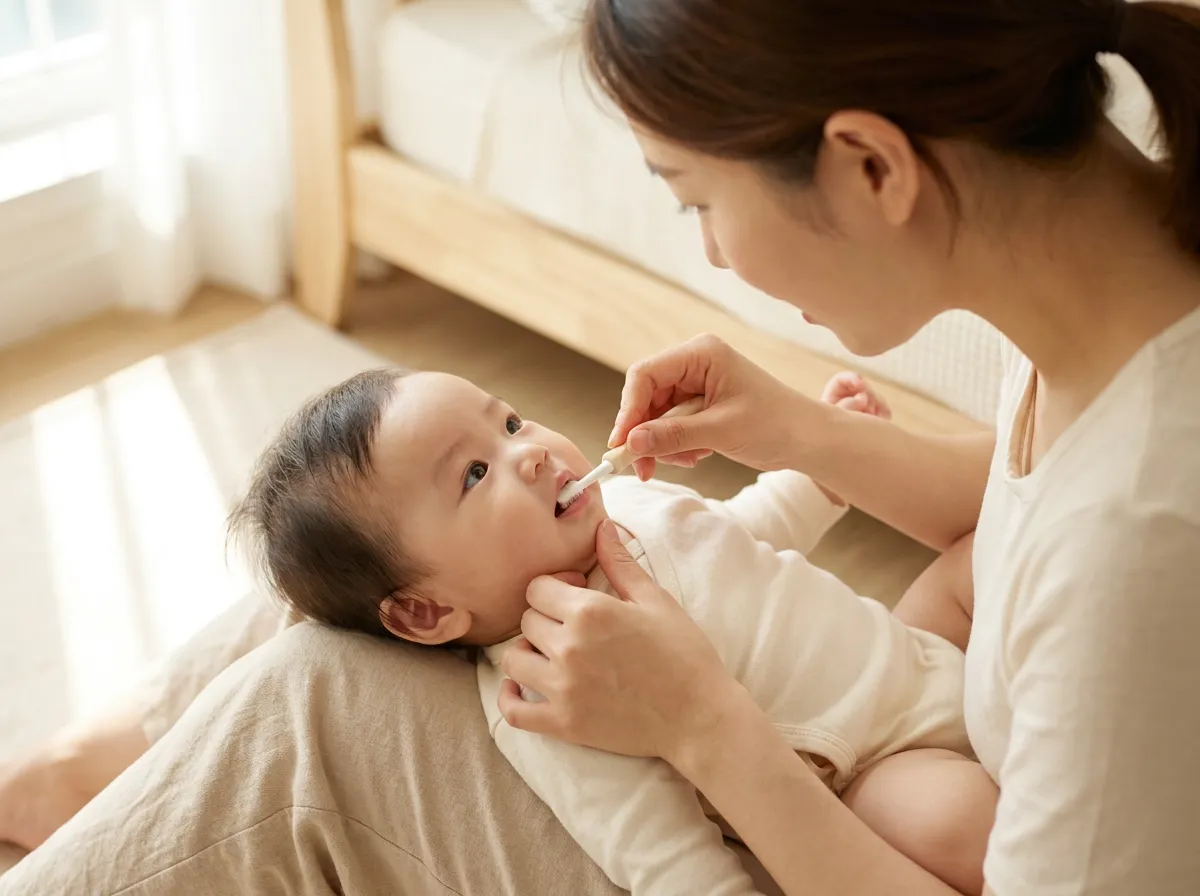
Lap position, recommended!
- Lay your baby on your lap with their head toward you
- Use one hand to gently support their chin, and the other to brush
- This position gives you a clear view inside your baby's mouth
- For older toddlers, have them stand in front of you with their back against you
Brushing sequence
- Outer surfaces: gentle circular motions along the gumline
- Inner surfaces: angle the brush vertically and use gentle up-and-down strokes
- Chewing surfaces: gentle back-and-forth strokes
- Tongue: gently brush the surface of the tongue as well
Frequency and duration
- Twice daily: after breakfast and before bed (bedtime brushing is the most important!)
- About 2 minutes per session
- The bedtime brushing is critical because it prevents bacteria from multiplying overnight
When Baby Hates Brushing
Nearly every baby resists brushing at some point. This is completely normal. Forcing it can create a lasting negative association, so focus on making it a positive experience.
Making brushing fun
- Sing a song: Create or find a short toothbrushing song to sing while you brush
- Give baby their own brush: Let your baby hold and chew on one toothbrush while you use another to actually clean the teeth. Keep your baby seated on the floor with you right beside them, and never let them walk or run around with a toothbrush in their mouth or hand, because a fall can push the brush into the back of the throat. Choose a child's brush with a throat guard
- Brush together: Let your baby watch you brush your teeth, babies love to imitate
- Use a mirror: Brush in front of a mirror so your baby can see what is happening
- Practice on a doll: Brush a stuffed animal's or doll's teeth first as a game
- Praise and celebrate: "Your teeth are so sparkly clean! Great job!" goes a long way
What NOT to do
- Do not physically force your baby's mouth open and pin them down
- Do not use brushing as a punishment
- Do not use fear tactics ("The cavity monster will get you!")
The First Dental Visit
When should you go?
The AAPD recommends the first dental visit within 6 months of the first tooth erupting, and no later than the child's first birthday. The AAP follows the same guideline.
What happens at the first dental visit
- Examination of teeth and gums
- Assessment of cavity risk
- Guidance on proper brushing technique
- Decision on fluoride varnish application
- Feeding habit and dietary counseling
- Answering parents' questions
Ongoing dental schedule
- After the first visit, schedule check-ups every 6 months
- Regular dental visits are the most effective way to catch and prevent cavities early
Common Dental Issues in Infancy
Nursing bottle caries (early childhood caries)
This occurs primarily when babies fall asleep with a bottle in their mouth. The sugars in formula, breast milk, or juice sit on the teeth all night, causing rapid decay.
Prevention
- Never put your baby to bed with a bottle of milk, formula, or juice
- Always brush teeth before bedtime, after the last feeding
- Begin transitioning from bottle to cup after age 1
- Skip juice before age 1; after that, serve it in a cup only, no more than 120ml per day
Thumb sucking / pacifier use
Before age 2: Thumb sucking and pacifier use are normal, self-soothing behaviors. There is no need for concern at this stage.
After age 3-4: If the habit persists, it can affect tooth alignment (malocclusion). Consult a pediatric dentist if the habit continues past this age.
Teething and oral care
Teething (approximately 6-30 months) causes swollen, sore gums, which can make babies even more resistant to brushing.
How to manage
- Offer a solid (not liquid-filled) teething ring, chilled but not frozen
- Massage the gums with a clean, cold, wet gauze
- Continue brushing as much as possible during teething, using a very soft-bristled brush
Oral Care Checklist by Age
| Age | What to do |
|---|---|
| 0-6 months | Wipe gums with gauze after feedings, get baby used to mouth touching |
| 6-12 months | Start brushing with fluoride toothpaste (rice grain size) when first tooth appears, schedule first dental visit |
| 12-18 months | Brush twice daily (parent-led), begin weaning off the bottle, transition to cup |
| 18-24 months | Let baby practice holding a toothbrush while seated with you watching; parent finishing brushing is essential |
| 2-3 years | Practice spitting out toothpaste, dental check-ups every 6 months |
| 3-6 years | Increase to pea-size fluoride toothpaste, independent brushing + parent finishing |
Track Health with BebeSnap
Keep your baby's oral health milestones organized and on track with BebeSnap.
- Health Log: Record the date of the first tooth, the order teeth appear, and dental visit schedules
- Milestone Tracking: Document oral development milestones like teething, first brushing, and first dental visit
- AI Health Consultant: Have questions about baby oral care? Ask the AI chatbot
- Feeding Log: Track feeding patterns and diet to identify cavity risk factors
FAQ
Q: Can I use fluoride-free toothpaste instead?
A: The ADA and AAP both recommend fluoride toothpaste starting from the first tooth. Fluoride-free toothpaste has significantly less cavity-prevention power. A rice-grain-sized amount of fluoride toothpaste is safe even if swallowed, so fluoride toothpaste is the recommended choice.
Q: Is it okay if my baby swallows the toothpaste?
A: Yes, a rice-grain-sized amount (under age 3) or pea-sized amount (ages 3-6) of fluoride toothpaste is safe to swallow. These amounts were set by the ADA and AAP specifically to be safe if ingested. However, make sure your child does not squeeze and eat toothpaste as a snack.
Q: Do I need to brush after nighttime feedings?
A: Ideally, yes, but this is often not practical. The most important thing is to brush as part of the bedtime routine after the last feeding of the evening. If your baby feeds during the night, at least wipe the gums and teeth with a water-dampened gauze afterward.
Q: Can I use an electric toothbrush for my baby?
A: Children's electric toothbrushes can be used from age 3 and older. They are effective at plaque removal, but parent finishing brushing is still needed until age 6-7. For children under 3, a manual toothbrush with a parent doing the brushing is safest.
Q: My baby has gaps between teeth. Is that normal?
A: Yes, and it is actually a good sign. Gaps between baby teeth create space for the larger permanent teeth that will come in later. Baby teeth that are crowded tightly together may actually lead to alignment problems when permanent teeth emerge.
References
- ADA - Fluoride Toothpaste for Young Children Guideline
- AAP - Fluoride Toothpaste Should Be Used When Child's First Tooth Erupts
- AAPD - Policy on Early Childhood Caries
- Nationwide Children's Hospital - Dental Care for Infants and Toddlers
- AAFP - A Practical Guide to Infant Oral Health
- CDC - Use of Toothpaste and Toothbrushing Patterns Among Children
Check Your Baby's Health from One Photo
AI stool analysis reads color and texture, and keeps every health record in one place.
See what the app does firstMedical Disclaimer: This article is for informational purposes only and does not replace professional medical advice. If you have concerns about your baby's health, please consult a pediatrician.
You Might Also Like
Tomato for Babies: When to Start, Skin and Seeds, and Why Cherry Tomatoes Are Never Served Whole
Apple for Babies: Stage-by-Stage Portions and When Raw Apple Is Safe
Spinach for Babies: When to Start, Why Boiling Matters, and the One Time to Skip It
Potato for Babies: When to Start, Safe Shapes, and Why Never to Blend It
You Might Also Like
Baby Impetigo: Golden Crusts, Antibiotic Treatment, and When Nursery Is Safe Again
Golden-brown crusts spreading across your baby's skin? Impetigo is a common, highly contagious bacterial skin infection in young children. It stops being contagious 48 hours after treatment starts. Here is how to recognise it and when nursery is safe again.

Baby Torticollis Guide: Causes, Home Checks, Stretches, and When to Start Physical Therapy
Does your baby always look one way or hold their head tilted? Torticollis is reported in about 4–16% of newborns and often occurs alongside flat-head shape. Learn the causes, home checks, and stretches; most resolve with early physical therapy.

Baby Ear Infection: Signs, Prevention & Treatment Guide
Baby pulling at ears with fever? 80% of kids get ear infections by age 3. Learn symptoms in babies who can't tell you it hurts.